
Help with Hyperactive Dog Oklahoma City: Veteran-Led Calmness Blueprint (2026)
Running your dog until exhaustion won't cure chronic hyperactivity; it only builds a faster, more overstimulated athlete. True hyperactivity is rarely an energy deficit. Instead, it is an impulse control and clear communication failure inside the home. If you need effective help with hyperactive dog Oklahoma City programs, you already know that another trip to the dog park never solves persistent indoor chaos.
You are exhausted by relentless jumping, destructive chewing, and frantic pacing through your living room. Answering the front door shouldn't trigger an emergency response, and daily neighborhood walks around Lake Hefner or Scissortail Park shouldn't turn into chaotic pulling contests. You need order, not endless physical exhaustion. Discover how structured leadership and in-home impulse control transform a chaotic, hyperactive dog into a calm companion. This veteran-led blueprint outlines the exact steps to establish clear household boundaries, enforce a reliable settle command, and bring lasting stability to your routine.
Table of Contents
Decoding Canine Hyperactivity: High Energy vs. Chronic Overarousal
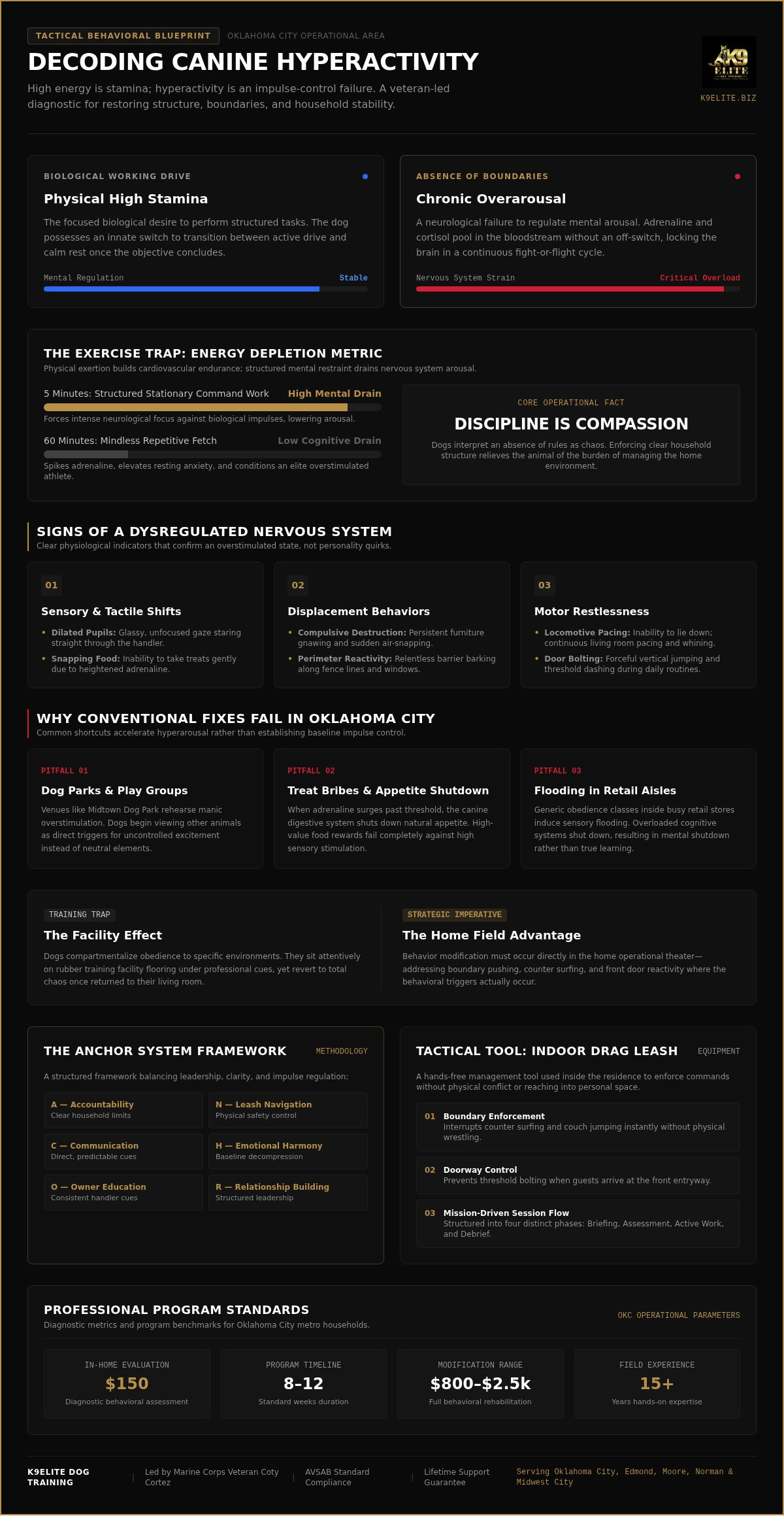
Most dog owners confuse high stamina with hyperactivity. A working breed possesses biological drive, which is the focused desire to perform a task. Hyperactivity is different. It represents a psychological failure to regulate mental arousal. When looking for real understanding dog behavior, you quickly find that true clinical hyperkinesis is exceptionally rare. What most households experience is chronic overarousal caused by an absence of boundaries.
Without an off-switch, adrenaline and cortisol pool in your dog's bloodstream. The canine brain remains locked in a biological fight-or-flight cycle. Treating this state with affection or frantic fetch games only feeds the fire. Dogs do not view endless freedom as kindness; they interpret an absence of rules as chaos. Discipline is compassion. Clear boundaries relieve the animal of the burden of running the home.
Physical Stamina vs. Mental Fatigue: The Exercise Trap
Running an agitated dog for miles merely creates an elite athlete with zero impulse control. Exhaustion without mental obedience actually spikes resting anxiety once the heart rate slows. Five minutes of structured, stationary command work burns significantly more mental energy than an hour of mindless fetch. Teaching a dog to hold a position against biological impulses requires intense neurological focus, draining arousal instead of conditioning physical endurance.
Recognizing Signs of a Dysregulated Nervous System
When searching for reliable help with hyperactive dog Oklahoma City services, owners must first learn to identify internal emotional overload. Watch for these clear physical indicators:
Dilated Pupils and Tactile Sensitivity: The dog stares through you with wide, glassy eyes and snaps food from your fingers rather than taking it gently.
Displacement Behaviors: Frantic humping, compulsive chewing on furniture, sudden air-snapping, or relentless barrier barking at perimeter fencing.
Motor Restlessness: Frantic pacing, persistent whining, door bolting, and forceful vertical jumping during everyday household routines.
These actions are not personality quirks. They are distress signals from an overstimulated nervous system. Seeking professional help with hyperactive dog Oklahoma City programs provides the structured leadership needed to de-escalate these frantic behaviors and restore peace to your living room.
Why Common Hyperactivity Fixes Fail in Oklahoma City Homes
Desperate dog owners often turn to popular quick fixes that actually accelerate hyperarousal. Packing a frantic dog into Midtown Dog Park or an off-leash run around the OKC metro rarely burns off energy safely. Instead, it rehearses uncontrolled overstimulation. High-intensity play groups teach animals to view other dogs as biological triggers for manic excitement. When you rely solely on high-value treat pouches to compete with that sensory surge, the food fails. Science-backed behavior modification techniques show that when adrenaline spikes past a critical threshold, the digestive system suppresses appetite, rendering food bribes useless.
Generic group classes inside busy commercial retail aisles introduce similar hazards. Subjecting an anxious dog to chaotic store aisles causes flooding, a training trap where sensory overload shuts down higher cognitive processing. True emotional regulation requires structured, graduated exposure rather than throwing a fragile nervous system into chaos.
The Facility Effect: Why Classroom Success Vanishes at Home
Many handlers wonder why their dog sits attentively during an outside obedience class, only to tear through their house an hour later. This disconnect stems directly from the facility effect. Dogs associate patterns of compliance with rubber gym flooring, professional scents, and trainer body language. They quickly compartmentalize obedience to that specific facility.
Your living room represents the true operational theater. Known as the home field advantage, working directly where your dog guards windows, jumps on visitors, or steals food off kitchen islands is mandatory. You cannot outsource basic household stability to a rented classroom.
Sensory Flooding and the Dangers of Dog Daycares
Unregulated daycare pack play creates dogs that cannot tolerate calm stillness. Rather than fostering healthy social manners, these unstructured settings reinforce frantic reactivity:
Loss of Impulse Control: Dogs spend eight continuous hours rehearsing adrenalized chasing, body slamming, and rough play with zero mandatory rest breaks.
Persistent Nervous Arousal: Dogs return home physically depleted but neurologically hyper-vigilant, often leading to defensive snaps over resting spaces.
Broken Leash Neutrality: Daycare attendees quickly learn that seeing another canine means immediate physical contact, leading to severe barrier frustration on neighborhood sidewalks.
Real-world stability requires teaching your pet to remain neutral around environmental stimuli rather than seeking manic interactions. If your dog struggles with indoor chaos, partnering with a balanced trainer through K9Elite dog training provides the structured home field advantage needed to replace erratic habits with lasting discipline.
The Tactical Blueprint for In-Home Impulse Control
Impulse control is not an innate personality trait; it is a learned discipline. Unless a veterinarian has diagnosed a rare physiological condition like true hyperactivity disorder, your dog simply lacks operational structure. Our proprietary ANCHOR System restores domestic order through accountability, clear communication, and leadership. Instead of allowing chaotic free-roaming, you establish deliberate protocols. Stop free-feeding kibble in a bowl. Turn mealtime into a mental conditioning drill where every ration of food is earned through calm eye contact and stationary impulse control.
Every member of the household must enforce an identical mission plan. If one handler enforces boundaries while another allows wild couch jumping, the animal stays locked in an anxious state of inconsistency. Unified execution eliminates behavioral ambiguity.
Step 1: Deploying the Drag Leash and Threshold Boundaries
Attach a lightweight, ten-foot indoor drag leash to your dog's collar whenever they are loose in common living areas. The line removes human emotion and physical conflict from corrections. If the dog attempts to counter surf or jump onto furniture, step on the leash without shouting or chasing. You immediately neutralize the self-rewarding behavior. Establish hard doorway thresholds: the dog must sit and wait until you cross the frame and issue a release word. Unearned house privileges end until calm compliance becomes default behavior.
Step 2: Mastering the Extended Place Command
Designate an elevated cot as a mandatory decompression outpost. The boundaries of the raised cot give the dog unambiguous physical edges, making the criteria simple to understand:
Targeted Relaxation: Guide the dog to the cot and reward a down-stay. The goal is voluntary mental decompression, where the head drops flat to the cot and respiration slows.
Proofing Real-World Stimuli: Keep the dog on place while you ring the doorbell, drop keys, or accept a package delivery. Reset them instantly if a paw touches the hardwood.
Duration Over Bribery: Increase duration from five minutes to forty-five minutes. This sustained mental stillness reconditions the nervous system far better than high-arousal treat lures.
Step 3: Tactical Leash Mechanics for Neighborhood Walks
Loose-leash walking represents an exercise in mental surrender, not physical endurance. When seeking practical master dog obedience OKC protocols, mechanics matter. Never maintain constant backward tension, which engages your dog's natural opposition reflex. Instead, use sharp directional changes whenever their attention drifts ahead of your knee. When seeking sustainable help with hyperactive dog Oklahoma City routines, forcing the dog to track your shoulder position creates mental focus and eliminates erratic pulling on neighborhood sidewalks.
Managing Hyperactive Triggers Across Oklahoma City Environments
Environmental stability requires proofing commands against real local disruptions. In central Oklahoma, sudden weather shifts and suburban neighborhood layouts create intense sensory pressures. Spring tornado sirens, barometric drops before severe squalls, and dense housing tracts keep uncontrolled dogs on high alert. If an animal lacks impulse discipline, these regional stressors provoke frantic pacing, destructive barrier frustration, and constant panic. Mastering true neutrality means preparing your dog to handle Oklahoma-specific stimuli with disciplined composure.
Navigating high-density public areas like Scissortail Park or the running loops around Lake Hefner demands absolute focus. Under Oklahoma City municipal ordinances, all dogs must remain on a physical leash outside designated dog parks, and owners face fines up to $500 if an animal displays menacing lunges or unprovoked charges. Calm neutrality in these crowded public corridors protects your dog, the public, and your legal standing.
Beating the Oklahoma Weather Factor with Indoor Mental Work
Triple-digit summer asphalt makes midday walks dangerous across the Oklahoma City metro. When outdoor exercise stops, dogs trapped indoors often channel pent-up drive into chaotic destruction. Replace hot physical exertion with indoor tactical training:
Targeted Scent Work: Hide scented targets or meal rations throughout your conditioned home. Scent discrimination requires deep neurological concentration that exhausts a dog faster than running.
Storm and Siren Conditioning: Oklahoma City tests municipal warning sirens regularly on Saturdays at noon. Use these scheduled tests to enforce a mandatory settle on place, teaching the dog that loud sirens trigger rest rather than frantic pacing.
Precision Obedience Ladders: Run rapid sequences of down-stays, sit-stays, and directional pivots in hallways, teaching the dog to follow clear commands despite atmospheric pressure shifts.
Suburban Neighborhood Proofing: From Edmond to Norman
Suburban tracts throughout Edmond, Moore, Norman, and Midwest City present endless fence-line provocations. Running the fence line to bark at neighboring dogs builds adrenaline addiction. Stop allowing free backyard access; use a long line to interrupt fence-running before it starts.
Proof this boundary discipline on local sidewalks. When walking past barking dogs behind cedar fences or strolling through outdoor commercial centers like Chisholm Creek, enforce tight heel positions. Your dog must understand that passing stimuli require complete indifference. For hands-on help with hyperactive dog Oklahoma City owners trust to conquer these environmental triggers, schedule an in-home evaluation with K9Elite to build a structured training plan tailored to your neighborhood.
Veteran-Led Professional Rehabilitation: Restoring Household Order
Quick fixes and cookie-cutter treat methods fall apart when an overstimulated dog hits peak arousal. Sustainable rehabilitation requires an objective, science-based structured approach led by experienced professionals. Marine Corps veteran Coty Cortez brings over 15 years of hands-on experience to canine behavioral modification, applying tactical discipline to home environments. When searching for reliable help with hyperactive dog Oklahoma City services, real success comes from identifying root dysfunctions rather than masking symptoms with bribes. Leadership builds confidence, and clear communication restores mutual trust.
Standard rehabilitation programs last 8 to 12 weeks. This deliberate timeframe gives the canine nervous system adequate time to decompress, build impulse endurance, and adopt new biological habits. By eliminating frantic reactions and replacing them with stationary accountability, your home transforms from a high-stress battleground into a peaceful environment.
The Role of the Initial $150 In-Home Evaluation
Meaningful rehabilitation begins where daily friction actually occurs. An initial $150 in-home evaluation allows an experienced trainer to conduct a thorough behavioral assessment in your dog's regular living space. We observe territory marking, barrier reactions, and everyday doorway chaos firsthand. Review our detailed overview of an in-home dog training evaluation to understand how we uncover subtle handling errors and communication gaps that accidentally reward hyperactivity. Following this diagnostic visit, we draft a customized mission plan tailored directly to your family dynamics.
Long-Term Stability Through Balanced Methodology and Lifetime Support
When chronic hyperarousal goes unchecked, it frequently spirals into defensive aggression, fence fighting, or severe separation anxiety. We apply proven aggressive dog rehabilitation OKC protocols to neutralize high-stakes reactivity before it leads to dangerous escalation:
Targeted Behavior Modification: Serious behavior modification programs run $800 to $2,500 for a full program, providing detailed, step-by-step guidance tailored to eliminate severe arousal triggers.
Balanced Training Tools: We teach clear accountability using physical spatial pressure, conditioned verbal markers, and an indoor drag leash, removing emotional frustration from daily handling.
Lifetime Support Guarantee: Behavioral success requires ongoing consistency. We back our training with a lifetime support guarantee, giving your family direct access to professional guidance as your dog matures.
You don't have to surrender your home to manic pacing and endless destruction. Professional help with hyperactive dog Oklahoma City programs gives you the tactical blueprint, hands-on coaching, and structural framework required to establish lasting calm.
Take Command of Your Home: Deploy the Blueprint for Lasting Calm
Living with relentless indoor turmoil is exhausting, but chronic hyperactivity doesn't have to define your household. Real behavioral transformation happens when you stop chasing physical fatigue and start enforcing structured impulse control where it matters most: your living room. By swapping chaotic dog parks for clear threshold boundaries and stationary place work, you give your dog the psychological off-switch they desperately need. When you seek lasting help with hyperactive dog Oklahoma City programs, disciplined leadership always outperforms empty food bribes.
Founded by Marine Corps veteran Coty Cortez, K9Elite brings over 15 years of hands-on experience to resolve your dog's behavioral triggers directly at the source. Every program is backed by our lifetime support guarantee, ensuring your household maintains reliable order as your dog matures. You can restore peace and rebuild mutual trust. Schedule your initial $150 in-home evaluation with K9Elite today and begin your dog's transition into a calm, confident companion.
Frequently Asked Questions
Can a professional trainer fix a dog that is naturally hyperactive?
Yes, professional training channels manic arousal into structured work, though true clinical hyperactivity is exceptionally rare. Most unruly dogs suffer from an absence of impulse control rather than an incurable genetic defect. When owners seek structured help with hyperactive dog Oklahoma City programs, experienced trainers install clear off-switches using stationary place commands and threshold rules, turning chaotic pacing into reliable, calm obedience.
How much does an initial in-home evaluation cost in Oklahoma City?
Why does taking my hyperactive dog to the dog park make their behavior worse?
Dog parks flood your pet with unstructured sensory chaos, conditioning them to operate in a permanent state of frantic overarousal. Running off-leash in high-excitement packs spikes adrenaline and cortisol levels. Rather than draining energy safely, it merely builds athletic stamina without teaching emotional regulation, resulting in worse jumping, frantic pacing, and barrier frustration once you return home.
What is the difference between high drive and behavioral hyperactivity?
High drive represents a purposeful, genetic desire to work and accomplish specific tasks, which is normal for working breeds. Behavioral hyperactivity is an emotional inability to self-regulate, characterized by wide pupils, frantic pacing, destructive chewing, and an absent off-switch. Drive channels cleanly into structured obedience drills, whereas unmanaged hyperactivity requires deliberate behavioral modification to calm the central nervous system.
Can high-energy dogs be trained without using harsh or purely positive methods?
Yes, a science-based balanced training approach delivers clear communication without extreme force or endless treat bribes. Purely positive lures fail when intense environmental distractions overpower food motivation, while punitive techniques increase underlying anxiety. Balanced methods combine fair spatial accountability, indoor drag leashes, and distinct verbal markers to teach voluntary impulse control while preserving mutual trust and confidence.
How long does a standard behavior modification program take to show results?
While handlers observe behavioral shifts once clear boundaries take effect, standard behavior modification programs last 8 to 12 weeks. Lasting neurological conditioning requires deliberate repetition across real-world environments. Serious behavior modification programs run $800 to $2,500, giving your dog the structured timeline necessary to replace manic habits with dependable impulse control backed by lifetime support.
What should I do if my hyperactive dog starts showing signs of leash reactivity?
Stop allowing nose-to-nose greetings on sidewalks and interrupt fence-line fixation before arousal explodes. Leash reactivity is an outward symptom of barrier frustration and unmanaged adrenaline. If you need tactical help with hyperactive dog Oklahoma City routines, enforce strict heel mechanics and execute sharp directional changes to keep your dog's focus locked onto your movement rather than surrounding neighborhood triggers.


Comments