
How to Keep Your Dog Mentally Stimulated: A Tactical Training Guide
Tiring out a high-drive dog with endless physical exercise does not create a calmer pet; it simply builds an athlete with greater endurance for destruction. You log miles around the neighborhood, yet your dog still paces the living room, demands attention with sharp barks, or chews baseboards the moment you turn your back. If you find yourself asking how to keep my dog mentally stimulated when standard exercise falls short, you are facing a common operational gap. Physical fatigue fades quickly, but an unchallenged brain actively looks for its own work.
True stability requires purpose, not just exhaustion. In this guide, you will discover how disciplined mental drills and structured engagement eliminate canine boredom and stop destructive behavior at the root. We will break down practical obedience protocols, focus work, and simple scent exercises designed to settle intense drive, establish clear leadership, and bring lasting calm to your home.
Table of Contents
Why Mental Stimulation Matters: The Science of Canine Restlessness
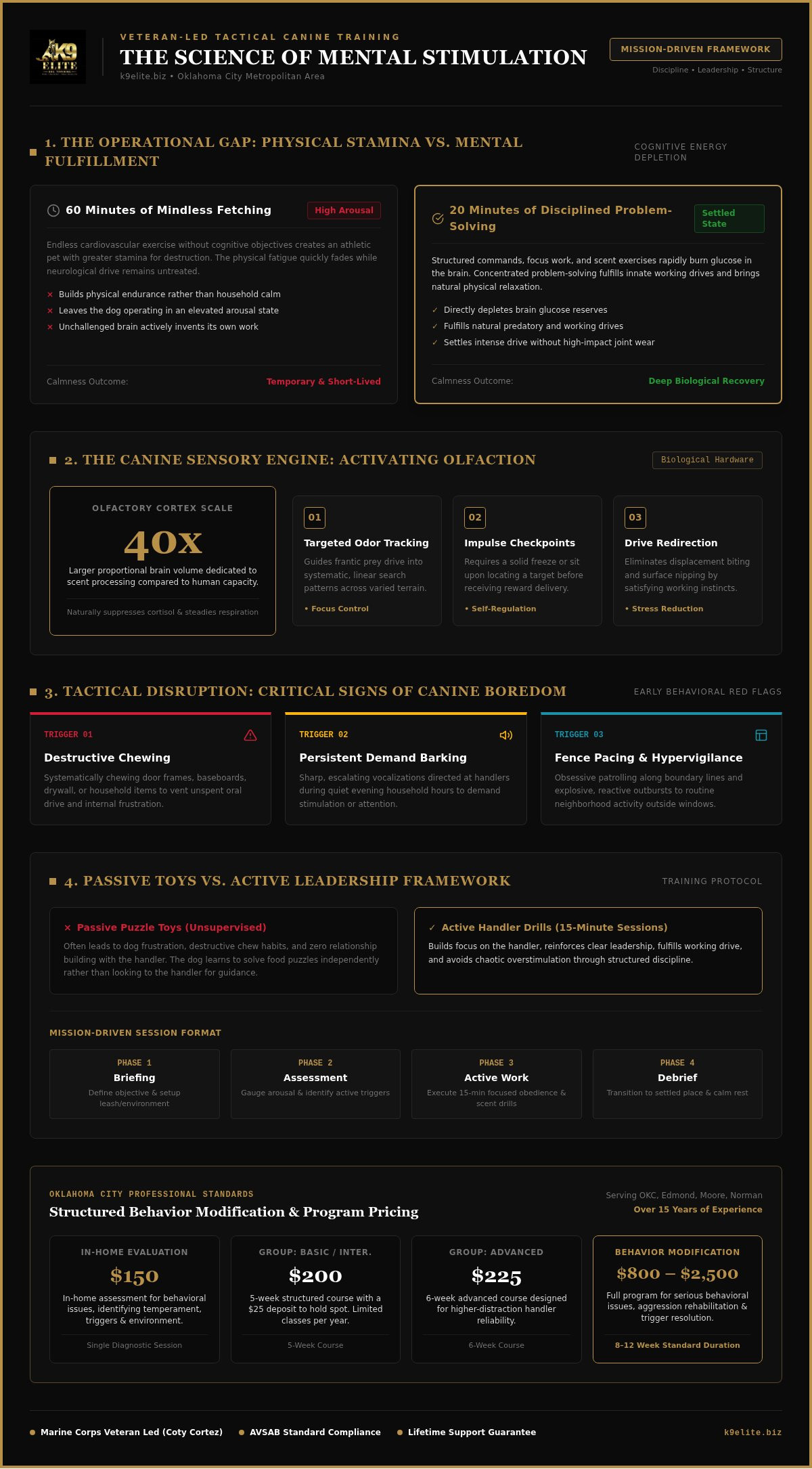
A common operational mistake in dog ownership is treating physical fatigue as a substitute for neurological fulfillment. When an owner asks how to keep my dog mentally stimulated, they are usually dealing with an animal operating on surplus cognitive energy. Research into canine cognition demonstrates that processing tasks, working through structured commands, and decoding scent profiles require significant mental bandwidth. Physical running merely increases athletic stamina. In contrast, twenty minutes of disciplined problem-solving burns glucose and settles a dog far faster than an hour of mindless fetching.
Physical Exhaustion vs. Mental Fulfillment
Endless cardiovascular workouts without mental objectives create an athlete that struggles to decompress. When dogs run, their bodies adapt, building greater physical endurance while their innate drives remain unaddressed. This cycle produces an over-exercised dog operating in an elevated state of arousal, unable to settle calmly on its own. Mental drills trigger biological shifts. Deep problem-solving demands concentrated focus, rapidly depleting glucose in the brain and promoting natural relaxation.
Recognizing Critical Signs of Canine Boredom
When high-drive dogs lack a dedicated mission, they invent their own work. Without structured leadership and cognitive outlets, boredom quickly manifests as tactical disruption inside the home:
Destructive chewing: Systematically targeting door frames, baseboards, drywall, or personal items to vent unspent oral drive.
Persistent demand barking: Sharp, escalating vocalizations directed at handlers during quiet evening household hours.
Fence pacing and hypervigilance: Obsessive patrolling along boundary lines and explosive reactions to routine neighborhood activity outside windows.
Understanding how to keep my dog mentally stimulated begins with recognizing these red flags early. Addressing the underlying cognitive deficit through purposeful engagement stops the cycle before these frustrations calcify into entrenched behavioral triggers.
The Canine Sensory Engine: Activating Olfaction and Drive
To master how to keep my dog mentally stimulated, you must engage the primary hardware nature gave them: their nose. While human beings process the world primarily through vision, a canine relies on an olfactory cortex that occupies a proportional brain volume forty times larger than our own. Scent analysis is not passive relaxation. Inhaling and processing complex odor profiles triggers neurotransmitter releases that naturally suppress cortisol, bringing elevated heart rates down into a steady, working rhythm.
The Neurological Power of Scent Work
Nose work fundamentally transforms a dog's mental state. Sifting through ambient air currents to locate a specific target requires sustained calculations and deep concentration. This internal processing forces rapid panting to give way to deliberate, slow respiration, shifting high-arousal dogs into a focused, methodically grounded search mindset. Scent exercises deliver intense cognitive conditioning without placing high-impact stress on growing joints or aging frames.
Directing Natural Drive into Purposeful Tasks
High-drive dogs crave an objective. When handlers fail to supply a mission, predatory motor patterns often spill out sideways as chaotic behaviors inside the living room. Directing innate drive through structured tracking channels raw working energy into productive focus rather than destructive impulses:
Targeted odor tracking: Guides frantic prey drive into systematic, linear search patterns.
Impulse control checkpoints: Requires a solid freeze or sit upon locating a target before receiving a reward.
Drive redirection: Eliminates displacement biting and surface nipping by fulfilling the dog's natural desire to work.
Managing oral fixations and unchanneled hunting energy through structured tasks is critical during early development. Learn practical containment methods in our guide to puppy biting training to build solid communication right from the start.
Focusing internal instincts through tactical exercises answers the question of how to keep my dog mentally stimulated while establishing clear handler leadership. If unchanneled drive continues to cause friction at home, scheduling an in-home evaluation provides an objective diagnostic baseline to redirect that energy safely.
Passive Toys vs. Active Leadership: Building the Right Framework
The pet product industry routinely markets plastic puzzles as the definitive solution for how to keep my dog mentally stimulated. In reality, outsourcing mental engagement to a static device creates diminishing returns. A dog does not build impulse control from a rubber maze; it simply memorizes a mechanical sequence until the challenge disappears. True cognitive endurance requires active engagement with a clear leader. Through our proprietary ANCHOR System, training prioritizes accountability, clear communication, and emotional harmony by keeping the handler at the center of every problem-solving exercise.
The Hidden Pitfalls of Solitary Puzzle Toys
Solitary enrichment toys often create more behavioral issues than they resolve. High-drive working breeds solve basic sliding compartments within minutes, quickly reverting to their baseline restless state. When a toy fails to yield treats fast enough, frustrated dogs frequently chew through rigid plastic casings, creating emergency foreign-body ingestion hazards. More critically, solitary toys condition your dog to seek dopamine and satisfaction independently of you, which frequently triggers intense resource guarding and weakens your household influence.
The Tactical Value of Handler-Led Drills
Interactive, handler-led drills transform everyday interactions into high-value cognitive challenges. When you control the problem, the criteria, and the reward, your dog must maintain active eye contact, practice impulse control, and listen for precise auditory markers. This operational setup builds respect and mental fatigue simultaneously:
Direct communication: Forces the dog to check in with the handler rather than fixating on an inanimate object.
Impulse conditioning: Teaches patience by requiring steady stays before granting access to food or toys.
Resource value: Elevates standard daily kibble into a powerful training currency that reinforces leadership.
Discarding passive floor toys in favor of guided drills changes the entire dynamic. It answers the operational question of how to keep my dog mentally stimulated while building a stable, cooperative partnership that carries over into everyday life.
Tactical Daily Drills: How to Keep Your Dog Mentally Stimulated
Endless, chaotic play sessions often ramp up an animal's adrenaline without addressing mental exhaustion. When planning how to keep my dog mentally stimulated, replace hour-long games of fetch with tight, fifteen-minute tactical blocks. Use your dog's daily meal rations as working currency rather than dumping food into a standard bowl. By requiring cognitive effort for every bite, you instantly activate their working drive and strengthen focus.
Step 1: The Scent Box Search Protocol
Deploy three inverted cardboard boxes across the floor, spacing them roughly four feet apart. Cut a small ventilation hole in the top of one box and place a portion of food underneath while holding your dog by their collar. Release them with a crisp command like "Search." The moment your dog marks the hot box with an intentional nose poke, mark the behavior verbally and lift the box to reward them immediately. Run three repetitions, varying the box position each time to build systematic search patterns.
Step 2: Tactical Impulse Control and Command Proofing
Place a handful of kibble directly on the floor two feet in front of your dog while maintaining a strict verbal or spatial boundary. If they lunge forward, cover the reward instantly with your foot without speaking. Wait for your dog to stop pawing at your shoe and offer sustained eye contact. The instant their focus shifts to your face, mark the choice and release them to take the reward. For handlers aiming to build ironclad focus under distraction, consult our veteran-led guide to master dog obedience OKC.
Step 3: Object Discrimination and Directional Work
Begin by naming two distinct toys, such as a ball and a tug rope. Present the ball, name it clearly, and reward your dog when their nose touches it. Repeat this associative drill with the second item in separate sessions. Once the labels are established, place both items six feet apart and command your dog to retrieve one specific object by name. Rotate target items every week to preserve novelty and keep working memory sharp.
Step 4: Mandatory Place Decompression and Settle
High-intensity focus work must conclude with disciplined biological rest. Immediately after completing drills, direct your dog to an elevated cot using a firm "Place" command. Do not provide chew bones or interactive toys on the mat; enforce quiet stillness so your dog practices internal emotional regulation. Release them from the boundary only when you observe softened facial muscles, a limp body posture, and deep, rhythmic breathing.
Executing these structured steps daily provides the ultimate answer for how to keep my dog mentally stimulated inside a busy home. If your dog struggles with extreme reactivity or basic impulse control during these drills, reach out to schedule an initial $150 in-home evaluation to establish a clear mission plan tailored to your living space.
When Boredom Masks Behavioral Triggers: Seeking Professional Guidance
When daily enrichment fails to settle an agitated dog, the root problem is rarely a shortage of games. Unaddressed mental frustration left unchecked often calcifies into severe leash reactivity, territorial barking, and explosive aggression inside the home. Handlers asking how to keep my dog mentally stimulated frequently assume their companion simply needs more tasks to complete. However, confusing simple canine boredom with deep-seated behavioral triggers creates a dangerous diagnostic error that basic parlor games cannot fix.
Differentiating Boredom from Severe Behavioral Reactivity
Bored dogs settle quickly once given a job; their pacing stops, and their attention locks onto the handler. In contrast, genuine fear-based reactivity and clinical anxiety do not dissolve through simple scent drills. Frantic pacing accompanied by lip-licking, dilated pupils, and hypervigilance toward ordinary neighborhood noise signals a nervous system trapped in fight-or-flight mode rather than simple restlessness. Forcing mental drills during elevated panic states only increases stress. Read how structured leadership and disciplined handling stabilize volatile reactions in our case study on aggressive dog rehabilitation OKC.
The Advantage of an In-Home Diagnostic Assessment
Resolving entrenched household friction requires evaluating behavior where it actually occurs. Dogs often behave impeccably inside an unfamiliar commercial training building, only to revert to chaos the moment they return home. This phenomenon is known as the facility effect. Conducting a professional behavioral assessment directly in your living room gives trainers an unvarnished look at your dog's actual environment, allowing them to pinpoint precise triggers:
Environmental boundary testing: Identifies territorial stress points around windows, doors, and fences.
Handler mechanics: Pinpoints communication breakdowns and mixed signals during routine daily interactions.
Targeted mission plan: Establishes a structured, step-by-step roadmap to eliminate unsafe reactivity at the root.
Knowing how to keep my dog mentally stimulated is an essential training pillar, but structure must precede stimulation. Learn what to expect during a veteran-led in-home dog training evaluation to diagnose the real cause of your dog's distress and build lasting household stability.
Take Command of Your Dog's Mental Stability
Physical stamina without mental fulfillment will always leave your home vulnerable to chaos. Mastering how to keep my dog mentally stimulated does not require expensive gadgets or hours of aimless running; it demands tactical, handler-led engagement that channels natural canine drives. When you implement structured search exercises, clear impulse boundaries, and mandatory decompression periods, you replace frantic pacing with deep, restorative calm.
If your dog's restlessness has already escalated into stubborn behavioral triggers, you don't have to fight that battle alone. Founded by Marine Corps veteran Coty Cortez, K9Elite applies the proven ANCHOR System to address underlying frustration directly at the source. We back our training with a lifetime support model throughout Oklahoma City, Edmond, Moore, and Norman. Take the first step toward reclaiming peace in your household. Schedule your professional in-home evaluation today and give your dog the clear direction they need to thrive.
Frequently Asked Questions
Can mental stimulation replace my dog's daily physical walks?
Mental stimulation cannot completely replace physical walks, but it drastically reduces the mileage needed to achieve biological calm. Walks provide essential environmental exposure and elimination opportunities. However, physical walking alone builds athletic stamina without draining neurological drive. Pairing a brisk twenty-minute walk with structured obedience or scent drills provides a complete workout, balancing physical movement with the cognitive fatigue required for reliable house manners.
How much time should I spend on mental stimulation exercises each day?
Aim for fifteen to thirty minutes of structured mental engagement daily, split into two short sessions. High-drive working dogs benefit far more from concise, disciplined drills than from marathon play sessions. When pet owners in Oklahoma City ask how to keep my dog mentally stimulated without disrupting busy work schedules, we advise integrating focus commands and nose work directly into scheduled morning and evening feeding routines.
What happens if a high-drive working dog lacks mental stimulation?
A high-drive working dog deprived of mental work will inevitably invent its own destructive mission. Unspent neurological drive triggers severe displacement behaviors, including tearing into drywall, ripping door casings, nuisance fence-running, and incessant demand barking. Over time, chronic cognitive frustration elevates cortisol levels, transforming everyday household restlessness into defensive territorialism, leash reactivity, and unpredictable aggressive responses toward visitors.
Are puzzle toys safe to leave with my dog when left alone?
Commercial puzzle toys are generally unsafe to leave with an unattended dog. Driven dogs frequently bypass sliding mechanisms with sheer jaw pressure once treats become trapped or difficult to access. Chewing through plastic or rubber housings creates urgent foreign body ingestion risks requiring surgical intervention. Always supervise interactive puzzles directly, or replace them entirely with handler-led scent drills that build communication rather than toy fixation.
Can mental exercise help calm a reactive or aggressive dog?
Mental exercise significantly lowers baseline arousal, but it cannot cure deep-seated aggression or reactivity on its own. Structured drills activate the parasympathetic nervous system, helping an anxious dog regulate adrenaline. However, when evaluating how to keep my dog mentally stimulated alongside reactivity issues, handlers must pair cognitive work with clear boundary enforcement and a professional behavioral assessment to safely address underlying fear triggers.
How do I know if my dog is mentally exhausted or just stubborn?
Mental exhaustion looks like deliberate biological settling, whereas stubbornness is typically an avoidance behavior caused by communication confusion. A mentally drained dog breathes deeply, exhibits softened facial muscles, and willingly remains on their place cot. If your dog turns away, sniffs the floor mid-command, or ignores known cues during training, the criteria are likely unclear or the session has run too long without proper reward timing.
Is scent work suitable for senior dogs or dogs with joint injuries?
Scent work is one of the safest and most effective mental outlets for older dogs or canines recovering from joint injuries. Olfactory exercises demand immense concentration without putting concussive force on hips, spines, or elbows. Because processing scent plumes biologically lowers heart rate and stress hormones, senior dogs gain the cognitive fulfillment of a working task while remaining comfortably stationary or moving at a gentle, self-regulated pace.


Comments