
Tactical Help with Fearful Dogs in OKC: A Veteran-Led Approach to Confidence
What if your dog’s fear isn’t a reason to avoid every trigger, but a signal that your dog needs clearer guidance and a safer plan? If anxiety has you planning your day around closed doors, worrying your dog may bite in self-defense, or second-guessing conflicting training advice, you’re not alone. Finding reliable help with fearful dogs OKC starts with understanding what your dog is communicating and responding with structure, not guesswork.
You can build skills that help your dog feel more secure while giving you a calm, consistent way to lead. K9Elite Dog Training, led by Marine Corps veteran Coty Cortez, applies more than 15 years of hands-on experience through science-based behavior modification and the ANCHOR System. Training begins in your dog’s home environment, where specific triggers and communication gaps can be assessed without the facility effect.
This article explains how a mission plan can guide gradual work around fear, strengthen your leadership, and support a more predictable home. You’ll also learn how to prepare for real-world goals, such as walking through Scissortail Park with greater calm, one structured step at a time.
Table of Contents
Defining Canine Fear: Why Your Dog is Stuck in Defensive Mode
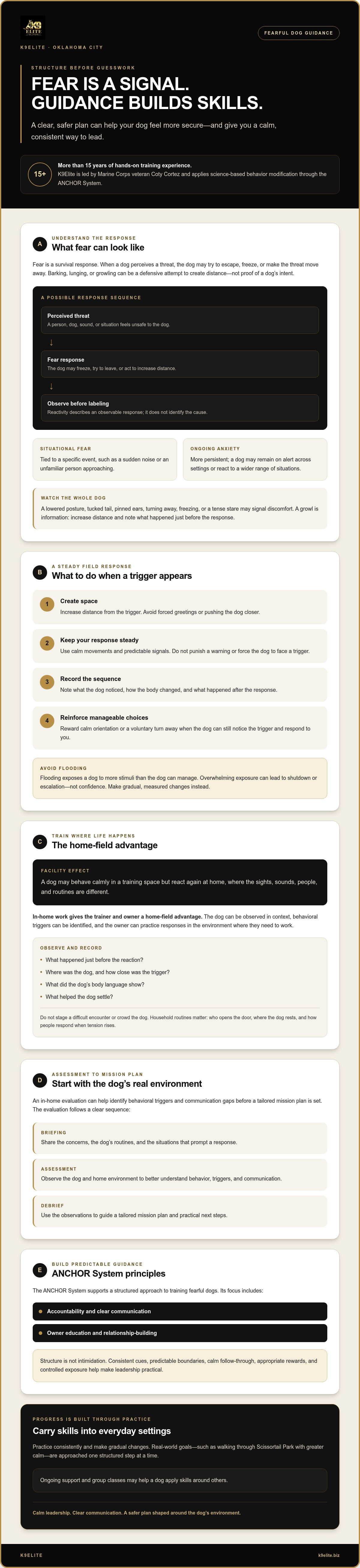
Fear is a survival response. When a dog perceives a threat, the dog may try to escape, freeze, or make the threat move away. A bark, lunge, or growl can look like deliberate aggression, but it may be a defensive attempt to create distance. Understanding the cause is the first step toward useful help with fearful dogs OKC.
A situational fear response is tied to a specific event, such as a sudden noise or an unfamiliar person approaching. Chronic anxiety is more persistent: a dog may remain on alert across settings or react to a wider range of situations. Dog behavior has roots in communication, social patterns, and environmental responses; the overview of Defining Canine Fear offers useful background. A professional behavioral assessment can help distinguish patterns and identify likely behavioral triggers.
In Oklahoma City, possible triggers include close encounters with unfamiliar dogs or people, traffic and sudden noises, visitors entering the home, and busy walking routes or park environments. Watch the dog’s full body, not just the bark. A lowered posture, tucked tail, pinned ears, turning away, freezing, or a tense stare may signal discomfort. Growling is information. Don’t punish a warning; increase distance and note what happened just before the response.
Fear vs. Reactivity: Identifying the Communication Gap
Reactivity describes an observable response, not its cause. A fearful dog may bark or lunge to keep a perceived threat away, while another dog may react for different reasons. Look for the sequence: what the dog noticed, how the body changed, and what happened after the response. That record gives an owner and trainer a clearer starting point than labeling the dog “bad.”
Calm reassurance doesn’t automatically reinforce fear. Avoid frantic reactions, forced greetings, or immediately repeating an encounter at closer range. Instead, create space, keep your movements steady, and reward calm orientation or a voluntary turn away. Don’t force the dog to “face” a trigger.
The Science of Balanced Training for Fearful Dogs
Science-based training starts by observing context and behavior, then adjusting the plan to the individual dog. Flooding means exposing a dog to more stimuli than the dog can manage; overwhelming exposure can lead to shutdown or escalation, not confidence. Work at a distance where the dog can still notice the trigger and respond to you, then make gradual, measured changes.
Structure is not intimidation. Use consistent cues, predictable boundaries, and calm follow-through so the dog can understand what to do. Pair that clarity with appropriate rewards and controlled exposure. That balance makes leadership practical: protect the dog from unnecessary pressure while building the skills needed to handle the next step.
The Facility Effect: Why Training Must Happen in Your OKC Home
A dog may respond calmly in a quiet, controlled training space and still bark at the doorbell, pace when a visitor arrives, or react to backyard noises at home. That difference is the facility effect: behavior learned in one setting may not carry over to the environment where the dog’s real challenges occur. The dog hasn’t necessarily forgotten a lesson. The sights, sounds, people, and routines have changed.
In-home work provides a home field advantage. A trainer can observe the dog in context, identify behavioral triggers, and help the owner practice the response where it needs to work. Tufts University’s guidance on anxiety in dogs also underscores why anxiety should be understood through its signs and causes, rather than treated as simple disobedience.
Identifying Triggers in the Natural Environment
Start by noting what happens before, during, and after a reaction. Does the dog bark when the doorbell rings, watch the window for the mail carrier, or stiffen when a family member enters the backyard? Record the setting, distance, body language, and what helped the dog settle. Don’t stage a difficult encounter or crowd the dog. Share these observations with a trainer so the plan can account for the dog’s actual threshold.
The family’s routines matter, too. Who opens the door? Where does the dog rest? How do household members respond when the dog becomes tense? Seeing these interactions helps a trainer coach the owner, not just cue the dog. The goal is for the owner to become a steady, trusted source of direction through consistent signals and safe, predictable choices. Corrections made at the point of behavior can be timely and relevant, but they should not overwhelm a fearful dog.
Why Skills Must Transfer Home
The pitch for sending a dog away can sound simple: return home with new behavior already in place. But skills practiced elsewhere may not transfer automatically. A fearful dog may also find unfamiliar surroundings and routines stressful; too much pressure can make learning harder. Progress depends on the dog’s needs, and the owner must learn how to guide practice in daily life.
In-home sessions let the owner take an active role: observe the trigger, follow the trainer’s instruction, and repeat the exercise consistently at a manageable level. K9Elite provides in-home services across the greater Oklahoma City area, including Edmond, Moore, Norman, and Midwest City. For owners seeking help with fearful dogs OKC, that setting can reveal details a controlled space may miss. Learn more about in-home dog training and behavior support as you consider the right next step for your dog.
The Mission Plan: Why an Initial In-Home Evaluation is Vital
A behavior plan should begin with a diagnosis of the situation, not a guess about which technique to try. K9Elite’s initial in-home evaluation is a professional assessment of the dog, household routines, and owner-dog communication. Its purpose is to clarify the behavior concerns and determine appropriate next steps, not to pressure the owner into a preset program.
The session follows a mission-driven structure: briefing, assessment, active work as appropriate, and debrief. During the briefing, the owner describes the dog’s history, concerning incidents, and goals. The trainer then observes how the dog responds to ordinary cues and household expectations, without deliberately provoking a fearful reaction. In the debrief, the trainer explains observations, answers questions, and identifies priorities for training.
What Happens During a Professional Evaluation?
The assessment considers more than the dog’s response to a single trigger. The trainer looks for patterns: whether the dog responds to a particular cue, whether household members use that cue consistently, and what happens immediately before and after the behavior. These details can reveal communication gaps, such as a dog receiving conflicting signals about where to settle or how to respond when a visitor arrives.
Owners can prepare by writing down their main concerns, noting when the behavior occurs, and identifying the outcome they hope to work toward. Goals should be specific and realistic, such as helping the dog settle when a visitor enters, rather than expecting the dog to become comfortable with every person at once.
From Assessment to a Practical Mission Plan
After the evaluation, the trainer can outline a customized mission plan based on the dog’s needs and the owner’s capacity to practice. K9Elite’s standard programs typically last 8–12 weeks; the evaluation helps determine whether that structure fits the situation and what skills should be addressed first. The plan should give the owner clear actions to practice and a way to assess progress, while allowing adjustments as the dog responds.
Ask how the trainer will teach you to carry out each step, what signs indicate that an exercise is too difficult, and how you can request guidance as training proceeds. K9Elite provides lifetime support for program graduates, extending assistance beyond scheduled sessions. A well-defined mission plan gives the owner a disciplined starting point and a clearer role in the dog’s ongoing progress.
Tactical Groundwork: Using the ANCHOR System for Confidence
Confidence needs more than patience. A fearful dog benefits from clear communication, safe boundaries, and practice at a pace the dog can manage. K9Elite’s ANCHOR System provides a structured framework built around Accountability, Navigation, Communication, Harmony, Owner Education, and Relationship. Each element helps the owner respond consistently instead of improvising under pressure.
Discipline is compassion when it means calm, predictable guidance rather than punishment. The owner sets up the environment, gives a clear cue, and helps the dog move through a manageable task. Pair that structure with appropriate rewards and gradual exposure. If fear rises, reduce the challenge; don’t force the dog to endure a situation that overwhelms them.
Step 1: Establish Accountability and Structure
Begin with a simple routine. Choose consistent times and cues for meals, rest, walks, and transitions. Set household boundaries everyone can follow, such as having the dog wait calmly before moving through a doorway. Predictability can reduce uncertainty by making daily expectations easier to read.
Teach a “place” cue by guiding the dog to a designated resting spot, rewarding calm behavior, and building duration gradually. Use the spot as a predictable option, not as isolation or punishment. Keep the exercise easy enough that the dog can succeed, then increase difficulty only when the dog remains settled.
Step 2: Navigate with Clear Leash Communication
A leash is a communication tool, not just a restraint. Keep handling steady, use a consistent cue, and guide the dog away from a trigger before the response escalates. A drag leash can help an owner guide a dog away from a resource without reaching into the dog’s personal space. Use it only with supervision and trainer guidance; don’t leave a leash attached when the dog is unattended.
Build a small, consistent vocabulary, such as “come,” “place,” and “let’s go.” Give each cue once, then calmly help the dog understand the requested movement. Avoid repeating commands rapidly or pulling the dog toward a trigger. Clear signals and manageable distance help keep the exercise controlled.
If a muzzle is appropriate for a specific safety plan, treat it as a temporary tool, not a correction. Introduce it through gradual muzzle conditioning so the dog can become comfortable wearing it. Don’t force it onto a frightened dog or use it to justify closer exposure. A trainer can help determine whether it fits the situation and coach the process.
For help with fearful dogs OKC, use these principles as a starting point, not a substitute for an individualized plan. Explore K9Elite’s behavior modification training to discuss structured guidance for your dog.
The Path to Freedom: Lifetime Support and Long-Term Success
Training doesn’t end when scheduled sessions do. K9Elite provides lifetime support for program graduates, meaning ongoing assistance and resources as owners maintain their dog’s skills and work through questions that arise later. That support complements the owner’s daily role: give consistent cues, keep routines predictable, and use the plan rather than improvising when the dog struggles.
Progress may include setbacks. A new environment, an unexpected noise, or a change in routine can make a familiar skill harder. Lower the difficulty, create distance from the trigger, and return to a step the dog can handle. Note what changed, then ask for guidance if the response persists or intensifies. The mission is steady improvement and a stronger relationship, helping families keep dogs safely integrated into their homes.
Reclaiming Your Life in Oklahoma City
Build toward community outings in stages. Start with a quiet route where your dog can focus, reinforce calm responses, and leave before stress rises. Later, a walk through Scissortail Park or a visit to a pet-friendly shop may be a suitable goal if your dog is ready. Don’t measure success by how close your dog can get to a trigger; measure it by calm, manageable participation and your ability to guide the dog safely.
Moving from Private Practice to Group Classes
Once the trainer agrees your dog is prepared, group classes can provide a structured setting to practice obedience around other people and dogs. K9Elite offers Basic and Intermediate courses that run for five weeks, and an Advanced course that runs for six weeks. Classes are limited each year. A group setting isn’t the right next step for every fearful dog, so discuss readiness and safety with the trainer before making the transition.
Veteran-led training emphasizes responsibility, clear communication, and follow-through. Those habits benefit the individual dog and contribute to a community where owners make thoughtful choices about their dogs’ needs. For help with fearful dogs OKC, long-term success depends on applying the skills at home and choosing new challenges at a pace the dog can manage.
Ready to establish a structured starting point? Schedule your in-home evaluation today and discuss a plan tailored to your dog and household.
Take the Next Step Toward Steadier Days
Your dog’s fear can be met with a clear plan, consistent leadership, and training in the environment where daily challenges happen. A professional in-home evaluation helps identify what may be driving the behavior, while structured practice gives you practical ways to guide your dog without forcing progress. The goal isn’t a quick transformation. It’s a safer, more predictable relationship built one step at a time.
If you’re looking for help with fearful dogs OKC, K9Elite brings a veteran-owned and operated approach led by Marine Corps veteran Coty Cortez, with more than 15 years of hands-on experience. Program graduates also receive a lifetime support guarantee, so guidance continues beyond scheduled training.
Start with an assessment of your dog’s needs and home environment. Schedule your in-home evaluation and take the first step toward greater confidence and calmer routines. With steady practice and the right support, meaningful progress is within reach.
Frequently Asked Questions
Is my dog too fearful for professional training?
Fear alone doesn’t mean a dog is beyond help. A professional evaluation can identify the dog’s behavioral triggers, responses, and current comfort limits, then guide a plan that starts at a manageable level. Don’t force greetings or expose your dog to overwhelming situations to test readiness. K9Elite provides behavior modification in Oklahoma City, with training tailored to the dog and household rather than a one-size-fits-all standard.
How much does it cost to get help with a fearful dog in OKC?
This article doesn’t list service prices. For current fees for K9Elite’s in-home evaluation or behavior modification, contact the company directly before scheduling. An evaluation gives the trainer a chance to observe the dog and home, discuss behavioral triggers, and explain suitable next steps. That diagnostic process helps clarify what the training plan involves before you decide how to proceed.
Will you use harsh methods on my anxious dog?
K9Elite describes its training as science-based and balanced, with an emphasis on clear communication, structure, and owner education. Discipline means calm, consistent guidance, not frightening or hurting a dog. Training should account for the dog’s emotional state and avoid overwhelming exposure. Ask the trainer to explain any proposed tool or technique, how it will be introduced, and what signs would mean the exercise needs to be adjusted.
What is the difference between a fearful dog and an aggressive one?
Fear describes an emotional response; aggression describes behavior such as growling, snapping, or biting. A fearful dog may use aggressive-looking behavior to increase distance from a perceived threat, but those actions alone don’t establish the cause. Context and body language matter. A trainer can assess what happens before and during an incident, identify possible triggers, and recommend a plan focused on safety and behavior modification.
How long does a behavior modification program usually last?
K9Elite’s standard programs typically last 8–12 weeks. The appropriate pace depends on the dog’s behavior, the training goals, and the owner’s ability to practice consistently. Fear-related behavior isn’t resolved on a fixed schedule, so use the program period to build repeatable skills rather than expect an overnight change. Ask how the plan will be reviewed and adjusted as your dog responds to training.
Do you offer group classes for fearful dogs in Oklahoma City?
K9Elite offers group classes in Oklahoma City, but a group setting may not suit every fearful dog at the outset. Ask the trainer whether your dog is ready to work around other people and dogs, or whether individual behavior modification should come first. Readiness should be based on the dog’s behavior and ability to remain engaged, not pressure to participate before the dog can manage the environment.
Why is an in-home evaluation better than a phone consultation?
An in-home evaluation lets a trainer observe the dog’s behavior and surroundings directly. The trainer may notice responses to household routines, visitors, door sounds, or interactions among family members that a phone conversation can’t show. A phone discussion can share background, but it can’t replace seeing the dog in context. That home field advantage helps inform a more specific behavioral assessment and training plan.
Can a veteran-led approach really help with my dog's separation anxiety?
A veteran-led approach can provide structure and owner education, but separation anxiety needs an individualized assessment and a plan suited to the dog’s behavior. K9Elite offers behavior modification for anxiety-related concerns; no particular outcome should be assumed without evaluating the dog. Track when distress begins, what it looks like, and how long it lasts, then share those observations during an evaluation to help shape appropriate next steps.


Comments