
Oklahoma City Dog Separation Anxiety Training: 2026 Guide
What if the barking, pacing, or damage you notice after leaving is a clue about your dog’s distress, rather than a problem a generic checklist can solve? Finding dog separation anxiety training Oklahoma City families can rely on starts with understanding when the behavior occurs, what happens before you leave, and how your dog responds at home.
It’s understandable to feel uncertain. These behaviors can have different causes, and a single incident doesn’t confirm separation-related distress. Start by recording the timing, duration, and context of each episode, along with any changes in your dog’s routine. Share health concerns with your veterinarian. Training can support behavior change, but it doesn’t replace veterinary guidance.
This guide explains what to document, what to discuss during an in-home evaluation, and how to compare training approaches. K9Elite provides private in-home dog training in Oklahoma City, including obedience training and behavior modification. Founded by Marine Corps veteran Coty Cortez, the business uses science-based, balanced methods. An evaluation can give you a chance to discuss your dog’s behavior in the setting where it occurs and consider practical next steps.
Table of Contents
Dog Separation Anxiety in Oklahoma City: Recognize the Pattern Before Choosing Training
How a Structured Separation Anxiety Assessment Finds Behavioral Triggers at Home
Compare Separation Anxiety Training Approaches Without Chasing a Quick Fix
A Practical Oklahoma City Plan for Preparing Your Dog and Household
Start Dog Separation Anxiety Training with K9Elite in Oklahoma City
Dog Separation Anxiety in Oklahoma City: Recognize the Pattern Before Choosing Training
Seeing your dog bark, pace, scratch at a door, or damage belongings around your departure can be stressful. Start by observing the pattern rather than assuming its cause. These behaviors may be consistent with separation-related distress, but signs alone don’t confirm a diagnosis. They are useful information to share with your veterinarian or a qualified trainer.
Separation-related distress describes observable behavior that occurs in connection with an owner’s departure or absence. A confirmed diagnosis requires appropriate assessment; a list of signs cannot establish it. For background on common signs and how the condition is discussed, see Separation anxiety in dogs. Careful notes can inform a professional evaluation and help guide dog separation anxiety training Oklahoma City owners are considering.
What signs should an owner document when leaving home?
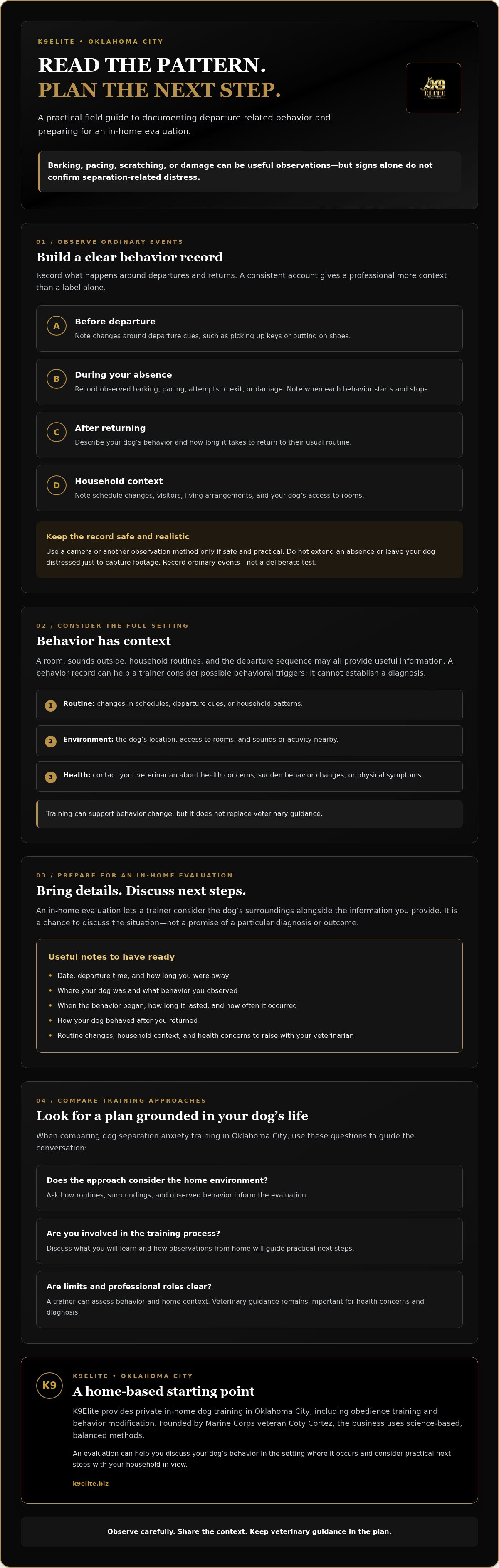
Keep a simple record of what happens before you leave, what you can safely observe while away, and what you see after returning. Include the date, departure time, how long you were gone, where your dog was, and the behavior’s duration and frequency. Note whether your dog settled after you returned or continued to seem unsettled.
Before departure: Note changes around departure cues, such as picking up keys or putting on shoes.
During your absence: Record observed barking, pacing, attempts to exit, or damage, including when each behavior starts and stops.
After returning: Describe your dog’s behavior and how long it takes to return to their usual routine.
Household context: Note changes in schedules, visitors, living arrangements, or your dog’s access to rooms.
Use a camera or another observation method only if it’s safe and practical. Don’t extend an absence or leave your dog distressed just to capture footage. A useful record reflects ordinary events, not a deliberate test.
Could another factor explain the behavior?
Yes. Noise outside, a changed routine, or other environmental factors may affect a dog’s behavior. Health concerns can also be relevant, particularly when behavior changes suddenly or physical symptoms appear. Contact your veterinarian in those cases. A trainer can help assess behavior and the home context, but neither a checklist nor a single observation replaces veterinary guidance or a professional behavioral assessment.
Bring your notes to a conversation with a professional. Details about timing, setting, and recovery provide a clearer starting point than a label alone. They can help the trainer consider possible behavioral triggers before discussing a structured plan.
How a Structured Separation Anxiety Assessment Finds Behavioral Triggers at Home
A dog’s response to a departure may be influenced by more than the moment the door closes. The room where the dog waits, sounds from outside, household routines, and the owner’s departure sequence can all provide useful context. An in-home evaluation lets a trainer consider the dog’s actual surroundings rather than relying only on reports from a different setting.
Context makes a behavior report more useful. A behavioral assessment involves observation and information gathering; it isn’t a guaranteed diagnosis. It can help a trainer consider which triggers may be relevant and what further guidance may be appropriate. The ASPCA’s overview of common dog behavior issues also discusses separation-related signs and behavior modification.
What happens during a professional evaluation?
A professional evaluation should begin with your account. Be prepared to discuss your dog’s history, household routine, departure and return patterns, observed behavior, and main concerns. Notes about when behaviors start, where they occur, and how your dog recovers can make the discussion specific.
The trainer may consider the home environment and relevant behavior alongside the information you provide. The purpose is to understand the situation and discuss possible next steps, not to promise a particular finding or outcome. For more about what an in-home assessment involves, read the in-home dog training evaluation guide.
Why does the plan need to fit the individual dog?
One dog may react to departure cues; another may become unsettled in a particular room or during a change in household routine. Similar-looking behaviors can have different contexts. A generic checklist can miss those distinctions, so a training plan should reflect the dog’s observed responses, environment, and the owner’s ability to practice consistently.
After an evaluation, a training plan can help organize next steps for the owner and trainer around the dog’s needs. The plan should be reviewed as the dog responds, rather than treated as a fixed promise. Progress depends on consistent practice and the individual dog’s response.
For dog separation anxiety training Oklahoma City owners are considering, look for an approach that accounts for the home context and includes owner education. To learn about K9Elite’s in-home services, see K9Elite’s in-home training options.
Compare Separation Anxiety Training Approaches Without Chasing a Quick Fix
General instructions can offer a starting point, but they can’t account for every dog’s departure cues, home layout, or response to being alone. In-home coaching gives a trainer the opportunity to consider those details and involve the owner in applying the plan. A tactic that suits one dog may be ineffective or overwhelming for another.
Be cautious of claims that one command, device, or shortcut will resolve every separation-related concern. Training should address the behavior’s context and support the dog’s ability to cope, rather than suppress distress through fear, pain, or punishment. For a veterinary perspective on causes and signs, see Texas A&M’s guidance, Recognize the Pattern Before Choosing Training.
Structured training builds skills gradually and adjusts to the dog’s response. Flooding exposes a dog to overwhelming stimuli in an attempt to force a reaction or adaptation. That exposure can increase distress rather than teach a useful coping skill. Ask how a trainer will keep practice appropriate for your dog and how the plan may change if your dog seems overwhelmed.
What should owners ask a dog trainer before starting?
These questions can help you assess whether an approach fits your dog and household:
How will you assess my dog’s behavioral triggers and adapt the plan to observed responses?
What will I learn to practice between sessions, and how will you help me apply the approach consistently?
What follow-up is available, and what does lifetime support mean in practice?
Clear answers should describe a process, not guarantee an outcome. A sound plan includes owner participation and takes the dog’s individual response into account.
How do structure and accountability fit compassionate training?
Predictable routines and clear communication help owners respond consistently. Foundational obedience can support communication between dog and owner, but it isn’t a single-command solution to separation-related distress. For background on that foundation, read K9Elite’s guide to master dog obedience.
Ask how the trainer will apply their approach to your dog’s assessment and what you’ll be expected to practice. That conversation can help you decide whether the process offers the structure and owner education you’re seeking for dog separation anxiety training Oklahoma City.
To review K9Elite’s in-home services, visit K9Elite’s dog training services.
A Practical Oklahoma City Plan for Preparing Your Dog and Household
A useful appointment starts with information, not a deliberate test of your dog’s limits. Before seeking dog separation anxiety training Oklahoma City, prepare a clear record of what happens during normal departures and agree on simple routines everyone in the household can follow. These steps help a professional understand the situation without adding unnecessary stress.
What can owners safely prepare before an evaluation?
Use this checklist to organize your observations and questions:
Document the routine. Note the usual steps before leaving, how the household exits, how long your dog is alone, and what happens when someone returns.
Record observed behavior. Include the setting, timing, frequency, and duration of barking, pacing, damage, or other changes. Add relevant household changes, such as a new schedule, visitors, or a move.
Write down your questions. Ask how the trainer will assess possible triggers, what you’ll be expected to practice, and what follow-up is available.
Keep the dog’s routine steady. Avoid abrupt confinement changes or exposure exercises that could overwhelm your dog. Don’t prolong an absence to provoke or capture distress.
Bring the record to the appointment. A practical account of ordinary events is more useful than a staged scenario that may not reflect your dog’s usual experience.
How can the household support a structured approach?
Consistency is a team effort. Household members should agree on who handles departures and returns, which routines will stay predictable, and how everyone will follow the trainer’s guidance. If one person changes the routine while another introduces unrelated techniques, it becomes harder to understand how the dog is responding. Follow the individualized plan rather than layering advice from multiple online sources.
Use equipment only when it fits the plan. A drag leash or muzzle should be used only when a qualified professional advises it and shows the household how to introduce and handle it safely. Neither tool should be treated as a shortcut for addressing distress.
K9Elite provides private in-home dog training in Oklahoma City. When making an inquiry, share your location and ask whether an in-home evaluation is available for your household. An appointment at home can keep the conversation focused on the routines and surroundings where the behavior occurs.
To learn more about K9Elite’s in-home services, visit K9Elite’s in-home dog training page.
Start Dog Separation Anxiety Training with K9Elite in Oklahoma City
If your notes show a recurring pattern around departures, an in-home evaluation can help clarify what to discuss next. K9Elite provides in-home evaluations and behavior modification in Oklahoma City. The evaluation offers an opportunity to discuss your dog’s history, explain your concerns, and consider the routines and surroundings where the behavior occurs.
Founded by Marine Corps veteran Coty Cortez, K9Elite provides private in-home dog training using science-based, balanced methods. The company offers obedience training, behavior modification, therapy dog training, protection dog training, service dog training, and group classes. For dog separation anxiety training Oklahoma City owners are considering, begin by discussing your dog’s needs rather than expecting a particular result.
What should owners expect from the first step?
Bring your observations about departure routines, behavior, and recovery, along with any household changes that may provide context. During an in-home evaluation, you can discuss that history and the home environment with the trainer, then talk through priorities for further work. K9Elite lists its evaluation at $150. A separate behavior-modification case study may help explain the scope of that work: K9Elite’s aggressive dog rehabilitation case study.
K9Elite also offers lifetime support to help owners strengthen their bond with their dogs. Ask what that support includes and how to access it. Clear answers about the evaluation, training process, and follow-up can help you decide whether the service fits your household.
How can Oklahoma City owners request help?
When contacting K9Elite, share your location and a concise summary of what you’ve observed. Include when the behavior happens, what you’ve already tried, and whether any health concerns have come up. Ask about fit, current availability, and possible next steps for an in-home evaluation.
Clear information helps start a useful conversation. Request an in-home evaluation to discuss your dog’s behavior and whether K9Elite’s evaluation and behavior-modification services fit your needs.
Build a Clear Next Step for Your Dog
Steady progress starts with accurate observations, not assumptions. Record what happens around departures, consider the home context, and bring those details to a professional evaluation. A plan tailored to your dog and practiced consistently gives you a more deliberate path than trying disconnected tips or expecting one command to resolve distress.
For dog separation anxiety training Oklahoma City owners can explore an in-home approach with K9Elite. Founded by Marine Corps veteran Coty Cortez, the company provides in-home evaluations and behavior modification, along with other dog training programs. K9Elite also offers lifetime support. Ask what that support includes and how it applies to your needs.
You don’t have to determine the next step alone. Share your observations and ask whether an in-home evaluation and behavior-modification plan fit your dog and household. Request an in-home evaluation with K9Elite.
Frequently Asked Questions
What are common signs of separation anxiety in dogs?
Common signs include distress-related behavior around departures or during an owner’s absence, but no single behavior confirms separation anxiety. Record what happens before leaving, what you observe while away, and how your dog behaves after you return. Include timing and context, such as changes in routine or sounds outside. If behavior changes suddenly or physical symptoms appear, consult your veterinarian before treating the issue as a training problem.
Can separation anxiety be trained out of a dog?
A dog’s behavior may improve with an individualized plan, consistent owner participation, and suitable professional guidance, but outcomes vary. Be cautious of anyone promising an instant or guaranteed fix. Start by documenting the behavior pattern and consulting a veterinarian about possible health concerns. Then ask a trainer how the plan will adapt to your dog’s responses and what you’ll need to practice between sessions.
How do I help my dog when I leave the house?
Begin by observing and recording your dog’s usual routine without deliberately provoking distress. Keep household routines predictable, and avoid sudden changes, such as abrupt confinement, that could overwhelm your dog. If the behavior is severe, worsening, or difficult to manage safely, consult a veterinarian and seek a qualified trainer’s assessment before trying exposure exercises. A measured plan is safer than testing your dog’s limits without guidance.
Is in-home training useful for separation anxiety?
In-home training can help a professional consider your dog’s actual surroundings, daily routines, and possible behavioral triggers. It also gives the trainer a chance to coach you in the setting where those patterns occur. Whether this approach fits depends on your dog’s needs and the trainer’s assessment. Ask how the trainer will review progress, adjust guidance, and support your role in practice between sessions.
What happens during a dog training evaluation in Oklahoma City?
A dog training evaluation in Oklahoma City typically starts with a discussion of your dog’s history, household routine, and your concerns. The trainer may observe relevant behavior and the home environment to inform recommendations. Ask what the evaluation includes, how findings shape a plan, and what you’ll be expected to do. K9Elite provides in-home evaluations in Oklahoma City; ask about fit and availability for your location.
How long does separation anxiety training take?
There’s no single timeline that fits every dog. The pace can depend on the behavior pattern, your dog’s response, household consistency, and the plan developed after assessment. Ask the trainer how progress will be reviewed and what signs may prompt an adjustment. Avoid relying on a fixed timeline or guarantee before a professional has assessed your dog. Consistent practice and clear communication help guide the work.


Comments