
A Practical Guide to Crate Training a Puppy
Crate training a puppy relies on incremental, reward-based conditioning rather than forced isolation. By establishing a structured routine, you can eliminate crying at night (behavioral triggers) and fast-track potty training (structured approach) within 10 to 14 days. Veteran-led leadership ensures your dog accepts the den as a secure tactical sanctuary.
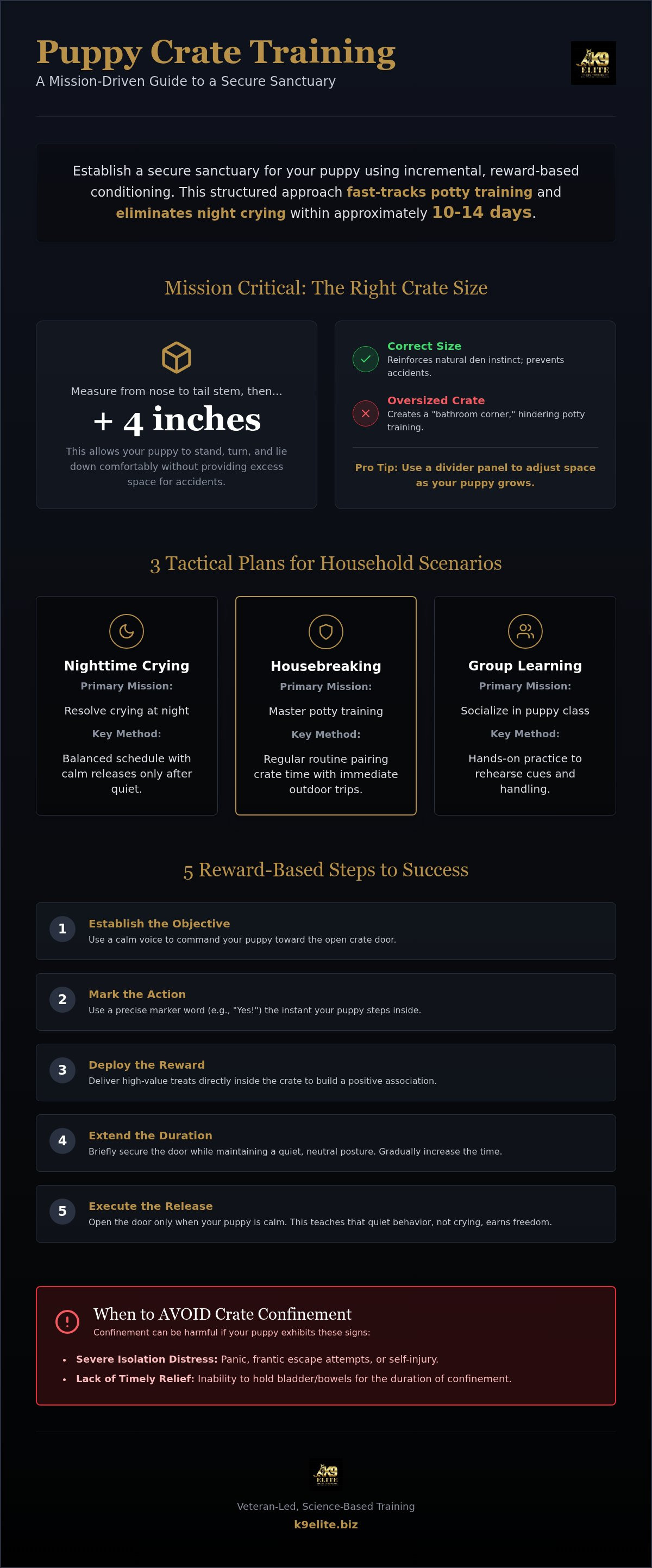
Key Takeaways: Crate training a puppy uses incremental reward-based conditioning to establish a secure sanctuary that fast-tracks potty training and eliminates night crying within 14 days.
Measure your puppy from nose to tail stem and add 4 inches for sizing.
Avoid crate confinement if your puppy exhibits severe isolation distress or lacks timely relief.
Use a wire crate with a divider panel for growing puppies to prevent accidents.
K9Elite recommends waiting 10 to 15 minutes before intervening when a puppy cries initially.
The decisions you face are concrete: which plan matches your household, which crate size protects housebreaking, when confinement helps versus when it harms, and how you expand from crate to free access without losing gains. Work those decision points with the same mission-driven structure we use in the field.
Table of Contents
3 Crate Training Plans That Fit Real Household Scenarios
Every tactical mission needs a clear strategy matched to your household. With clients we see that establishing a mission plan immediately creates consistency, and that structured approach accelerates learning because clear leadership removes confusion for your puppy.
Two or three situations show up again and again. If your puppy vocalizes after lights-out, run a balanced night schedule with the crate near your bed and calm releases only after quiet. If housebreaking stalls, pair crate time with a regular outdoor routine the moment the door opens. If you want shared skills and owner handling, join hands-on group work so you rehearse the same cues at home.
Select the tactical track that fits your current operational needs:
You need to address night vocalizing where it actually happens, while avoiding the pitfalls of temporary facility-based fixes. For complete guidance on building daily consistency, read the 7-step crate process for your home and run the protocol each day so structure can stabilize the household.
Choose Crate Types That Protect Safety and Calm
Select a crate that permits your puppy to stand, turn around, and lie down comfortably. Wire crates offer strong airflow, while plastic units provide security during transport.
Choosing your tactical gear carefully supports long-term safety. Wire models with adjustable divider panels fit growing dogs well. Plastic shells suit nervous animals that need fewer visual distractions.
According to a Wikipedia article on crate training (2025), proper sizing prevents puppies from using one end of their enclosure as a bathroom. You must measure your dog from nose to tail stem, then add four inches to establish proper interior dimensions. Fit the crate the way you fit protective gear: correct dimensions create a secure sanctuary, and a poor fit compromises the mission.
Settle early night distress by placing the enclosure near your bed. Facility-only progress can leave a puppy calm inside the crate while chaotic habits return across your living space. To establish true leadership at home, balance early confinement with in-home training support. A structured potty approach demands immediate outdoor trips after crate release, and each phase needs the same disciplined consistency.
Right Crate Size Protects Growth and Housebreaking
Your young dog needs a secure enclosure that offers enough room to stand up, turn around, and lie down comfortably. An oversized enclosure creates spatial tactical errors.
A common oversight is that an overly spacious interior ruins your dog's natural drive to maintain a clean sleeping spot. When extra floor area remains open, puppies frequently convert the far corner into an immediate bathroom zone. Proper spatial containment accelerates potty training success by reinforcing natural bladder control.
Deploying proper equipment supports long-term operational success during your puppy training mission. For a growing recruit, adult-sized housing equipped with a physical partition panel is an efficient strategy. That tactical setup lets you adjust the interior footprint incrementally as your recruit gains weight and height, and precision spatial management maintains structural discipline throughout early development.
Tip: Use a crate divider panel to adjust interior space as your puppy grows, preventing them from using one end as a bathroom.
5 Reward-Based Steps for Crate Training a Puppy
Following the AVSAB standard, reward-based techniques deliver dependable long-term outcomes for your pup. Veteran-led operations show that establishing clear mission parameters early prevents daily conflict in the home.
Establish the objective: Command your dog toward the open door with a calm voice.
Mark the action: Use a precise marker word the second your dog steps inside.
Deploy the reward: Deliver high-value treats directly inside the enclosure to reinforce success.
Extend the duration: Secure the door briefly while maintaining a quiet, neutral posture.
Execute the release: Open the door only when your puppy shows calm behavior, so night vocalizing loses its payoff.
Executing a tactical plan requires absolute consistency. You can secure guidance through OKC puppy training to build clear leadership during potty training. Professional owner-training (puppy class) sets a solid foundation for home success, and precision work builds trust. Opting for training inside your own rooms lets you tackle behavioral triggers in their real environment, skipping short-term facility solutions.
Tip: High-value treats reserved exclusively for crate entry create an immediate positive association.
Potty Training Holds When Your Crate Routine Stays Consistent
Potty training requires tactical routine consistency to prevent severe night distress inside the home. Execute scheduled breaks immediately after meals, naps, and intense play.
Our veteran-led mission at K9Elite focuses on establishing clear leadership to stabilize your puppy. Maintaining a strict timeline builds reliable habits faster than passive observation.
A frequent mistake is using the enclosure as punishment. That tactical error creates negative associations, causing vocal distress or intense panic. Never flood your dog by ignoring extreme anxiety signals.
When your puppy whines, evaluate their immediate needs before acting. If they just drank water, issue a calm command and head directly outside. When you select coaching in your own living space, you target the triggers right where they occur instead of relying on temporary facility fixes. K9Elite delivers structured guidance throughout the Oklahoma City area to keep your mission on target.
When Crate Use Works Against Your Puppy
Crate confinement is counterproductive when a puppy exhibits severe isolation distress or faces prolonged periods without elimination breaks. Forcing a panic-stricken animal into a closed space escalates trauma and breaks structural balance.
Many overlook that caging an energetic pup with a full bladder invites failure and sparks night vocalizing. In our tactical assessment, using a crate as a holding cell during excessive shifts violates sound operational strategy. In-home dog training OKC addresses these behavioral triggers directly, though it cannot replace the physical need for timely relief.
A crate is a training tool, not a solitary confinement unit. If you need professional guidance to stabilize your puppy's routine in Oklahoma City, a professional evaluation establishes clear leadership without resorting to destructive isolation tactics.
Why Owners Still Skip Crate Training Despite Clear Payoffs
Owners fail because night crying causes emotional distress, leading to early surrender.
Training inside the home targets these outbursts where they happen. Addressing problems at home avoids the facility effect, where pets behave only in training centers. Grounding your tactical mission in structure builds stability. Noise also drains your energy, so treat crate work with the same repeatable cadence you would use in disciplined drills, and consistent execution carries the result.
Founded by Marine Corps veteran Coty Cortez, K9Elite is committed to mission success through our science-based, balanced approach. Training requires commitment, and results stall when the plan is not executed.
A structured approach (potty training) prevents early training breakdown. Establish firm boundaries immediately and maintain consistent rules daily.
Choose owner-training if you want full personal command over daily progress. Boarding programs fit busy schedules better. If night crying feels like failure, hold steady, enforce your boundaries, and rely on clear leadership.
Transitioning from a Crate to Free Access Without Losing Discipline
Expand your puppy's operational boundary slowly to secure long-term housebreaking discipline without compromising established household rules.
Execute this phase with tactical precision. In veteran-led field work across Oklahoma City, rushing territorial freedom triggers immediate regression. Begin by tethering your dog using a drag leash inside a confined playpen area. This setup enforces physical control while allowing controlled movement. Maintain strict potty training protocols throughout this phase.
Phase one targets single-room permission during active supervision. Secure all exit points, clear potential hazards, and assign clear tasks. If your dog exhibits zero accidents or destructive urges for two consecutive weeks, advance to phase two. This step expands tactical perimeter access to adjacent living spaces.
Progress demands patience and steady leadership. Revert immediately to crate isolation if nighttime distress or night vocalizing resurfaces.
Moving from strict containment to full room access works the way security clearances work: every expanded zone requires demonstrated reliability. K9Elite builds this structured progression into every custom mission plan to preserve accountability. Secure your home baseline first, then gradually grant full freedom.
Frequently asked questions
At what age should a puppy be crate trained?
You should start crate training a puppy at eight weeks old. Early initiation establishes immediate structural balance in your household. Reward-based methods, the AVSAB standard, give reliable long-term results when you apply them from day one with tactical, science-based protocols.
How long to let puppy cry in crate first night home?
You should allow a puppy to settle for ten to fifteen minutes before intervening. Short vocalizations are normal during initial confinement tactical drills. Yielding to every whimper reinforces the night-crying pattern. Address these vocalizations directly where they happen in your home to avoid temporary facility-based fixes.
Can a crate help with potty training a puppy?
Yes, a crate accelerates potty training by leveraging a dog's natural instinct to keep its den clean. Direct your dog outside on a strict schedule immediately after release. Consistent timing builds clear boundaries fast under steady operational control.
What should I do if my dog cries or barks in the crate?
You must wait for a brief moment of quiet before releasing your dog from confinement. Time that release precisely, because rewarding noise undermines unit discipline. Correct the root issue calmly without using harsh punishment, and secure guidance when you need sharper focus.
Why should I crate train my puppy?
Crate training provides your dog with a safe den while preventing home destruction and dangerous household accidents. It builds essential mental resilience through structure, and this controlled environment secures your puppy when direct supervision is impossible.
Master Crate Training with Veteran-Led Precision
Successful crate training requires consistent execution and a structured approach. The same decisions you met at the start still apply: match the plan to your scenario, size the crate for clean habits, use reward-based steps, and expand freedom only after your puppy earns it.
You build lasting reliability when you establish clear leadership from day one. Founder Coty Cortez, a Marine Corps veteran and career dog trainer, applies tactical precision to every mission plan. The K9Elite team delivers science-based guidance across Oklahoma City in 2026.
If night distress persists, home-field evaluations target issues directly inside your living space, and local in-home work addresses those triggers where they happen while avoiding temporary facility-based fixes. For balanced results, explore our professional obedience programs and reserve your spot in a Group Class Session. Contact our advisers today to request a personalized quote.


Comments