
Canine Good Citizen Test Prep in OKC: A Practical Readiness Checklist
Your dog may sit, stay, and come reliably at home, then struggle when a stranger approaches or another dog passes nearby. That gap matters: Canine Good Citizen test prep OKC should build dependable behavior across settings, not just polished cues in a quiet room. The CGC test covers ten skills, including polite greetings, loose-leash walking, coming when called, and staying calm around distractions.
If you’re unsure what evaluators look for or which skill to address first, a clear plan makes preparation more manageable. This checklist explains the test, helps you identify training priorities, and offers ways to practise without overwhelming your dog.
Start by reviewing the test skills and observing your dog in everyday situations. Then strengthen one priority at a time through short, consistent sessions, adding distractions gradually. In Oklahoma City, preparation can include obedience practice, group classes, or an in-home evaluation to identify individual behavioral triggers and communication gaps. The mission is steady progress: clear expectations, balanced training, and reliable behavior wherever the test takes you.
Table of Contents
What the Canine Good Citizen Test Measures, and Who It Suits in OKC
The American Kennel Club’s Canine Good Citizen (CGC) test is a manners and behavior skills assessment. It looks at how a dog and handler work together in common situations, from meeting people to responding around distractions. The goal is controlled, manageable behavior, not a performance built on perfect obedience in a quiet room. The Canine Good Citizen program provides background on the program and its purpose.
For Oklahoma City owners, Canine Good Citizen test prep OKC is a practical way to build public manners through clear, consistent practice. Preparation can strengthen useful skills, but it can't promise a passing result or grant certification. The test reflects the behavior a dog demonstrates on test day, in that setting, with that handler.
What the CGC test is designed to assess
The American Kennel Club test reviews ten standardized skills involving people, handling, leash manners, cues, other dogs, distractions, and brief separation. Together, these tasks assess whether a dog can remain manageable while the handler provides direction. A dog may recognize “sit” at home yet find it harder to respond when an unfamiliar person, dog, or new environment competes for attention.
Knowing a cue is not the same as demonstrating it under changing conditions. Preparation should teach your dog to respond while staying composed, rather than relying on repeated commands or expecting the environment to stay predictable. Assess what your dog actually does, not only what the dog can do in familiar surroundings.
Is CGC preparation right for your dog?
Consider your dog’s current comfort with unfamiliar people, gentle handling, nearby dogs, and ordinary distractions. Notice whether your dog can recover after a surprise, stay connected to you on leash, and accept guidance without escalating. These observations help identify a sensible starting point. Dogs of any breed, including mixed breeds, can take the test; age or breed alone does not determine readiness.
A nervous or reactive response does not automatically rule out future preparation. It does mean the training plan should account for your dog’s needs. If your dog freezes during handling, barks or lunges at nearby dogs, or struggles to settle around unfamiliar people, begin with an individualized assessment before increasing exposure. Work at a manageable pace. Too many triggers at once can overwhelm a dog and make learning harder.
Readiness also depends on learning history and the test environment. A dog with solid skills in one setting may need structured practice in others before those behaviors become dependable. Puppies can be tested, though behavior can change as they mature; the AKC recommends retesting as adults. Start by observing and recording the situations your dog handles well, then identify where more support is needed.
The 10 CGC Test Skills to Review Before Training in Oklahoma City
Use this checklist to turn the test into a clear training brief. The American Kennel Club’s AKC Canine Good Citizen program sets out ten skills that assess how a dog responds to people, handling, movement, cues, and everyday challenges. Review the current test description and follow the evaluator’s guidance for assessment details and acceptable performance.
People, handling, and leash manners
Practise calm, controlled behavior without rushing your dog into contact. For greetings, help your dog remain manageable as a friendly stranger approaches; for petting, build comfort with brief, gentle interaction. Introduce handling gradually, rewarding relaxed participation as you touch areas involved in an appearance and grooming check. Keep sessions brief if your dog shows discomfort.
Accepting a friendly stranger: Practise your dog staying composed while a person approaches and greets you.
Sitting politely for petting: Build a calm sit while a friendly person briefly pets your dog.
Appearance and grooming: Help your dog accept gentle handling and examination without force.
Out for a walk: Practise walking on a loose lead with your dog responsive to your direction.
Walking through a crowd: Work on moving calmly among people, distinct from walking beside you on a quieter path.
Loose-leash walking tests teamwork in motion; moving through a crowd adds close human traffic. Practise both deliberately, starting at a distance and in a setting where your dog can stay attentive. Increase difficulty in measured steps rather than placing your dog in a dense group before the behavior is ready.
Cues, distractions, and separation
For cue-based skills, look for observable responses, not just a dog who recognizes a word. Practise clear communication and steady handling, then add manageable changes in location or background activity. If your dog becomes tense or disengages, reduce the challenge and return to a level where your dog can respond comfortably.
Sit and down on cue and stay in place: Practise both positions and maintaining them until released.
Coming when called: Build a prompt return to you, then practise with controlled distractions.
Reaction to another dog: Work toward calm, manageable behavior near another dog without forcing an encounter.
Reaction to distraction: Practise recovery and attention around ordinary sights or sounds at a suitable intensity.
Supervised separation: Prepare your dog for a brief separation from you while another person supervises.
The ten items are a review guide, not a substitute for the evaluator’s current directions. Canine Good Citizen test prep OKC should reflect your dog’s comfort, learning history, and the conditions under which the test will be assessed. For structured obedience practice in the Oklahoma City area, K9Elite’s dog training support can help you focus on relevant skills without advancing faster than your dog is ready for.
CGC Readiness in OKC: Practice at Home Versus Real-World Performance
A dog can respond quickly to a cue in the living room and hesitate when the same cue is given somewhere unfamiliar. That difference is not stubbornness. The surroundings may compete for attention, change the dog’s comfort level, or bring the dog closer to people and other dogs. Test readiness depends on whether the dog can respond with you across settings, not only in one familiar space.
Dogs learn through repetition, but they also need practice applying a behavior in different contexts. This skill is called generalization. A reliable sit at home may need to be practised in a quiet outdoor area before adding people at a distance. Commands alone don't establish readiness; the dog’s body language, ability to recover, and response to your guidance matter too. For Canine Good Citizen test prep OKC, increase difficulty deliberately rather than treating every outing as a test.
Signs your dog may need more preparation
Watch for patterns as the environment changes. Does your dog respond to a familiar cue in the yard but ignore it near foot traffic? Is settling difficult? Does handling prompt avoidance, or does the leash tighten as another dog comes into view? These observations identify gaps to work on, not reasons to force a harder session.
Pay attention to changes in posture and behavior, such as stiffening, turning away, repeated attempts to retreat, or difficulty disengaging from a trigger. A single signal doesn't explain the whole picture; consider the context and whether several signs appear together. If anxiety or reactivity affects safe practice, pause exposure and use a behavioral assessment to identify your dog’s behavioral triggers and set a suitable starting point.
How to make practice more representative
Use a gradual progression. Begin where your dog can respond comfortably, keep practice brief, and allow time to recover between challenges. Add one change at a time, such as a new location or a person visible at a distance. If your dog struggles, increase distance or return to an easier setting. This measured approach supports learning without overwhelming your dog.
Keep a simple record after each session: note the setting, what your dog handled well, and where attention or comfort changed. That gives you a practical readiness picture and helps you adjust the next training step with purpose.
A Step-by-Step Canine Good Citizen Test Prep Checklist
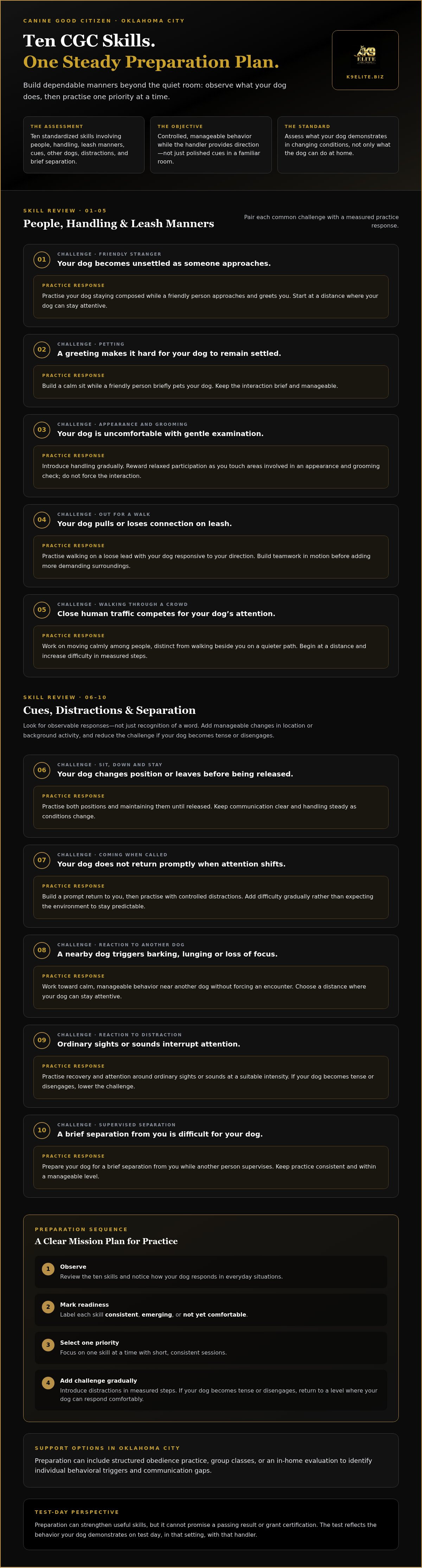
Preparation works best when you know what is reliable and what still needs coaching. Treat each practice session as a short mission: set a clear objective, observe your dog’s response, and adjust the next step based on what you see. This checklist gives Canine Good Citizen test prep OKC a practical structure without asking your dog to master every skill at once.
Rate each test skill. Mark each one as consistent, emerging, or not yet comfortable. “Consistent” means your dog responds calmly in more than one setting. “Emerging” means the behavior appears but needs support, while “not yet comfortable” flags a skill that causes hesitation, stress, or loss of focus.
Select one priority. Choose the skill that will make the next practice session useful and manageable. If your dog is unsettled by handling, work on calm, brief handling before adding an unfamiliar person. Avoid drilling several difficult skills in one session.
Start with a familiar setup. Practise the selected skill at home, where you can communicate clearly and limit distractions. Use a consistent cue, reward calm and clear behavior, and end or simplify the exercise if your dog shows stress. Don’t use flooding or punitive corrections to force a response.
Add one controlled challenge. Once the behavior is steady at home, practise in a quiet setting with one manageable change, such as a new location or mild activity nearby. Keep enough distance from people, dogs, or other behavioral triggers for your dog to stay engaged.
Record the result and adjust. Note the cue, setting, your dog’s response, and how quickly your dog returned to a calm state. If performance becomes less reliable or stress signals appear, reduce the difficulty before trying again.
Build a practical practice schedule
Plan brief, repeatable sessions around one or two target skills rather than a full test rehearsal every time. Move from home to a quiet, low-distraction setting only when your dog can work comfortably at the easier level. A simple log helps show whether progress carries across locations or depends on familiar surroundings. Use the Master Dog Obedience OKC guide for broader obedience foundations that can support this practice.
Prepare the handler as well as the dog
Your timing and movement shape the exercise. Rehearse giving a cue once, allowing your dog time to respond, and guiding leash movement without abrupt changes. Plan transitions between skills so your dog has a clear moment to reset. Give your dog space from approaching people or dogs while maintaining safe control; distance is a tactical adjustment, not a failure.
An individualized preparation path can start with an in-home dog training evaluation. The evaluation helps identify skill gaps and behavioral triggers, then organize next steps around your dog’s needs.
How K9Elite Can Support CGC Preparation in Oklahoma City
Preparing for the Canine Good Citizen test is easier to direct when you understand what your dog handles well and where the team needs more structure. K9Elite connects that assessment to relevant obedience or behavior-modification work, rather than treating every dog as if the same training sequence fits. The objective is steady, practical progress.
What an in-home evaluation can clarify
An in-home evaluation lets a trainer observe your dog in familiar surroundings and consider temperament, communication gaps, and behavioral triggers. That home field advantage can reveal how your dog responds to everyday routines, visitors, handling, and leash guidance. K9Elite’s in-home dog training evaluation in OKC helps identify which skills need focused work and what conditions affect your dog’s behavior.
The assessment also considers your dog’s learning history and the situations that are difficult to manage. For example, a dog that walks calmly at home may need a different plan if attention breaks down around unfamiliar dogs. Identifying the gap first keeps practice relevant and appropriately paced.
Choose a structured next step
After the evaluation, a mission plan organizes training around the needs identified. Private obedience training may suit a team working on specific cues, leash communication, or consistency. Behavior modification may be the right focus when anxiety or reactivity affects safe practice. Group classes offer structured practice around other dogs and people when that setting matches the dog’s current readiness.
K9Elite’s veteran-led, science-based, balanced methods emphasize clear communication and consistent expectations. The training path should account for the dog’s behavior, not just the test checklist. Review progress and adjust the plan as skills become more reliable across settings. K9Elite also provides lifetime support, continued guidance after training sessions conclude.
Start with the individual picture: Use the evaluation to identify skill gaps and behavioral triggers.
Match the work to the need: Focus on obedience, behavior modification, or group practice as appropriate.
Build in measured steps: Increase challenge only when your dog can remain engaged and responsive.
Bring notes on the situations your dog handles well and those that remain difficult to make the evaluation more useful. K9Elite’s in-home evaluation establishes a focused starting point for your dog’s preparation.
Set the Next Training Objective
The CGC goal can be a starting point for dependable manners long after test day. Choose one behavior your dog can practise consistently, then carry that standard into everyday routines around Oklahoma City. Progress comes from clear expectations, steady handling, and preparation matched to your dog, not from rushing toward a pass.
For Canine Good Citizen test prep OKC, an individualized starting point can turn uncertainty into a practical training direction. K9Elite is led by Marine Corps veteran Coty Cortez and brings more than 15 years of hands-on training experience to its work with dogs and handlers throughout the greater Oklahoma City metropolitan area.
Take the next step with a plan built around your dog’s needs. Schedule an in-home evaluation with K9Elite to establish a focused path forward. Consistent practice gives you and your dog a clear mission to work toward, one manageable step at a time.
Frequently Asked Questions
Is the Canine Good Citizen test the same as therapy dog certification?
No. The CGC assesses manners and behavior skills; it isn’t therapy dog certification. Therapy dog programs have their own preparation and participation expectations, which vary by organization and setting. If your goal is visits to a school, hospital, or community center, identify the requirements of the program you’re considering, then prepare for the behaviors and working conditions it expects. A CGC result alone doesn’t qualify a dog for therapy work.
Can any dog take the Canine Good Citizen test?
Yes, the CGC is open to purebred and mixed-breed dogs, with no minimum or maximum age limit. Dogs must be old enough to have the required immunizations, including rabies. The American Kennel Club recommends retesting puppies as adults because behavior can change with maturity. Eligibility doesn’t necessarily mean a dog is ready for the test, so consider comfort and safe handling in the situations the assessment involves.
How do I know if my dog is ready for the CGC test?
Before scheduling, check whether you can calmly guide your dog through each test item without relying on repeated cues or physical prompting. Ask someone familiar with the CGC criteria to observe a practice run and note where your handling or timing becomes uncertain. A useful final check is whether you understand the evaluator’s instructions and can keep your attention on your dog throughout the assessment.
What happens if my dog does not pass the CGC test?
A dog that doesn’t pass has shown you which test behavior needs more preparation; that result isn’t a judgment of your dog’s worth or your bond. Write down the evaluator’s feedback while it’s fresh, then practise the specific skill in a less challenging setup before adding distractions. Retesting procedures can depend on the evaluator or program, so use the guidance provided for your test rather than assuming a particular waiting period.
Can I prepare my dog for the CGC test at home?
Yes. Home practice can help you rehearse with the equipment intended for test day. The AKC CGC test permits a well-fitting buckle collar, slip collar such as a Martingale, or body harness; retractable leashes, head halters, slip leads, and special training collars aren’t permitted. Check current AKC instructions before the test, and practise handling your chosen permitted setup calmly so it feels familiar to you and your dog.
Where can I find Canine Good Citizen test preparation in OKC?
For official testing information in Oklahoma City, use the American Kennel Club’s online directory of approved CGC evaluators to locate evaluators and learn about test schedules. Keep testing logistics separate from preparation: the evaluator provides test instructions, while your training plan should target the skills your dog needs to practise. K9Elite serves the Oklahoma City area, so local preparation can be organized around your team’s specific training priorities.
Does passing the CGC test guarantee my dog will behave well everywhere?
No. A passing result records performance on the CGC assessment, not a guarantee about every future situation. The title also doesn’t grant the legal public-access rights of a service animal. Keep the CGC skills as a foundation, and treat any new behavior concern as a separate training need. If your dog’s behavior changes suddenly, consider whether health or environmental factors may be involved and seek appropriate professional guidance.
Comments