
Dog Leash Reactivity Training in Oklahoma City: A Structured Guide
When a dog reacts on leash, the safest response is often to create space, not push closer. Unpredictable encounters can leave you wondering whether your dog is afraid, frustrated, or showing aggression. This guide to dog leash reactivity training Oklahoma City owners can use explains how to read those reactions and make safer decisions on walks.
You’ll learn to recognize behavioral triggers and early signs of escalation, manage distance, and avoid flooding your dog with more stimulation than they can handle. The goal is not a quick fix. It is to build clear, consistent skills through individualized practice.
At K9Elite, veteran-led, in-home behavior modification begins with a professional evaluation in the environment where daily routines and triggers occur. That home field advantage helps shape a mission plan for your dog and household, with owner education and lifetime support guiding the work. The sections ahead outline practical handling steps and explain how professional guidance can make walks more predictable and controlled.
Table of Contents
What leash reactivity looks like on Oklahoma City walks
A leash reaction is an observable response to a trigger while a dog is restrained. It may look like barking, lunging, pulling hard, freezing, or struggling to disengage and move on. The term describes what happens in a particular situation, not a diagnosis. A dog may react when another dog approaches, a person passes nearby, or the available walking space narrows.
One reaction does not establish a dog’s intent, temperament, or a permanent aggression label. The same outward behavior can have different causes, and one moment does not tell the whole story. For broader context on how aggression and leash-specific reactions are discussed, see Dog aggression and leash reactivity. Start with careful observation before drawing conclusions.
Observed behavior is evidence of what happened, not proof of why it happened. Keep your attention on details you can record rather than assumptions about your dog’s motives. Those details support a more accurate plan for dog leash reactivity training Oklahoma City owners can apply to their own walking routines.
How to recognize a leash reaction before it escalates
Watch the full sequence, not one signal in isolation. Your dog may suddenly fix attention on a person or dog, shift posture, slow down, pull forward, or become still. Vocalization may follow, but it may also be absent. None of these signs alone proves fear, frustration, or aggression. Treat them as cues to pause, scan the surroundings, and decide whether you need more space.
After a difficult encounter, note what happened just before the response, what your dog did, and how long it took to return to the walk. Record the trigger, distance, movement, and recovery. A brief note on your phone can reveal patterns that are easy to miss while handling the leash.
Why leash reactions can feel harder in the Oklahoma City area
A familiar route can still bring changing conditions. Your dog may encounter another dog on a neighborhood sidewalk, meet people near a home entrance, or have little room to pass on a shared path. These are examples, not claims about local incident patterns. Nearby people or dogs and limited space can affect an individual walk and the distance available for a calm response.
K9Elite provides in-home services throughout the greater Oklahoma City metropolitan area, including Edmond, Moore, Norman, and Midwest City. Wherever you walk, treat each outing as a specific setting rather than assuming the same trigger will produce the same response every time. Track what changes, including the location, proximity, and your dog’s ability to disengage. That record gives you a clearer starting point for understanding the behavior.
What behavioral triggers and distance reveal about leash reactivity
Behavioral triggers are specific situations or stimuli that provoke an unwanted response. A trigger might be another dog moving toward your dog, a person approaching from behind, or a sudden change in the walking environment. The trigger alone does not explain the response. Fear, anxiety, frustration, and other factors can contribute, so avoid assigning a motive from one encounter. UC Davis discusses why dog aggression can have causes beyond dominance in Understanding dog aggression beyond dominance.
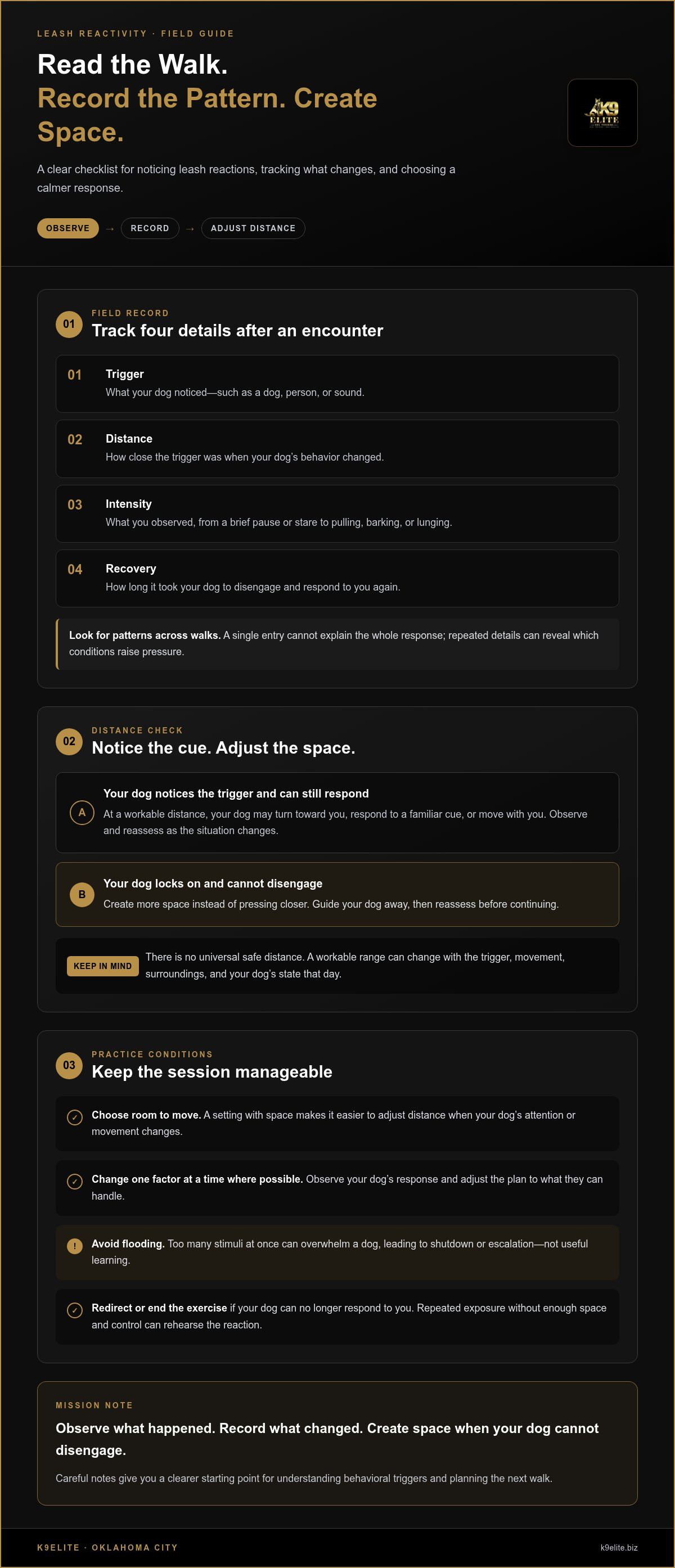
Build a simple field record after each walk. Note:
Trigger: What your dog noticed, such as a dog, person, or sound.
Distance: How close the trigger was when your dog’s behavior changed.
Intensity: What you observed, from a brief pause or stare to pulling, barking, or lunging.
Recovery: How long it took your dog to disengage and respond to you again.
Patterns matter more than a single entry. Your notes may show, for example, that your dog can pass a stationary dog at one distance but reacts when that dog approaches. These observations clarify which conditions increase pressure and give you a practical basis for planning the next walk. Repeated exposure is not automatically productive practice. Without enough space and control, it can rehearse the reaction instead of building a calmer response.
Use distance to keep practice below the dog’s reaction point
There is no universal safe distance. A dog’s workable range can change with the trigger, movement, surroundings, and the dog’s state that day. At a useful distance, your dog may notice the trigger but still turn toward you, respond to a familiar cue, or move with you. If your dog’s attention locks on and they cannot disengage, create more space instead of pressing closer. Reassess before continuing. Do not rely on a fixed measurement or expect the same response every time.
Avoid flooding a reactive dog with too many stimuli
Flooding means overwhelming a dog with too many stimuli at once. A crowded route, a close encounter, and sustained exposure may exceed what the dog can manage. The result may be shutdown or escalation, not useful learning. Controlled practice calls for calm observation, manageable distance, and gradual progression based on what your dog can handle. Change one factor at a time where possible, and end or redirect the exercise if your dog can no longer respond to you.
Use your log to set a tactical plan: choose a setting with room to move, observe your dog’s response, and adjust distance when their attention or movement changes. If the pattern remains difficult to interpret, individualized guidance can turn those observations into training priorities. K9Elite’s in-home behavior modification support assesses the dog’s environment and shapes practice around specific triggers.
What to do when your dog reacts on a leash
A reaction can develop quickly, so use a simple sequence to keep your decisions clear. Your first priority is safety, not securing a greeting or keeping your dog near a trigger. Adapt each step to your dog’s behavior and the space around you. If the route is narrow or another dog is approaching, choose the safest available direction instead of following a rigid script.
Notice the trigger. Identify what your dog is responding to and watch for changes in attention or movement.
Create space. Move away, cross the street where safe, or use an open area to increase distance.
Guide your dog. Use a familiar cue and steady leash handling to help your dog move with you.
Reassess. Once there is more room, check whether your dog can respond to you and continue calmly. If not, create more space or end the encounter.
Clear foundational cues make this sequence easier to apply. K9Elite’s dog obedience training builds consistent communication and leash skills that owners can practice during everyday walks.
Create space and redirect without escalating pressure
When the surroundings allow, calmly turn and move away from the trigger. Keep your instructions brief and consistent. Avoid leash corrections, raised voices, or confrontational handling that can add pressure. A drag leash can guide a dog away from a resource without reaching into the dog’s personal space, enhancing safety. A muzzle may be used as a temporary safety tool when appropriate, but it is not a substitute for training or careful management. The ASPCA guide to canine aggression offers additional context on recognizing aggression and seeking professional support.
Not every situation gives you room to turn or change direction. Keep your dog at a manageable distance, avoid moving toward people or dogs, and prioritize reaching a safer, less crowded area. Do not force a greeting or hold your dog in prolonged exposure to a trigger. Dog leash reactivity training Oklahoma City owners can apply begins with deliberate handling and decisions matched to the dog in front of them.
Build a repeatable practice plan between walks
After an encounter, record what triggered the response, the approximate distance, what your dog did, and how recovery looked. These notes can show whether a particular setting or approach makes a walk harder to manage. Keep practice short enough that your dog can remain responsive. If your dog becomes overwhelmed, increase distance or stop the exercise. Do not press for another repetition just to complete a plan.
Household consistency matters. Agree on the same cues, leash-handling approach, and decision to create space so your dog receives clear guidance from each handler. Foundational obedience work can support that coordination, but reactive behavior may call for individualized behavior modification. A structured plan gives handlers a shared, calm, safety-first routine without imposing a fixed timeline.
When leash reactivity needs professional behavior support
Professional support does not have to mean harsh discipline. A balanced, science-based plan focuses on understanding the dog’s behavior, setting safe boundaries, teaching clear skills, and coaching the owner to apply them consistently. The objective is not to suppress a reaction through intimidation. It is to identify factors contributing to the behavior and build a more controlled response through structured practice.
Consider professional help if reactions are becoming more intense or frequent, you are concerned about someone’s safety, or you cannot reliably identify what sets off your dog. Support can also help when daily walks remain difficult despite your efforts to create space and use familiar cues. Dog leash reactivity training Oklahoma City should account for the individual dog, not rely on a generic script.
What a structured professional plan should address
A professional evaluation should include a behavioral assessment, observation of triggers, an examination of leash-handling skills, and practical owner education. In-home work lets the trainer see the dog’s surroundings and household routines, which may shape where and how reactions occur. That context helps set realistic training priorities and supports a mission plan tailored to the dog’s needs instead of a generic timetable.
K9Elite’s ANCHOR System provides a structured framework for accountability, leash navigation, communication, emotional harmony, owner education, and relationship-building. The plan gives the owner clear skills to practice and ways to apply them in daily routines. Explore K9Elite’s dog training evaluation OKC to take the first step toward an individualized assessment.
When a muzzle may support safer training
A muzzle may be appropriate as a temporary safety tool within an individualized plan. Muzzle conditioning is gradual: the dog learns to accept the muzzle through careful, positive introduction rather than having it forced on as punishment. A muzzle does not resolve the behavior, remove all risk, or replace supervision and training. Its use should fit the dog’s situation and work alongside clear handling and appropriate practice.
During an in-home evaluation, the trainer observes how the dog responds in its own environment, discusses safety concerns, and helps determine which skills to prioritize. The assessment may reveal that a trigger is tied to a particular routine, space, or interaction that a generic walk-through would miss. Owners also receive guidance for carrying the plan beyond a training session and maintaining consistent handling at home.
Seeking guidance is a responsible step, not a judgment of your dog or your ability as an owner. Clear observation, individualized priorities, and steady practice help you make informed decisions about walks while protecting your dog and the people nearby.
How K9Elite builds a leash reactivity mission plan in Oklahoma City
Effective behavior work starts with an accurate picture of the dog, not a preset sequence of exercises. K9Elite’s in-home evaluation lets the trainer observe the dog’s behavior, relevant triggers, and living environment. That home field advantage can reveal how household routines and surroundings shape the challenge, helping set priorities that fit the dog and the people responsible for daily practice.
The process follows a mission‑driven structure: briefing, assessment, active work, and debrief. Each phase has a purpose. The briefing clarifies the owner’s concerns and routine; assessment gathers observations; active work introduces practical handling and communication; and the debrief identifies what to practice next. This organized process helps owners understand what to do and why each skill belongs in the plan.
What the in-home assessment examines
During the assessment, the trainer observes the dog’s behavior and environment, then considers which situations may be relevant to leash reactions. The goal is to identify priorities and communication gaps, not label the dog based on one moment. Those observations help determine which handling skills owners can practice and where further guidance will help.
This individualized view supports dog leash reactivity training Oklahoma City owners can apply within their actual routines. An assessment can help distinguish a broad concern from a specific pattern, such as difficulty settling before walks or responding to the handler when a trigger appears. The resulting mission plan reflects those observations and the dog’s needs instead of following a generic timetable.
How veteran-led structure supports consistent practice
Clear leadership depends on repeatable handling and informed owners. K9Elite’s training process emphasizes structure, communication, and owner education. Training gives the household a shared framework for daily practice, so each handler can follow consistent guidance without expecting a fixed timeline or guaranteed outcome.
Use the mission plan to set practical priorities between sessions: agree on consistent cues, note how the dog responds in relevant situations, and bring those observations into the next training discussion. This approach keeps practice connected to the dog’s needs and gives handlers a clear basis for adjusting routines as circumstances change.
For a tailored starting point, start with K9Elite’s in-home dog training evaluation. A clear assessment can turn uncertainty into a focused plan for your dog and household.
Make your next walk a deliberate step forward
Progress begins with a clear decision: treat each walk as a chance to practice safe, consistent handling, not as a test your dog must pass. Choose a manageable route, stay attentive to your dog’s response, and adjust your plan when the surroundings change. If uncertainty or safety concerns are getting in the way, individualized guidance can help set priorities that fit your dog and daily routine.
For dog leash reactivity training Oklahoma City owners can approach with structure, an in-home evaluation helps shape a focused mission plan. K9Elite was founded and is led by Marine Corps veteran Coty Cortez, bringing over 15 years of hands-on training experience to the work. Lifetime support provides ongoing assistance after training sessions conclude as owners continue practicing.
Begin with K9Elite’s in-home evaluation and build a clear mission plan. Take the next step with purpose and keep moving forward together.
Frequently Asked Questions
Can leash reactivity improve without forcing my dog to meet other dogs?
Yes. Greetings are not required for useful training. In dog leash reactivity training Oklahoma City owners can focus on noticing what changes their dog’s behavior, keeping enough distance for the dog to remain responsive, and practicing a calm turn or check-in instead. A trainer can help choose suitable exercises when reactions are difficult to manage. The right plan depends on the dog’s behavior and context, so do not treat close contact as a necessary test or expect a fixed outcome.
Is leash reactivity always a sign that my dog is aggressive?
No. Barking, lunging, or pulling describes what you can observe; it does not establish intent or provide a diagnosis. Fear, frustration, and other factors may contribute, and the same behavior can have different meanings in different situations. An assessment can consider the dog’s history, surroundings, and response patterns. Take safety seriously while avoiding a permanent label based on one walk. If you are unsure how to manage encounters, seek individualized professional guidance.
What should I do if my dog reacts only to certain dogs or people?
Keep a brief record of who or what was present, how close the trigger was, what your dog did, and how the dog recovered afterward. For example, note whether a response occurs around moving dogs but not stationary ones. Create space instead of arranging repeated close encounters to test the reaction. These details can help a trainer identify behavioral triggers and shape an individualized plan without assuming a single cause.
Can a puppy show leash reactivity?
Yes. A young dog can have a strong response while restrained, but one difficult walk does not determine future behavior. Keep outings calm and manageable, observe what precedes the response, and avoid pushing the puppy into close encounters. Age-appropriate structured practice can build useful handling skills. Seek professional guidance if reactions persist, intensify, or make walks hard to manage. Early support helps you make informed choices without overwhelming the puppy.
How long does leash reactivity training take?
There is no reliable fixed timeline; progress depends on the dog, triggers, consistency, and the individual training plan. K9Elite’s standard programs last 8-12 weeks, but that is a general program duration, not a promise that leash reactivity will be resolved within that period. Follow the plan and track how your dog responds in relevant situations. A trainer can adjust priorities as the dog’s needs become clearer.
Can I use a muzzle while training a leash-reactive dog?
A muzzle can support safety when it is included in an appropriate plan, but it is a temporary tool, not a cure. Introduce it gradually through muzzle conditioning so the dog can learn to accept wearing it without force or punishment. A muzzle does not replace supervision, distance from triggers, or skill-building, and it does not remove all risk. Individualized guidance can help determine whether it fits your dog’s circumstances and how to include it responsibly.
Comments