
Dog Training for Kids and Families in OKC: A Practical Guide
Safer family dog training starts with adults changing the plan, not asking children to control the dog. In busy Oklahoma City households, family members may respond differently to jumping, pulling, guarding, or overexcitement. Dog training for kids and families OKC should center on adult leadership, predictable rules, and safe ways for children to participate. The goal is a practical plan for daily life, not perfect behavior in every situation.
Children can build a positive relationship with the family dog, but adults remain responsible for managing behavior. A structured, science-based approach gives caregivers clear roles and teaches children how to interact safely under supervision. It also helps the household work toward goals that matter at home, not only during a training session.
This guide covers adult-led routines, child-safe interaction boundaries, and ways to choose a training format that suits your dog and family. You’ll also learn how a dog training evaluation OKC can identify household triggers and communication gaps, and when in-home training or group classes can support your goals.
Table of Contents
Dog Training for Kids and Families in OKC Starts With Clear Adult Leadership
Family dog training is shared learning led by responsible adult handlers. Adults set the plan, manage the dog, and keep household expectations consistent. Children can join simple, supervised routines, but they should not be responsible for the dog’s behavior. This distinction matters in dog training for kids and families OKC, where several caregivers and changing schedules can make consistency harder.
Dogs get clearer information when people respond predictably. If one person encourages jumping during greetings while another discourages it, the dog receives conflicting signals. Before practice, agree on the cue, the behavior you want, and how adults will respond. Adult leadership provides the steady structure that makes learning clearer and safer.
What should children do during dog training?
Give children a defined role while keeping an adult in charge. A child might follow an adult-led greeting routine, give an agreed cue such as “sit” with adult supervision, or help deliver a reward when the dog responds appropriately. The adult controls the setup and remains responsible for the dog throughout the interaction.
Show children how to approach calmly and use only the agreed cue.
Keep an adult present and attentive during every child-dog interaction.
Teach children to leave the dog alone while it eats or sleeps and to respect its resting space.
Have the adult pause the activity if the dog appears uncomfortable or becomes overly excited.
Children aren’t substitute handlers. An adult decides when practice begins, guides the dog, and ends the interaction when needed. These principles align with broader Dog Training Principles, including clear communication and consistent practice.
Which family routines need clear structure?
Start with recurring moments: greetings at the door, meals, play, and settling in shared spaces. Before involving children, caregivers should agree on what the dog is expected to do and how adults will respond. For example, decide whether the dog waits calmly before greeting visitors and where it settles while the family eats. Children can then follow a routine instead of improvising.
Make the plan specific. Choose one cue for each behavior and use it consistently. If the dog is learning to settle on a designated bed, adults should guide practice and reward calm settling. Avoid giving mixed signals, such as inviting the dog onto furniture at one time and correcting it for the same behavior later. Consistent feedback helps the dog learn which actions earn reinforcement.
Keep the first objective simple: align the adults, explain the routine to the children, then practice with close supervision. This mission-first sequence gives everyone a clear role while keeping safety and follow-through with the adults.
How In-Home Dog Training Helps Families Address Real Household Triggers
A dog may respond differently at home than in a quiet training space. The doorbell, a child running through the room, or activity around a food bowl can change the situation. In-home training offers home field advantage: the trainer can observe the dog, caregivers, and routines where behavioral triggers occur. That context helps show whether the dog understands a skill and can use it amid normal household activity.
A behavioral assessment is more than a command practice session. It involves observing the dog’s temperament, responses to relevant triggers, household patterns, and the way family members communicate with the dog. A neutral setting can help with skill practice, but it won’t show how the dog responds to a familiar doorway, shared space, or family routine. For dog training for kids and families OKC, the home environment provides direct information for practical training.
During an in-home session, a trainer can coach an adult through a realistic scenario and observe the dog’s response. For example, the family might practice a calm routine around a visitor arriving. The adult handles the dog while children follow the agreed plan. The trainer can help the caregiver notice what happens before the dog reacts and how timing, cues, and the environment affect the interaction. Children can take part in appropriate ways, while adults remain responsible for managing the dog.
What does a trainer assess in a family home?
The trainer observes the dog’s temperament and the circumstances surrounding the family’s concerns. That can include where a behavior occurs, who is present, what activity is underway, and how caregivers respond. The goal is to identify relevant behavioral triggers and communication gaps, then use those observations to shape a mission plan around the dog’s needs and household routines.
A dog training evaluation OKC includes an in-home assessment of the dog and its environment. For families, that means the discussion can focus on actual routines rather than relying only on a description of the problem after it occurs.
How do families support practice between sessions?
Between sessions, an adult can choose one relevant routine and practice it briefly and consistently. Use the agreed cue, prepare the space, and reinforce the response the family is working toward. Keep children’s participation supervised, and let the adult control the setup and handling. The AKC’s guidance on involving kids in dog training can also help families plan suitable participation.
Record questions and observations for the trainer: what happened, what was going on around the dog, and how the dog responded. This field log gives the next session specific information to work with. K9Elite’s in-home dog training evaluation connects the assessment to your family’s daily environment.
In-Home Training, Group Classes, or Board and Train: What Fits a Family?
Choose a training format by matching where practice happens to the family’s goals, the dog’s needs, and the adults’ ability to reinforce skills at home. For dog training for kids and families OKC, the key question isn’t just where the dog learns. It’s how caregivers will take part and carry the plan into everyday routines.
Private in-home training puts coaching where the dog lives. Adults can practice skills in familiar spaces and work through household routines with guidance, which can help when concerns involve particular rooms, family interactions, or behavioral triggers. Group classes provide practice around other people and dogs. Board and train is an intensive program in which a dog lives with a trainer for two to four weeks and receives multiple daily training sessions.
Each format has a different path for transferring skills home. A dog may learn a behavior during training, but the family still needs a consistent plan for reinforcing it in daily life. Children can participate in supervised routines while an adult remains responsible for handling and follow-through. Families interested in child-safety education can also explore Family Paws Parent Education for Dog and Child Safety.
When is private in-home training a strong fit?
Consider in-home coaching when the family needs help with routines that happen at home, such as settling in a shared space or managing the dog’s response to household activity. The trainer can coach adults in the dog’s familiar environment, connecting instruction to the family’s actual routines. In-home work is especially practical when home context is central to the training goal.
When might group classes or board and train fit?
Group classes can suit families seeking structured practice around people and dogs. Caregivers can learn the same cues and handling approach, then reinforce those skills at home. For obedience-focused topics, K9Elite’s master dog obedience guide offers more detail, but families still need consistent practice.
Board and train offers concentrated work with a trainer, but it doesn’t remove the family’s role. After the dog returns home, adults need to know how to use the trained skills and maintain consistent expectations. Use this decision sequence: identify the main challenge, decide where the dog needs to practice it, and choose a format that gives caregivers a clear role in follow-through. K9Elite’s dog training services in Oklahoma City include in-home training and group classes for different practice settings.
Family Plan for Safer, Consistent Dog Training at Home
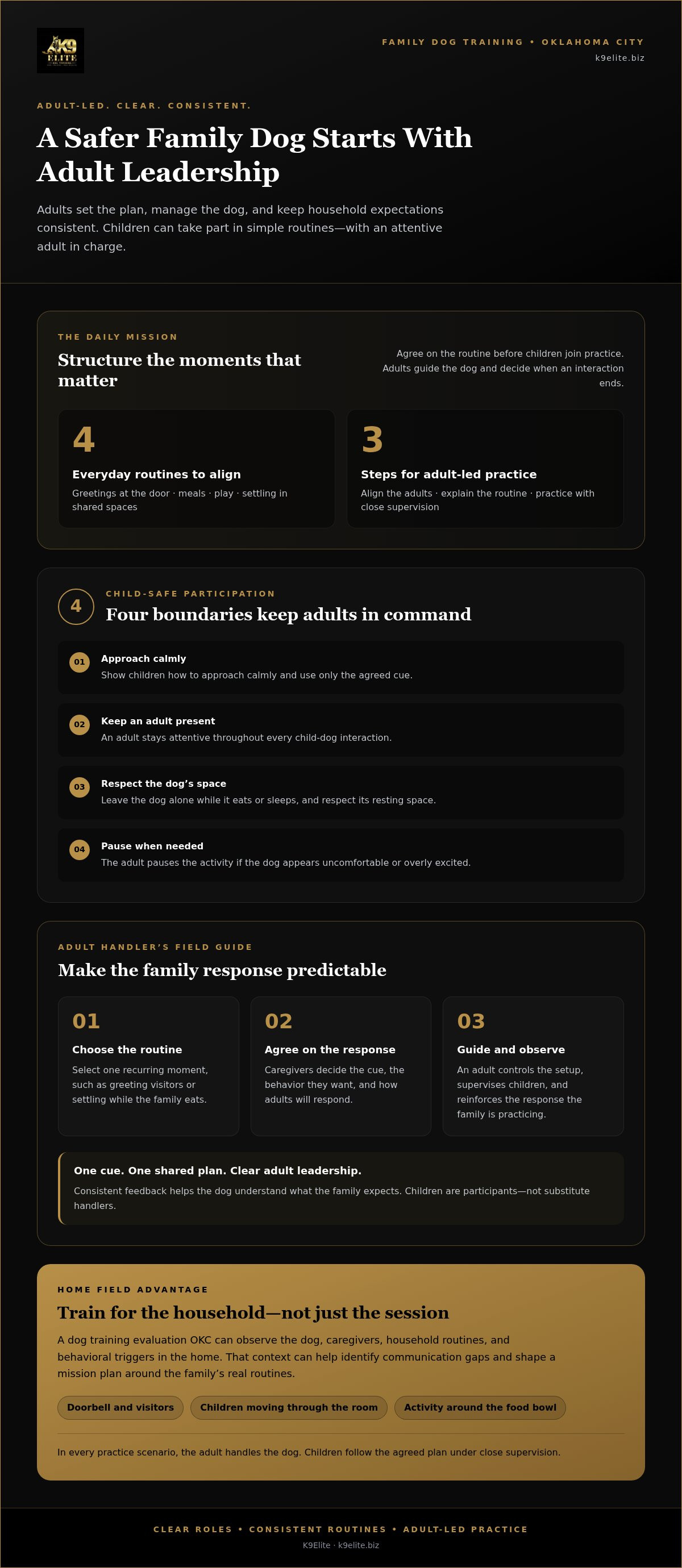
A reliable home plan gives every adult the same playbook and gives children clear boundaries. Keep the sequence simple: agree on household rules, assign adult roles, practice one routine, observe the dog’s response, then adjust the plan. Children may join supervised activities, but adults make decisions, manage the dog, and stop practice when needed.
Brief the family, assign adult handlers, practice one skill, then review the dog’s response and adjust the plan. This mission-driven sequence helps caregivers stay coordinated instead of changing expectations in the moment.
Agree on the rule. Choose one behavior to work on and decide what the dog should do instead.
Assign adult roles. Decide who handles the dog, who supervises children, and who gives the agreed cue.
Practice with structure. Set up the routine calmly and keep instructions consistent.
Observe and record. Note what happened before the dog responded, what the dog did, and how the family reacted.
Adjust deliberately. If the setup is too difficult or someone needs space, pause and revise the next practice.
Avoid flooding, a training pitfall in which a highly reactive dog becomes overwhelmed by too many stimuli at once, potentially leading to shutdown or escalation. Don’t add extra people, activity, or difficulty just to test the dog. Keep practice manageable, and seek guidance when the dog’s response makes the routine difficult to handle safely.
How should caregivers set up everyday practice?
Choose one routine, such as settling before family play, and agree on the adult’s cue and the behavior to reinforce. Keep sessions brief and calm. Pause if the dog or child needs space; ending practice is a sound decision, not a failure. Afterward, write down the setting, the dog’s response, and questions for the trainer. Those observations can guide future coaching.
How can adults keep interactions predictable?
During practice, adults manage the leash, environment, and decisions. Teach children the family’s interaction boundaries, including when to give the dog space, and supervise every interaction. A drag leash is used to guide a dog away from a resource without reaching into the dog’s personal space. Its use should follow trainer direction; handling it is never a child’s responsibility.
Consistency doesn’t mean forcing a routine when the situation changes. If a visitor arrives unexpectedly or household activity becomes distracting, an adult can increase distance, pause the exercise, or return to an easier step. The objective is clear communication and a safe, repeatable plan, not a performance under pressure.
For hands-on coaching that puts this family plan into practice, explore in-home dog training in Oklahoma City.
Starting Family Dog Training With K9Elite in Oklahoma City
A family training plan starts with understanding the dog where daily life happens. K9Elite begins with an in-home evaluation of the dog, behavioral triggers, household patterns, and family interactions. This dog training evaluation OKC lets the trainer observe the context around a concern instead of relying only on a general description of what happened.
Before the evaluation, caregivers can prepare a concise account of the behavior: what it looks like, when it tends to occur, who is usually present, and what happens immediately beforehand. Share what the family has tried and what questions remain. These details help focus the assessment. The trainer observes the dog and home environment, then uses those observations to develop a mission plan for the family’s behavioral needs.
What happens after a family identifies its main concern?
During a professional evaluation, the trainer considers the dog’s behavior alongside the household context. The assessment can clarify which situations need attention and where caregiver communication needs more structure. The mission plan then gives adults a practical direction for training and follow-through. Progress depends on consistent work by the family; an evaluation is a starting point, not a promise of a particular result.
Caregivers can prepare for the evaluation with a short briefing:
Describe the behavior clearly, without interpreting the dog’s intent.
Note when and where it occurs, and who is present.
Share relevant household routines and the responses family members typically use.
Identify the family’s immediate training priorities and questions.
This preparation keeps the session focused on the dog’s needs and the family’s real circumstances. Children may be present as part of the household picture, while adults remain responsible for handling the dog and maintaining safe boundaries during the assessment.
How does K9Elite support family follow-through?
Led by Marine Corps veteran Coty Cortez, K9Elite brings over 15 years of hands-on training experience to a science-based, balanced approach. Clear structure and caregiver education help adults understand the plan and apply it consistently. K9Elite provides in-home services across the greater Oklahoma City metropolitan area, including Edmond, Moore, Norman, and Midwest City, so training can account for the household environment.
Training sessions conclude, but support continues. K9Elite’s lifetime support provides ongoing assistance and resources after training, giving families a way to get guidance as they work to maintain consistent communication with the dog. The family’s role remains active: adults lead practice, follow the mission plan, and share observations when questions arise. There is no fixed timeline for behavioral change; the work must match the dog and the family’s follow-through.
To begin with an in-home assessment of your dog and household, Schedule an in-home evaluation with K9Elite.
Keep Your Family’s Training Plan Moving Forward
A family’s training plan should adapt as household routines change. A different schedule, a new activity at home, or a change in who handles a routine can affect consistency. When something changes, adult caregivers can pause, agree on a practical adjustment, and make sure everyone understands the updated expectations before practice resumes. This keeps the mission organized and avoids asking children to resolve mixed signals.
For families considering dog training for kids and families OKC, the next step doesn’t need to address every concern at once. Choose the behavior or routine that most affects daily life, then focus the family’s effort there. Adults can record what they want to change and what a workable result would look like at home. Clear priorities help guide a useful conversation with a trainer and keep expectations grounded in daily practice.
Begin planning an in-home evaluation with K9Elite as a practical first step. With a clear objective and adults working from the same plan, your family can approach training with greater confidence and direction.
Frequently Asked Questions
Can children participate in dog training?
Yes, children can join supervised activities that fit the family’s training plan. For example, a child might give an agreed cue or offer a reward while an adult manages the dog and training setup. In dog training for kids and families OKC, participation should teach safe, predictable interaction, not put a child in charge of handling, correcting, or controlling the dog.
Is in-home dog training better for families with children?
Not automatically. In-home training can be a strong fit when the family’s main concern happens during everyday home routines, such as visitors arriving or activity in a shared room. If the goal is practice around other dogs and people, a group setting may also be useful. Match the format to the behavior and the setting where the family needs the dog to respond.
How do I choose between private training, group classes, and board and train?
Start by identifying who needs to learn and where the skill must work. Private training lets caregivers practice with the dog at home; group classes add structured practice around other people and dogs. Board and train involves focused work with a trainer, so plan how adults will reinforce skills after the dog returns. The family’s ability to follow through consistently should guide the decision.
What should children do if a dog growls or walks away?
Children should stop approaching or touching the dog and calmly get an adult. They shouldn’t chase, corner, scold, or try to hold the dog in place. The adult should create distance and safely separate the dog from the activity, without reaching toward a tense dog. Treat the growl or retreat as a signal to pause the interaction and review what happened before trying again.
Can family dog training help with jumping, pulling, or reactivity?
Yes, training can address these behaviors by teaching practical alternatives and helping adults manage the situations in which they occur. For jumping, a plan might focus on a calm greeting. For leash pulling, adults can practice consistent leash cues. Reactivity calls for attention to triggers and manageable practice conditions. The trainer can tailor the approach to the dog’s behavior, with progress depending on steady follow-through.
What happens during a dog training evaluation in OKC?
A dog training evaluation OKC is an in-home assessment of the dog and household context. The trainer discusses the concern, observes relevant routines and responses, and considers the dog’s temperament, triggers, and communication with caregivers. Families can prepare by noting when a behavior occurs, who is present, and what happens beforehand. Those observations help shape a training plan suited to the household.
Does K9Elite offer family dog training in Edmond, Moore, and Norman?
Yes. K9Elite provides in-home dog training in Edmond, Moore, and Norman, as well as Oklahoma City and Midwest City. Families can use an in-home evaluation to discuss their dog’s behavior and household needs, then follow a plan with adults leading practice and supervising children’s interactions. The training approach is science-based and balanced, with guidance focused on clearer communication and consistent routines.
Comments