
How to Have a Calm Dog in Public in Oklahoma City
What if the best way to prepare your dog for busy public spaces is to start farther away? If barking or lunging around people and dogs has you worried that an encounter could escalate, take that concern seriously. Learning how to have a calm dog in public Oklahoma City starts with recognizing stress early and practising at a distance your dog can manage.
Public confidence grows through clear communication, controlled exposure, and repeatable steps, not by forcing a dog to face every trigger at once. Learn to spot early signs of stress, choose a workable distance, and gradually practise calm responses around real-world activity. Professional guidance can help make training safer and more consistent.
K9Elite Dog Training brings a veteran-led, science-based approach to behavior modification and obedience training throughout the Oklahoma City area. A professional evaluation can identify behavioral triggers in your dog’s home environment and inform a mission plan tailored to your needs. The goal is a steady team: you make clear decisions, your dog has room to respond, and each outing becomes purposeful practice.
Table of Contents
Why Public Settings Can Overwhelm a Dog in Oklahoma City
A calm dog isn’t a dog who ignores every person or distraction. Calm means the dog can notice manageable activity, remain responsive to the handler, and recover after something catches its attention. In Oklahoma City, an outing may involve passing dogs, traffic, unfamiliar voices, sudden sounds, or a narrow sidewalk that limits room to move. Several challenges appearing together can make the situation harder.
Behavioral triggers are specific situations or stimuli that provoke an unwanted response in a dog. A person approaching directly, a dog appearing around a corner, a loud vehicle, or a confined space may prompt barking, pulling, or an attempt to retreat. The same setting won’t affect every dog in the same way. Calm behavior also doesn’t require greeting every person or dog. Passing at a comfortable distance, staying connected to the handler, and moving on are valid goals.
Understanding the principles of dog training can help owners see why consistent communication matters. Public practice still needs to account for the dog in front of you. Treat each outing as a mission with a clear priority: preserve enough space for your dog to observe activity without losing the ability to respond.
Recognize early signs of stress before behavior escalates
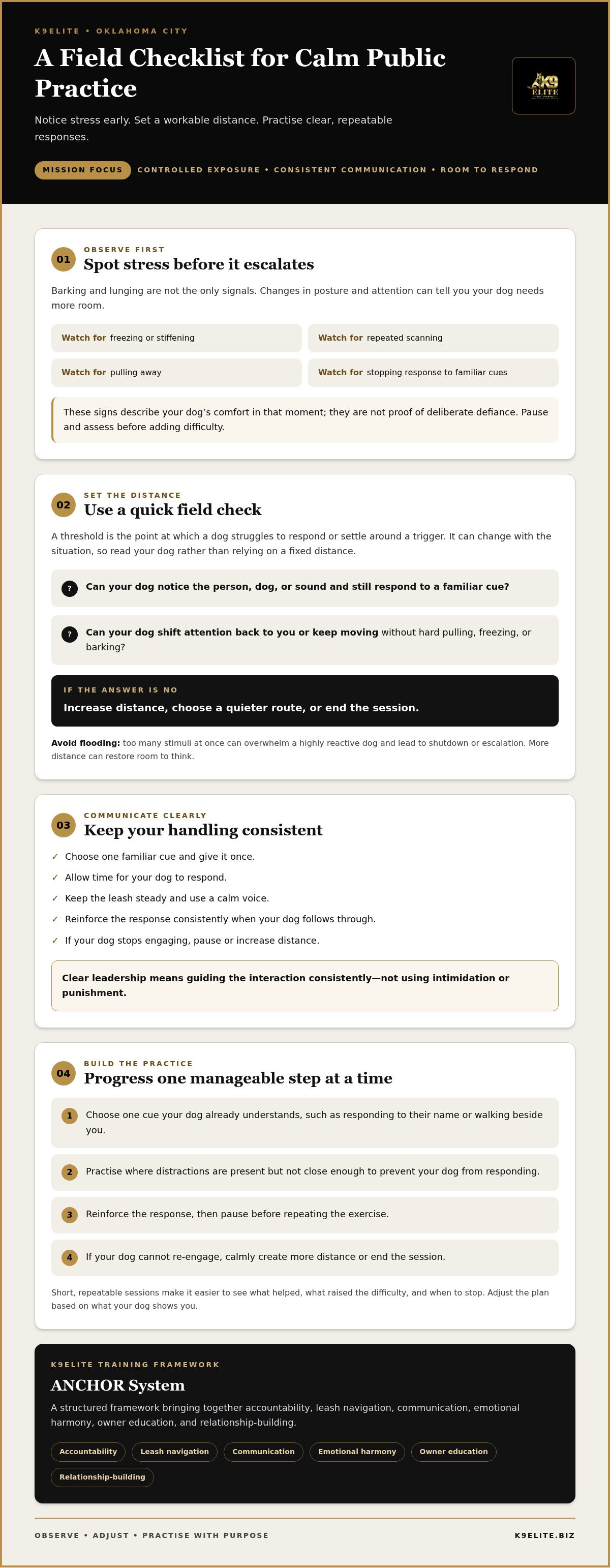
Watch for changes in posture and attention, not only barking or lunging. A dog may freeze, scan repeatedly, pull away, stiffen, or stop responding to familiar cues. These signs tell you about the dog’s comfort in that moment; they aren’t proof of deliberate defiance. Pause and assess before adding difficulty. If your dog locks onto a trigger or starts withdrawing, create more space instead of pressing forward.
Understand distance, thresholds, and the risk of flooding
A threshold is the point at which a dog struggles to respond or settle around a trigger. The distance can change with the situation, so observe your dog instead of relying on a fixed number of feet. Flooding is a training pitfall where a highly reactive dog becomes overwhelmed by too many stimuli at once, which can lead to shutdown or escalation. More distance can restore room to think and make practice safer and more productive.
Use a simple field check before moving closer: Can your dog notice the person, dog, or sound and still respond to a familiar cue? Can your dog shift attention back to you or continue moving without pulling hard, freezing, or barking? If not, increase distance, choose a quieter route, or end the session. That’s sound tactical judgment, not failure.
For owners learning how to have a calm dog in public Oklahoma City, the first objective isn’t a long visit to a busy place. It’s accurate observation. Note what appeared, how your dog responded, and whether your dog recovered after you changed the distance. This record helps you choose the next practice level without mistaking exposure for progress.
How Dogs Learn Calm Behavior Through Structure and Communication
Public calm develops through clear expectations and practice at a level your dog can manage. Choose a familiar cue, give it once, and allow time for your dog to respond. When your dog follows through, reinforce the response consistently. This creates a clearer pattern than changing cues, repeating commands, or expecting your dog to work through distractions that are already too intense.
Your handling is part of the communication. Keep the leash steady, use a calm voice, and respond promptly when your dog follows a cue. If your dog notices a distraction but can still focus on you, mark that moment with praise or another appropriate reward. If your dog stops engaging, pause or increase distance. Accountability means guiding the interaction consistently, not using intimidation or punishment.
Gradual practice builds more reliable public behavior by giving a dog repeated chances to respond successfully before the next challenge is added. For anyone learning how to have a calm dog in public Oklahoma City, the mission is to make each step clear, achievable, and easy to assess.
Use the ANCHOR System as a structured training framework
K9Elite’s ANCHOR System brings together accountability, leash navigation, communication, emotional harmony, owner education, and relationship-building. These connected elements help owners consider both the dog’s response and their own timing and handling. Leash navigation supports clear interaction, while owner education helps the handler apply consistent expectations during practice. The framework guides training while keeping the plan responsive to the individual dog.
Build consistency without overwhelming the dog
Keep practice focused. Work on one familiar cue at a time in a setting where your dog can notice activity and still re-engage. Short, repeatable sessions make it easier to see what helped, what raised the difficulty, and when to stop. Uncontrolled exposure can obscure those details and push a dog past a manageable level. Adjust the plan based on what your dog shows you.
Choose one cue your dog already understands, such as responding to their name or walking beside you.
Practise where distractions are present but not close enough to prevent your dog from responding.
Reinforce the response, then pause before repeating the exercise.
If your dog can’t re-engage, calmly create more distance or end the session.
Consistency doesn’t mean repeating the same exercise in every setting regardless of your dog’s response. It means keeping cues and expectations understandable while adjusting the challenge. A trainer can help tailor that structure through K9Elite’s dog training guidance, giving owner practice a clear direction while keeping it responsive to the dog.
Compare Ways to Practise Calm Behavior Around Public Distractions
The right practice setting depends on what your dog can manage now. Owner-led outings offer flexibility, group classes provide a shared learning environment, and individualized in-home coaching can help clarify behavior in your dog’s everyday surroundings. No option suits every dog. Choose conditions that let your dog remain responsive, and adjust the plan when behavior shows that the challenge is too high.
A group setting may be too difficult if your dog can’t respond to familiar cues, settle, or recover while other dogs are nearby. That doesn’t mean group training is unsuitable forever. It means the current mission may call for more distance or individualized preparation before adding the demands of a class. Match the setting to observed behavior, not to an ideal timeline.
When owner-led practice may be an appropriate starting point
Begin with one familiar cue and ample distance from a distraction your dog can notice without losing focus. Select a place with room to move away, and plan an exit before starting. If barking or lunging occurs, or your dog can’t recover after the trigger passes, stop increasing difficulty. Tailored guidance can help identify behavioral triggers and establish a safer starting point.
When individualized coaching can help clarify the next step
An in-home professional evaluation gives a trainer the opportunity to observe your dog’s behavior alongside the environment and routines where relevant patterns may appear. This context can inform which triggers to address first and how to set manageable practice conditions. K9Elite’s dog training evaluation in OKC connects that assessment to individualized guidance instead of a one-size-fits-all prescription.
As you decide how to have a calm dog in public Oklahoma City, use a simple field test: Can your dog notice activity and still respond or re-engage? If yes, continue at that level. If not, change the conditions before trying again. This keeps the decision grounded in your dog’s behavior and helps you choose the next step with purpose.
Follow a Step-by-Step Plan to Practise Calm Behavior in Public
Progress should be deliberate. Start in a quiet setting, then add one manageable challenge at a time. For owners learning how to have a calm dog in public Oklahoma City, the objective isn’t to stay in a busy place as long as possible. It’s to help your dog practise while remaining able to respond, and to adjust the plan when your dog needs more space.
Prepare the session before entering a public setting
Set a brief objective, such as calmly noticing one person walking past. Bring the familiar leash and rewards you already use in training. Choose a location with room to turn away or leave, rather than a narrow route where close encounters may be difficult to avoid. Keep the session focused so you can make steady decisions.
Begin in a low-distraction area. Practise a familiar cue where your dog can respond without competing activity nearby.
Add a distant public distraction. Move to a quiet spot where your dog can see activity from far enough away to remain responsive.
Notice and reinforce calm attention. When your dog observes a distraction and can still respond or turn back to you, acknowledge that response with a familiar reward.
Repeat at the same level. Practise the same simple objective before adding another challenge. Consistency gives you a clearer read on your dog’s response.
Increase difficulty gradually. Choose a busier setting or reduce distance only when your dog remains engaged at the current level. Change one factor at a time.
End or simplify when stress rises. If your dog becomes increasingly tense, stops responding, or can’t re-engage, increase distance, return to an easier setting, or leave.
Respond calmly when a behavioral trigger appears
As soon as a behavioral trigger appears, calmly guide your dog away to create space. Don’t pull your dog toward the trigger or force a greeting. Use a familiar cue only if your dog can attend and respond. If your dog can’t recover or safely re-engage, pause, reset at a greater distance, or end the session. A tactical retreat is the right call when conditions exceed your dog’s current ability.
Distance and consistency matter more than forced proximity. Your dog doesn’t need to get closer to every distraction to practise. Choose a distance that allows awareness without losing responsiveness. As skills develop, progress from quiet surroundings to more active public environments, using your dog’s behavior to guide each step.
If you need help setting a safe starting point or adjusting the plan, get individualized dog training guidance from K9Elite.
How K9Elite Helps Oklahoma City Owners Build Calm Public Behavior
Public behavior is shaped by what happens before and during an outing, including the dog’s environment, the handler’s communication, and the situations that prompt a response. K9Elite Dog Training provides in-home services in Oklahoma City, Edmond, Moore, Norman, and Midwest City. An in-home evaluation lets a trainer observe your dog in familiar surroundings and discuss your goals before setting training priorities.
Begin with an evaluation and a mission plan
A professional evaluation considers your dog’s behavior, surroundings, and behavioral triggers, along with your training priorities. Seeing your dog in the home environment can help clarify where a response begins and what conditions may affect practice. The assessment informs a customized mission plan, a roadmap for your dog’s behavioral needs rather than a fixed prescription applied to every dog.
That plan can give you a clearer starting point: which skills to practise, what conditions to adjust, and how to build toward public distractions at a manageable pace. If aggression is part of the concern, K9Elite’s aggressive dog rehabilitation in Oklahoma City provides focused behavior guidance. The aim is structured, balanced work that supports safer handling and consistent owner participation without relying on punitive methods.
Owners seeking how to have a calm dog in public Oklahoma City can use evaluation and training to connect home practice with real-world goals. The work doesn’t end with a cue performed in a familiar room. You also need to apply clear communication as the environment gradually becomes more demanding, while adjusting when your dog’s responses show that a step is too difficult.
Carry consistent skills into everyday life with lifetime support
Training requires owner practice beyond formal sessions. Use the agreed cues consistently, observe how your dog responds, and keep public practice within a level your dog can manage. Build on familiar skills before increasing distance challenges or environmental activity. If your dog struggles to re-engage, simplify the exercise and return to a workable starting point.
K9Elite provides lifetime support, ongoing assistance and resources after training sessions conclude. That continued guidance can help you maintain consistent communication and make thoughtful adjustments as everyday situations change. For foundational cues that support public handling, master dog obedience training in OKC offers relevant context for strengthening the owner-dog team.
Start with an evaluation that considers your dog’s behavior and environment, then use the mission plan to guide practice. Begin your dog training evaluation with K9Elite and build a structured path toward calmer public outings.
Set Your Dog’s Next Training Mission
Your next outing doesn’t need to be a test of how much your dog can tolerate. Treat it as a chance to build a steadier partnership, with clear priorities and a pace that respects your dog’s current ability. That is a practical foundation for learning how to have a calm dog in public Oklahoma City: make the next step achievable, then adjust based on what your dog shows you.
If you’re unsure where to begin, individualized guidance can turn concern about public encounters into a plan for purposeful practice. K9Elite’s training is led by Marine Corps veteran Coty Cortez and informed by over 15 years of hands-on experience. Take the next step with a plan built around your dog.
Schedule an in-home evaluation with K9Elite and begin setting clear, realistic training priorities. With consistent owner participation, your team can keep building confidence one manageable step at a time.
Frequently Asked Questions
Can a dog learn to stay calm in public without greeting people or other dogs?
Yes. Your dog can have a successful outing without any greetings. Decide on your greeting policy before you leave, then apply it consistently so your dog isn’t invited to approach on some outings and discouraged on others. A simple “We’re keeping moving” can help you decline an interaction without a lengthy explanation. This lets you focus on your dog and keeps social contact from becoming the measure of a good walk.
How do I know whether my dog is ready for a busier public setting?
Readiness depends on the specific setting, not on how many commands your dog knows. Before visiting a busy destination, consider a brief trial near its quieter edge and observe the full transition, including arrival and departure. A dog that manages one public setting may still find another too demanding. Owners working on how to have a calm dog in public Oklahoma City can assess each new environment on its own terms.
Should I let strangers approach my dog during public training?
You don’t need to allow strangers to approach or offer treats. Uninvited food can draw a dog toward someone before the dog is comfortable, so keep rewards in your own hands and deliver them yourself. If a person asks to interact, a brief response such as “Please don’t reach toward my dog” sets a clear boundary. You can decide later whether a particular greeting is appropriate for your dog.
What should I do if my dog suddenly barks or lunges at another dog?
Prioritize preventing contact. Keep a secure hold on the leash, turn away, and move toward open space rather than reaching between dogs or grabbing your dog’s collar during the reaction. Once separated, give both dogs room and don’t attempt an immediate second pass. If you can’t maintain control or another dog is close, focus on leaving safely instead of completing the planned walk.
Can a puppy learn calm behavior in public before mastering every obedience command?
Yes. A puppy doesn’t need a complete obedience repertoire before experiencing ordinary public sights and sounds. Keep early outings focused on observation rather than performance. For example, let the puppy watch people pass from a quiet location while you maintain a secure leash hold. Don’t ask for a difficult command simply to prove readiness. The aim is to keep new experiences within the puppy’s capacity to handle them.
How long does it take for a dog to become calmer in public?
There’s no fixed timeline, and progress may not follow a straight line. A dog may handle a familiar route well one day and need an easier outing another day. Rather than setting a deadline, choose practical goals that matter to your routine, such as completing a short walk without abandoning the route. Review those goals periodically and adjust them to reflect your dog’s actual performance.
Is a muzzle always necessary when training a reactive dog in public?
No. A muzzle isn’t needed for every reactive dog, and it doesn’t replace supervision or safe handling. If a muzzle is appropriate, introduce it outside a stressful encounter: let your dog inspect it, reward calm interest, and build toward brief voluntary nose placement before fastening it. Keep each introduction comfortable and stop if your dog shows distress. A professional can help determine whether muzzle conditioning belongs in your training plan.
Comments