
How to Stop Destructive Chewing in a Puppy in OKC
What if the goal isn’t to stop your puppy from chewing, but to teach your puppy what belongs in their mouth? If you’re learning how to stop destructive chewing puppy OKC households struggle with, start with a clear mission: protect your home while building better habits. Chewing is a normal way for puppies to explore, but that doesn’t make damaged furniture or belongings easier to manage.
You’re right to be cautious about corrections. Frightening or punishing a puppy can undermine trust without showing which choices are acceptable. A steadier plan combines supervision, puppy-proofing, suitable chew options, and calm redirection. Praise your puppy when they choose an appropriate item.
This guide explains why puppies chew, how to manage access to household items, and how to teach replacement behaviors with consistent follow-through. You’ll also learn when veterinary input may be needed and how an in-home dog training evaluation OKC can help identify your puppy’s behavioral triggers and shape an individualized mission plan. With structure and clear communication, you can protect your home while helping your puppy learn.
Table of Contents
Why Puppies Chew, and When Destructive Chewing Needs Attention in OKC
Destructive puppy chewing means repeatedly chewing household belongings instead of designated chew items. A puppy mouthing an object once is different from repeatedly targeting shoes, furniture, cords, or other items. The pattern, setting, and intensity can help you decide whether to improve management, practice new skills, or seek veterinary guidance.
Chewing and exploring with the mouth are common puppy behaviors. The goal isn’t to eliminate every urge to chew; it’s to notice what your puppy is practicing and guide that behavior toward appropriate items. In Oklahoma City homes, daily routines and access to tempting belongings can shape which habits take hold.
What can drive a puppy to chew household items?
Start by observing rather than assuming. Exploration, access to appealing objects, and unmet activity may all contribute to chewing, but none is a diagnosis. A puppy who finds a shoe within reach may return to it. Another may target items during a particular part of the household routine. Watch what the puppy chews, where it happens, and what is going on just beforehand.
Keep a short log for several days. Record the item, location, time, and whether an adult was supervising. Note whether the puppy had appropriate chew alternatives and opportunities for interaction or activity. A chew toy is designed to give dogs an item intended for chewing, but the right choice depends on the individual puppy. These observations can reveal possible behavioral triggers, meaning specific situations or stimuli linked to an unwanted response. They can also help distinguish a recurring household pattern from an isolated incident.
For owners asking how to stop destructive chewing puppy OKC routines can reinforce, the first tactical move is to identify the pattern before changing the plan. Use what you observe to adjust access, supervision, and routine. Don’t guess at the cause or treat every puppy’s chewing as the same problem.
When should an owner look beyond a training issue?
A recurring pattern of chewing household items may call for tighter management and consistent training. A sudden change deserves a different response. If your puppy appears to have mouth discomfort or chewing changes abruptly, contact a veterinarian for guidance rather than assuming it is only a training issue.
Suspected swallowing also warrants prompt veterinary advice, especially if you saw your puppy ingest an object or part of one. Don’t wait for training practice to address a possible health concern. A trainer can help assess learned behavior and the home setup, but veterinary assessment is needed for health concerns.
Keep the mission clear: observe, record, and respond to the right problem. Use management and teaching for repeated household patterns. Seek veterinary guidance when there’s a sudden change, apparent oral discomfort, or concern that your puppy swallowed something.
Prevent Destructive Puppy Chewing at Home in Oklahoma City
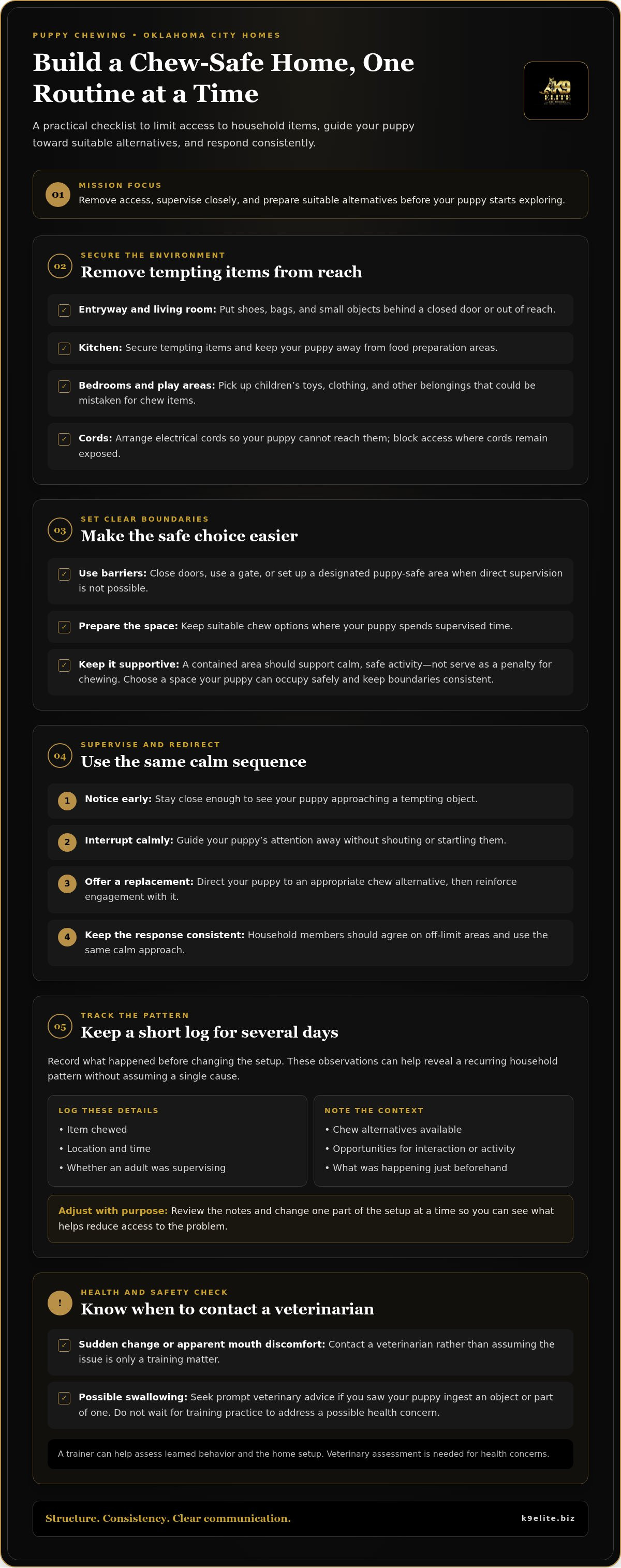
Set up your home so your puppy can make the right choice before a chewing opportunity becomes a repeated habit. Prevention is not punishment. It’s a tactical way to limit access, supervise learning, and make appropriate alternatives available. Remove access, supervise closely, and prepare suitable alternatives before your puppy starts exploring.
Set up a puppy-safe space without relying on correction
Work through your home one area at a time. In the entryway and living room, put shoes, bags, and small objects behind a closed door or out of reach. In the kitchen, secure tempting items and keep your puppy away from food preparation areas. In bedrooms and play areas, pick up children’s toys, clothing, and other belongings that could be mistaken for chew items.
Check cords: Arrange electrical cords so your puppy can’t reach them, and block access to spaces where cords remain exposed.
Use barriers: Close doors, use a gate, or set up a designated puppy-safe area when direct supervision isn’t possible.
Prepare the space: Keep suitable chew options in the area where your puppy spends supervised time.
A contained area should support calm, safe activity, not serve as a penalty for chewing. Choose a space your puppy can occupy safely, and keep the boundaries consistent. The ASPCA's guide to destructive chewing also discusses managing access and providing acceptable outlets for chewing.
Build a predictable supervision routine
Supervision means staying close enough to notice your puppy approaching a tempting object and respond calmly. If your puppy moves toward a shoe, step in, guide their attention away without shouting or startling them, and direct them to an appropriate alternative. Then reinforce engagement with that item. This gives your puppy useful information about what to do instead of reacting only after damage occurs.
Keep a brief household record of when and where chewing attempts happen. For example, note whether they occur near the entryway during a busy arrival or in a child’s play area when toys are left out. A pattern may point to a management gap or a routine that needs adjustment, but it doesn’t prove a single cause. Review your notes and change one part of the setup at a time so you can see what helps reduce access to the problem.
Every household member should follow the same response. Agree on which areas are off-limits, where your puppy’s alternatives are kept, and how to redirect calmly. Mixed signals make the home less predictable. A clear, repeated routine gives your puppy consistent guidance while adults maintain control of the environment.
To address how to stop destructive chewing puppy OKC households are facing, start with these management steps and adapt them to your puppy’s routine. If setting consistent boundaries at home remains difficult, K9Elite’s in-home dog training helps owners build structure and follow-through in the environment where chewing occurs.
How to Teach a Puppy What to Chew Instead
Management prevents many opportunities to chew household belongings. Training teaches your puppy what to do when an opportunity appears. Use the same sequence each time: notice the choice, redirect calmly, offer an appropriate alternative, and reinforce your puppy for engaging with it. Timing matters. The closer your response is to your puppy’s choice, the easier it is to connect the alternative with your guidance.
Use redirection to make the right choice clear
Keep practice brief and supervised. If your puppy begins chewing an unsuitable object, interrupt calmly with a consistent cue, then present a suitable chew item. Avoid shouting, scolding, chasing, or pulling the object away in a way that turns the moment into a game. As soon as your puppy engages with the alternative, offer calm praise or another appropriate form of reinforcement.
Repeat the sequence with steady timing:
Notice the choice: Step in when your puppy approaches or begins chewing a household object.
Redirect calmly: Use the same brief cue and guide your puppy’s attention away without creating excitement.
Offer an alternative: Present a chew item that suits your puppy and the supervised setting.
Reinforce the new choice: Acknowledge your puppy’s engagement with the appropriate item.
If your puppy returns to the household object, don’t escalate the correction. Increase supervision, make the object inaccessible, and reset the practice with the alternative. Repeated access to the unsuitable item gives your puppy more chances to rehearse that choice.
Make the learning consistent across the household
Every person in the home should follow the same sequence and use the same calm cue. Agree on the cue, where your puppy’s alternatives are kept, and how each person will respond. Consistency gives your puppy clear direction instead of a different reaction from each household member.
After practice, note a few details: the object involved, the location, and what was happening at the time. For example, record whether your puppy approaches a table leg during family activity or picks up an item left on the floor. These notes can show whether changes in supervision and access are reducing opportunities or whether the plan needs adjustment. Progress depends on repeated practice, so stay consistent.
Chewing and mouthing aren’t identical. Mouthing is contact with a person using the puppy’s mouth, while chewing is directed at an object. If your puppy’s behavior includes mouthing people, the puppy biting training guide addresses that related but distinct concern. For owners learning how to stop destructive chewing puppy OKC households are dealing with, the mission is to make the appropriate choice clear and repeatable, then follow through each time.
Compare Chewing Management Options Without Using Punishment
Choose management tools based on their purpose: preventing access, supporting supervision, or giving your puppy an appropriate item to chew. No single option fits every puppy or household. A practical plan may combine methods, then adjust based on what you observe.
Which management option fits the situation?
Use close supervision when you can focus on your puppy and intervene calmly. If you need to shift attention to cooking, a call, or another task, use a barrier or designated safe area to prevent access to household items. Keep suitable chew alternatives in that space, and observe how your puppy engages with them. Don’t assume one barrier or chew item will work equally well for every puppy.
Assess the setup regularly. If your puppy can still reach a tempting object, change the environment rather than relying on repeated interruption. If a chew alternative isn’t holding your puppy’s attention, consider whether the item and setting suit them, and continue active supervision.
Why punishment does not teach an appropriate alternative
The skill your puppy needs is selecting an approved item. Yelling, intimidation, or punishment may interrupt a moment, but it doesn’t clearly show your puppy what to choose instead. A calm interruption followed by an appropriate alternative and reinforcement gives more direct information: this item is available for chewing, and engaging with it is the desired behavior.
Keep your response steady. If your puppy returns to the unsuitable object, calmly prevent further access and reset the situation. Don’t chase your puppy or turn the object into a contest. Also avoid flooding, exposing a puppy to too many household stimuli at once in a way that overwhelms them. Instead, manage the environment and practice choices in a calm, supervised setting.
Owners learning how to stop destructive chewing puppy OKC homes can support the lesson by matching the tool to the moment and applying the same response consistently. For individualized guidance on building a structured plan at home, request an in-home dog training evaluation.
When Puppy Chewing Persists: In-Home Training Support in OKC
Sometimes household management and consistent practice aren’t enough to change a chewing pattern. Consider individualized help if your puppy repeatedly targets belongings despite restricted access, close supervision, and calm redirection, or if you can’t identify what tends to happen before the behavior. These signs don’t establish a cause. They indicate that it may help to take a closer look at your puppy’s routine and environment.
In-home coaching offers a home field advantage: a trainer can observe where your puppy chews, how household routines unfold, and which objects or situations may be relevant behavioral triggers. That context helps distinguish a management gap from a skill that needs more structured practice. It also lets you work on consistent responses where the behavior actually occurs.
What an individualized mission plan can address
A professional evaluation can include observing your puppy, household routines, access to tempting items, and your current response when chewing starts. Together, those details inform a mission plan tailored to the situation. You receive structured guidance for practicing clear, consistent responses at home, with attention to the patterns observed during the assessment.
K9Elite’s training framework is called the ANCHOR System. It keeps your role central: clear communication and consistent follow-through are part of the work, not an afterthought. The objective is to give your household a practical course of action without relying on intimidation or assuming every puppy responds to the same setup.
Take the next step with K9Elite in the OKC area
K9Elite provides veteran-led, science-based in-home behavior support throughout Oklahoma City, Edmond, Moore, Norman, and Midwest City. Founded by Marine Corps veteran Coty Cortez, K9Elite brings over 15 years of hands-on training experience to disciplined, supportive coaching. The focus is helping owners understand their puppy’s behavior and apply a consistent plan at home.
If you’ve followed a management and practice routine but chewing episodes continue, an individualized assessment can help clarify what to adjust. A trainer can observe your puppy in the home environment, discuss the patterns you’ve recorded, and help develop a mission plan for consistent practice. K9Elite also provides lifetime support after training, so you can continue seeking guidance as you apply what you’ve learned.
For owners weighing how to stop destructive chewing puppy OKC households are experiencing, start with an assessment built around your puppy and home. Schedule an in-home dog training evaluation to take the next step toward a clear, structured plan.
Build the Next Phase of Your Puppy’s Training
Your puppy’s next lesson begins with the routine you maintain. Keep a simple record of the choices you want to encourage, and use it to guide household practice over time. Small, consistent decisions help you see where your plan is working and where it may need adjustment.
Learning how to stop destructive chewing puppy OKC households face is part of a broader foundation: helping your puppy respond to clear guidance in everyday situations. If you’re ready to build that foundation beyond this specific behavior, explore K9Elite’s training options and consider which form of coaching best fits your goals.
Explore K9Elite’s dog training programs and choose a focused next step for your puppy. Keep leading with patience and consistency; each practice opportunity can strengthen the habits you’re building together.
Frequently Asked Questions
Is destructive chewing normal for puppies?
Chewing is common, but the specific pattern matters. Note whether your puppy seeks one type of object, chews only in a certain room, or damages items in several settings. A brief record can help you spot changes and make practical decisions about the home setup. If chewing involves a dangerous object or causes injury, prioritize safety and consult a veterinarian about any health concern.
Can teething cause a puppy to chew household items?
Teething may contribute to chewing, but it doesn’t tell you which item is suitable or whether discomfort has another cause. Offer an appropriate alternative and observe whether your puppy can chew and eat comfortably. Contact your veterinarian if you notice persistent mouth sensitivity, trouble eating, or another change that concerns you. A veterinarian can assess health questions that training alone can’t answer.
How do I stop my puppy chewing when I am not home?
Before leaving your puppy alone, test the planned setup while you’re home. Check that the space is secure, remove anything your puppy could reach and damage, and observe whether your puppy settles without distress. Make changes before relying on the setup during an absence. If your puppy remains unsettled or the arrangement isn’t safe, ask your veterinarian or a qualified trainer for guidance tailored to your puppy.
What should I do if my puppy swallows something it chewed?
Call your veterinarian promptly and describe the object, the amount that may be missing, and when the swallowing may have happened. Keep any remaining pieces or a clear photo available to help identify the material. Don’t induce vomiting or give medication unless a veterinarian directs you to do so. If your puppy appears unwell, report those signs during the call and follow the veterinarian’s instructions.
Should I punish my puppy for chewing furniture?
No. A correction after you discover damage may come too late for your puppy to connect it with the earlier chewing. Focus on preventing access to the furniture when you can’t supervise and arranging the space so an appropriate choice is available. If you find damage after the fact, secure the area and adjust the setup; avoid confronting or frightening your puppy.
When should I get professional help for destructive puppy chewing in OKC?
Consider professional help if your records show the same pattern continuing despite steady household practice, or if you’re unsure how to adapt the plan to your puppy. Before an evaluation, write down when episodes happen, which items are involved, what was happening beforehand, and what responses you tried. These details give a trainer useful context for individualized guidance in your Oklahoma City home.


Comments