
My Dog Is Scared of Everything: Calm, Practical Help in OKC
If you’re thinking, “my dog is scared of everything,” help in OKC starts with noticing what happens before fear escalates. Freezing, turning away, scanning the area, or refusing food can signal rising stress. These behaviors are information, not stubbornness. Your dog is showing you that the situation feels difficult to manage.
Unclear behavioral triggers can make walks, visitors, and ordinary routines feel unpredictable. You may wonder whether comforting your dog will reinforce fear or whether more exposure will help. Forcing a frightened dog to stay close to a trigger can lead to shutdown or escalation. Instead, stay calm, create distance, and give your dog room to recover.
This guide explains how to recognize early fear signals, respond consistently at home and around Oklahoma City, and choose practical next steps without rushing your dog. If fear appears suddenly or changes sharply, a veterinary conversation may be appropriate. K9Elite’s in-home approach uses the home field advantage to observe your dog’s everyday environment and build a structured mission plan around the behavior you’re seeing.
Table of Contents
Why Does My Dog Seem Scared of Everything in Oklahoma City?
Fear is an observable response to something a dog perceives as threatening or difficult to manage. A dog that avoids a person, sound, surface, or place may be trying to increase distance, not refusing a command to challenge you. Start with three questions: What happened just before the response? What did your dog do? What helped your dog recover?
Several factors may contribute, including a dog’s history, health, temperament, and surroundings. A single behavior does not establish the cause. Pain or another health change can affect behavior, so discuss sudden fear or a sharp change with your veterinarian rather than assuming it is only a training issue. For owners searching “my dog is scared of everything help OKC,” careful observation is a practical first step, not a diagnosis.
Behavioral triggers are specific situations or stimuli that provoke an unwanted response in a dog. One trigger might be a rolling trash bin; another might be a person approaching while the dog is confined. This introduction to dog behavior and fear offers general context, but your dog’s response needs to be understood in its own setting.
What fear can look like before it escalates
Look for a pattern rather than relying on one clue. Your dog may retreat, become still, lower the body, tuck the tail, or repeatedly avoid a route or person. Read posture, movement, facial tension, and the situation together. If your dog pauses on a particular floor, for example, consider the surface, a nearby sound, or something visible through a window. Don’t assign a cause from that moment alone.
Why a familiar home or backyard may still feel unsafe
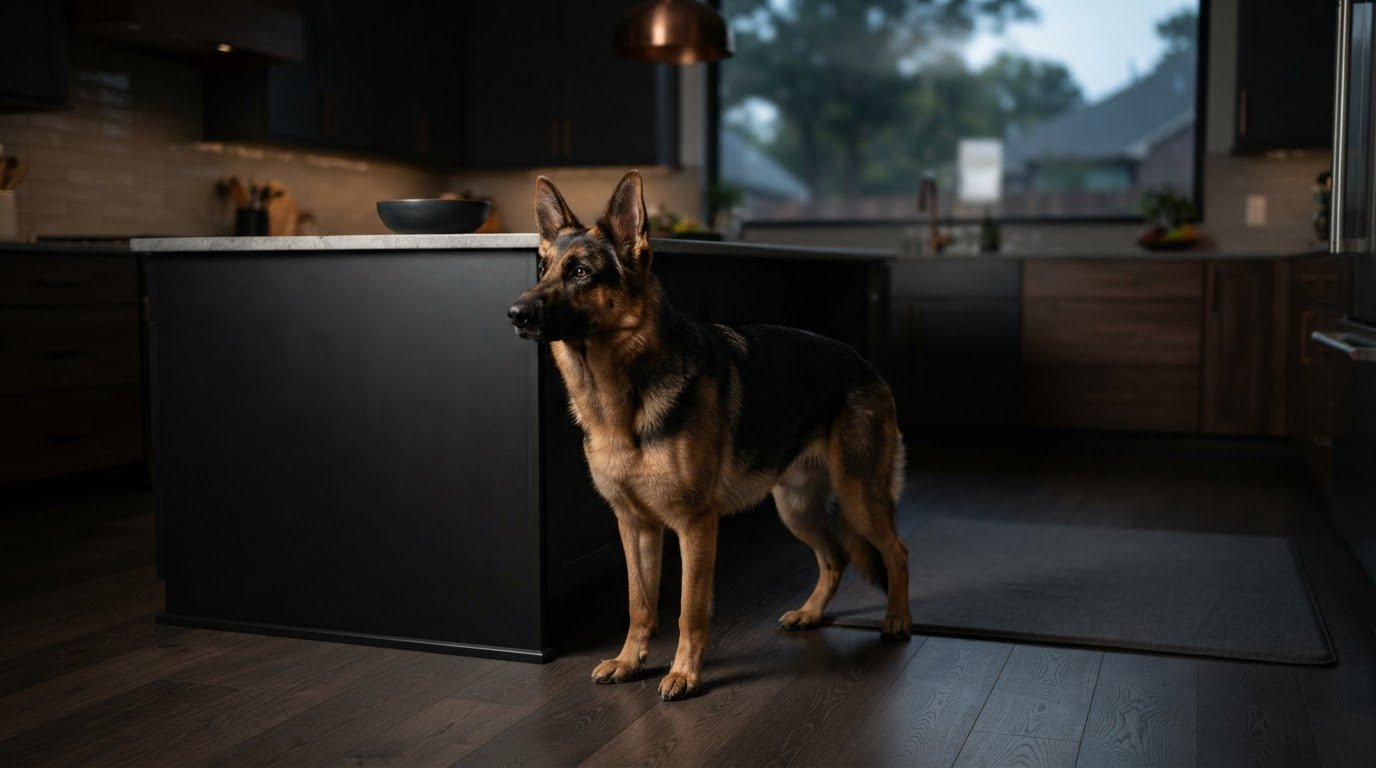
A familiar place can still contain unexpected events. A backyard may have new sounds, moving shadows, changed surfaces, people passing by, or equipment operating nearby. In an Oklahoma City home, note what was present when your dog’s behavior shifted, including activity beyond the fence. Don’t assume trauma or limited socialization is the cause without a professional behavioral assessment.
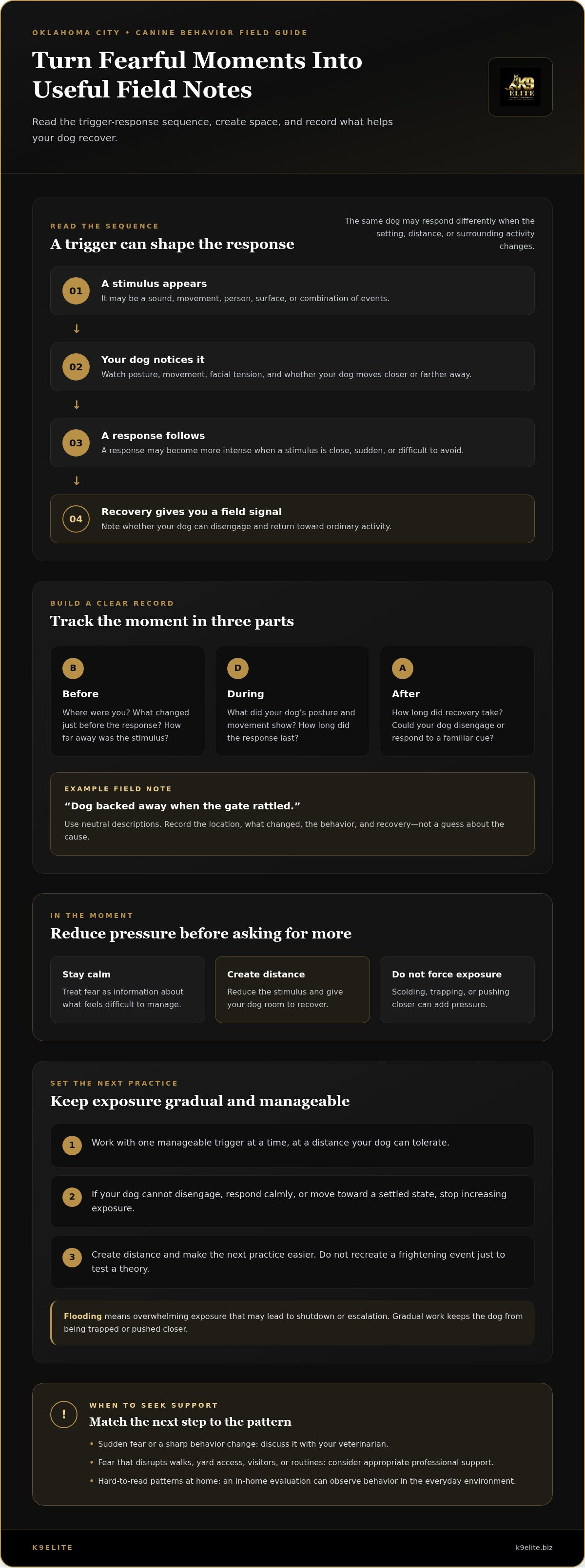
Keep a simple observation log. Record the location, what changed just before the response, your dog’s posture, whether your dog moved closer or farther away, and how long it took to return to ordinary activity. Neutral descriptions are more useful than labels. “Dog backed away when the gate rattled” gives you something specific to review.
Look for repeated patterns across days and settings, but don’t stage a frightening event to test a theory. If fear disrupts walks, yard access, visitors, or other routines, seek appropriate support. K9Elite’s in-home evaluation provides the home field advantage: a trainer can observe your dog where everyday triggers occur and use those observations to shape a mission plan.
How Fear and Behavioral Triggers Shape a Dog’s Response
A trigger-response sequence can make a seemingly unpredictable reaction easier to understand. A stimulus appears, your dog notices it, and a response follows. That response may become more intense when the stimulus is close, sudden, or difficult to avoid. More distance, a predictable routine, or a clear path away may make the situation easier to manage. The same dog can respond differently depending on the setting and what else is happening.
Triggers can include sounds, movement, people, surfaces, or combinations of events. A dog might react to someone approaching while a gate rattles, yet remain composed when the person is farther away and the setting is quiet. Trigger notes reveal patterns, not a diagnosis. They help you describe what you observe without deciding on a cause too soon.
Map the trigger without overwhelming your dog
After an incident, make brief, factual notes. Record what happened just before the response, where it occurred, and what your dog did. Include the distance from the stimulus, how long the response lasted, how long recovery took, and whether your dog could disengage or respond to a familiar cue. This detail is more useful than a broad label such as “afraid of people.”
Before: What changed in the environment?
During: What did your dog’s body and movement show?
After: Could your dog settle and return to ordinary activity?
Review your notes for recurring conditions, but don’t repeatedly recreate an upsetting event to confirm a pattern. If behavior changes suddenly or has no clear explanation, consult your veterinarian. Health concerns can affect behavior, and a concise log can help you describe the change.
Why flooding can increase pressure
Flooding is overwhelming exposure to a trigger that may lead to shutdown or escalation. Forcing a frightened dog to stay close to a stimulus until the dog “gets used to it” can add pressure rather than build confidence. Gradual work is different: keep the trigger at a tolerable distance and let your dog notice it without being trapped or pushed closer.
Use your dog’s recovery as a field signal. If your dog can’t disengage, respond calmly, or return toward a settled state, stop increasing exposure. Create distance and make the next practice easier. If you’re searching “my dog is scared of everything help OKC,” a structured in-home evaluation can help identify patterns in your dog’s own environment. An in-home behavior evaluation gives you a practical starting point when the pattern is difficult to assess alone.
What Should You Do When Your Dog Is Afraid in OKC?
Fear can intensify when a dog feels trapped or pressured. Your immediate task is to make the situation safer, not to make your dog approach the trigger. Follow this sequence: create space, reduce the stimulus, observe recovery, then record what happened. A dog who can move away and settle has more room to make a calmer choice than a dog held in a close encounter.
Create space. Move away from the person, dog, sound, or object when you can do so safely. Keep your movements controlled and avoid tightening the leash suddenly.
Reduce the stimulus. Use distance, a visual barrier, or a quieter location. Don’t pull your dog toward the trigger for a closer look.
Observe recovery. Give your dog time to settle. Notice whether your dog can look away, move normally, or respond to a familiar cue.
Record the event. Note the setting, what happened, your dog’s response, and what helped. Keep the description factual.
Scolding, forced greetings, and insisting that a dog “face the fear” can add pressure. Calm handling communicates that you’ll manage the situation without demanding contact. You can support safety without asking your dog to approach, sniff, or accept attention.
Create distance and restore predictability
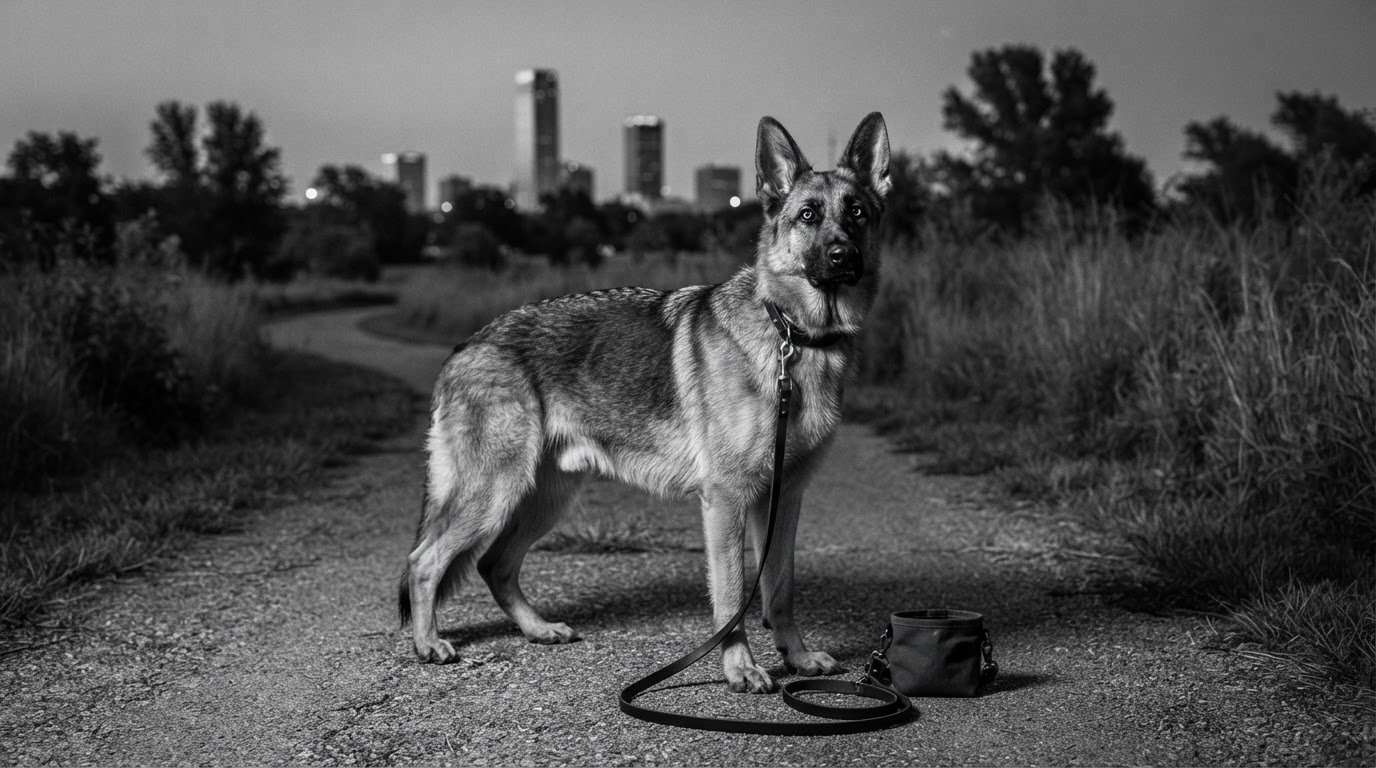
On an Oklahoma City walk, cross the street, turn down a quieter block, or pause behind a visual barrier if that creates room. Choose less busy routes or times when practical. Keep your dog secured with steady leash handling, and avoid narrow paths or crowded entrances where a close encounter is hard to prevent. The goal is a manageable outing, not maximum exposure.
Reward calm observation without forcing contact
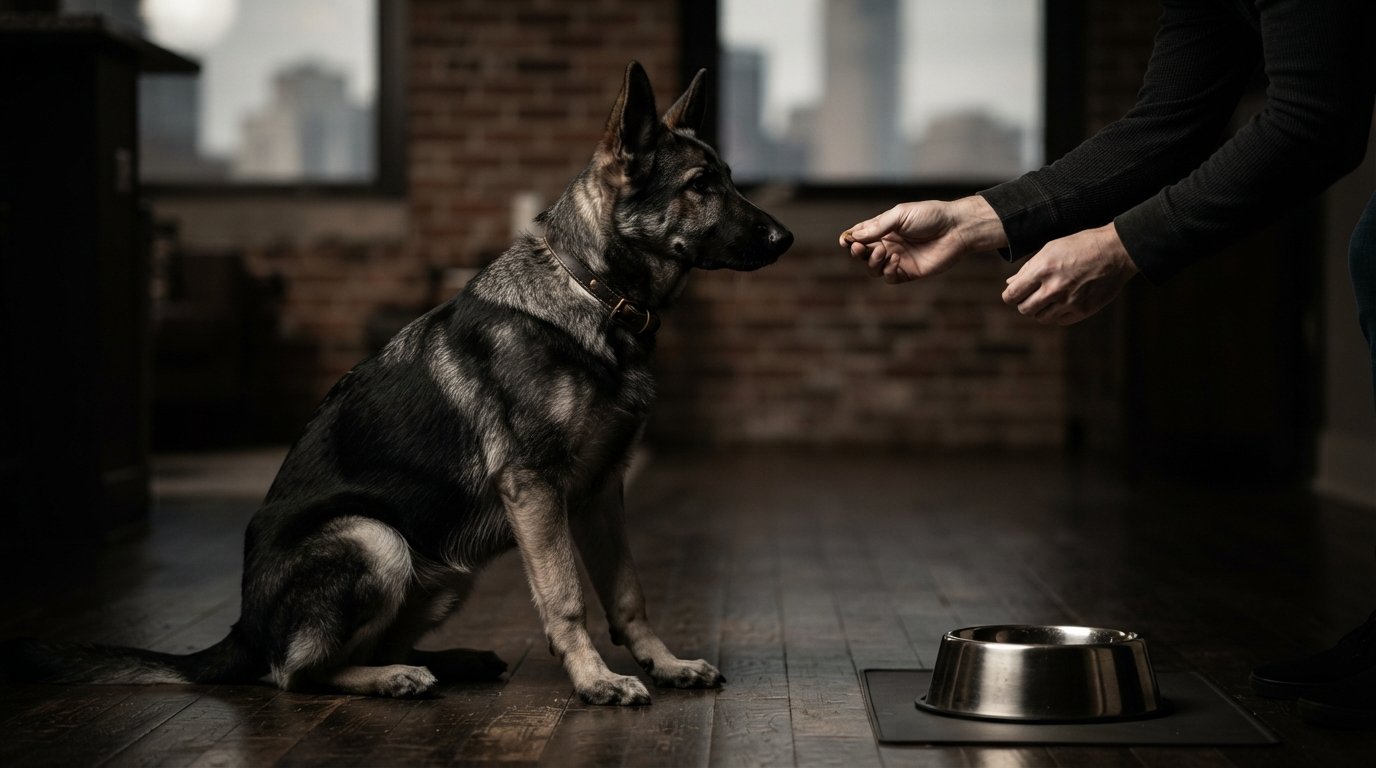
If your dog can notice a trigger and remain composed, calmly reward voluntary attention toward you, disengagement, or relaxed observation. Keep practice brief and finish while your dog can still recover. Don’t wait for stress to build, and don’t lure your dog closer to earn a reward. Progress means your dog can recover more readily and has room to choose distance, not that your dog must greet or stand near the trigger.
Practice should stay gradual and below your dog’s overwhelm point. If your dog freezes, repeatedly tries to retreat, or can’t respond calmly, increase distance and end the attempt. That is a tactical adjustment, not a failure. If you’re thinking, “my dog is scared of everything help OKC,” consistent responses can make daily decisions clearer while you identify the next step.
If fear repeatedly disrupts routines or feels difficult to manage safely, an in-home evaluation can put your observations into context. K9Elite’s in-home behavior modification support starts in your dog’s everyday environment, where specific challenges can be assessed as part of a structured plan.
Build a Gradual Fear-Reduction Plan for Home and Everyday Outings
A useful plan has a defined start, purpose, and finish. Choose one situation to work on and decide what a successful session looks like before you begin. For example, success might mean your dog stays engaged with you while a household member performs a familiar activity. Keep the goal observable and modest. A greeting or close approach does not need to be the mission objective.
Gradual exposure means introducing a trigger in a controlled way and changing the challenge in small steps. Counterconditioning pairs the trigger with something positive to help your dog form a more favorable association. For instance, a family member might make a low-level version of a sound while you offer a reward, then end the practice while your dog can still participate. The right pace depends on your dog, so don’t advance by calendar alone.
Start below the dog’s overwhelm point
Prepare the space and materials before practice so you can stay calm and consistent. Use a brief session with one clear objective, then stop while your dog is still participating. If your dog shows increasing stress or cannot engage, make the next session simpler rather than repeating a harder version. Build the challenge gradually, changing one part of the setup at a time.
Use consistency to support learning
Agree on a shared household plan: who leads practice, what cue marks the start, what reward to use, and when the session ends. Consistent expectations prevent family members from making the exercise harder in different ways. Review the plan regularly and adjust based on how your dog handles the current step.
Practice should eventually fit the places and routines your dog encounters, from activity inside the home to ordinary outings around Oklahoma City. Familiar obedience cues can support transitions and clear communication, but they should not push a dog through distress. K9Elite’s in-home training brings practice into your dog’s everyday setting. If you need help shaping a mission plan, request an in-home evaluation.
When to Seek Fearful-Dog Training Help in Oklahoma City
Consider professional help when your dog’s avoidance persists, ordinary routines are shrinking, or you can’t manage a response safely. Examples include repeatedly refusing to leave the house, struggling to pass familiar places, or becoming difficult to guide away from a trigger. These patterns don’t mean you’ve failed. They indicate that your current plan may need a clearer assessment and structured support.
Separate health questions from training questions. If fear appears suddenly, changes sharply, or has no clear pattern, speak with your veterinarian. Pain or another health concern can affect behavior. Training can address learned responses and behavioral triggers, but a trainer’s assessment isn’t a medical diagnosis. When a health concern may be involved, a veterinary conversation is a sound first step.
What an in-home professional evaluation helps clarify
An in-home evaluation lets a professional observe your dog where daily routines unfold. That home field advantage can reveal details that are hard to reproduce elsewhere, such as where your dog hesitates, what happens near a doorway, or how household activity affects a response. K9Elite’s evaluation considers your dog’s behavior, triggers, and home environment as a structured starting point, not an instant solution.
The observations inform an individualized mission plan for you and your dog, with clear priorities for practice and consistent handling. Learn what a dog training evaluation in OKC involves and how it can help organize the next steps.
How K9Elite supports structured follow-through
Assessment is only the start. K9Elite’s ANCHOR System is a structured framework that blends accountability, leash navigation, communication, emotional harmony, owner education, and relationship-building. In behavior modification, K9Elite uses science-based, balanced methods without relying on punitive responses. The plan reflects what your dog can manage and gives you practical direction for applying consistent skills in daily routines.
Follow-through depends on repetition, clear communication, and adjustments based on your dog’s response. K9Elite also provides lifetime support, ongoing assistance and resources after training sessions conclude. This gives you continued guidance as you practice and encounter familiar challenges in everyday settings.
If you’re asking, “my dog is scared of everything help OKC,” a professional evaluation can turn scattered observations into a focused plan. To discuss an evaluation for your dog, connect with K9Elite.
Set Your Dog’s Next Step With a Clear Mission
Progress begins with a realistic objective, not a demand that your dog feel comfortable everywhere at once. Choose one daily situation that has become difficult and decide what a safer, more manageable version would look like. A clear target can help you move from reacting to each incident toward a consistent plan for your dog and household.
If you need help because your dog is scared of everything in OKC, K9Elite can help identify a structured next step through an in-home evaluation. Founded by Marine Corps veteran Coty Cortez, K9Elite brings over 15 years of hands-on training experience to in-home services across Oklahoma City, Edmond, Moore, Norman, and Midwest City.
Connect with K9Elite about an in-home evaluation and start building a plan around your dog’s needs and real environment. A steady mission, guided by observation and consistent practice, gives you a practical way forward.
Frequently Asked Questions
Can I comfort my scared dog, or will that reward the fear?
Comforting your dog doesn’t reinforce the emotion of fear. Keep your response low-key and predictable: use a familiar phrase, avoid leaning over your dog, and let your dog choose whether to stay nearby or move away. Once the immediate moment passes, return to a simple, familiar activity. For example, guide your dog toward a quiet resting area rather than adding excited praise, repeated petting, or a crowd of concerned family members.
What should I do if my dog suddenly becomes afraid of familiar things?
Arrange a veterinary conversation and prepare a concise timeline of the change. Note when you first noticed it, which familiar activities are affected, and whether other changes appeared in appetite, sleep, movement, or tolerance for handling. These details help your veterinarian understand the broader picture. Don’t try to recreate the event for proof. If useful, share a safely recorded clip of behavior that occurs naturally.
Can an adult dog become more confident around people and new places?
Yes, adult dogs can learn new responses, though each dog’s progress differs. Set a practical measure that doesn’t depend on social contact, such as pausing with you outside a new location or resuming a familiar cue afterward. A predictable routine can make unfamiliar settings easier to assess. Set expectations for your dog rather than comparing progress with another dog’s behavior or age.
What happens if my dog is afraid of the backyard?
Make necessary yard trips easier to manage while you determine a longer-term plan. Accompany your dog, use a consistent exit and return routine, and keep the trip focused on the immediate need rather than extended exploration. If one part of the yard seems difficult, use another accessible area temporarily when possible. Record which routine works so household members can handle outings consistently while you assess what support is needed.
Should I make my fearful dog meet strangers to help with socialization?
No, a stranger’s greeting isn’t a required measure of socialization. Before visitors arrive, tell them not to reach toward your dog or block the dog’s route. Set up a place where your dog can remain separate from the interaction, and keep the visit orderly. Your dog can gain useful experience by remaining at ease in the same environment without direct contact. Respecting that choice keeps the interaction manageable.
How can I tell whether my dog is afraid or just being stubborn?
Compare the same request in different settings before drawing a conclusion. If your dog responds to a familiar cue in a quiet room but not near a particular doorway, the setting may affect the response. Also consider whether your dog understands the cue and has practiced it there. This comparison won’t diagnose fear, but it can show where communication or training needs more support.
When should I seek professional help for a fearful dog in Oklahoma City?
Seek professional help when you’re changing household routines to avoid recurring problems, when progress has stalled, or when handling the situation safely is difficult. Before an evaluation, write down which routines are affected, what you’ve tried, and what you need your dog to do more comfortably. K9Elite’s in-home evaluation considers your dog’s behavior and surroundings, providing a practical starting point for a mission plan.
Comments