
My Dog Won’t Listen to Me Anymore in OKC? A Structured Plan
What if your dog isn’t choosing to ignore you, but responding to cues that have become unclear in a distracting setting? If you’re thinking, my dog won't listen to me anymore OKC, repeated commands can make home and outdoor routines frustrating fast. A change in responsiveness may reflect distractions, inconsistent communication, stress, or a shift in behavior. Treat it as a reason to observe carefully, not to use a harsher correction.
Look beyond the label of “disobedience.” Identify what has changed, then make communication more consistent and safe. Start by giving a cue once, reducing distractions, and acknowledging the response you want. If your dog’s behavior has changed suddenly or includes reactivity, avoid forcing close contact and seek a professional evaluation.
This article covers common reasons dogs miss cues, practical steps to clarify your signals, and when an in-home evaluation can help. K9Elite provides veteran-led, science-based training in Oklahoma City, where your dog’s home environment and behavioral triggers can inform the plan. That home field advantage helps put the concern in context and identify a practical next step.
Table of Contents
My Dog Won’t Listen to Me Anymore in OKC: What Changed?
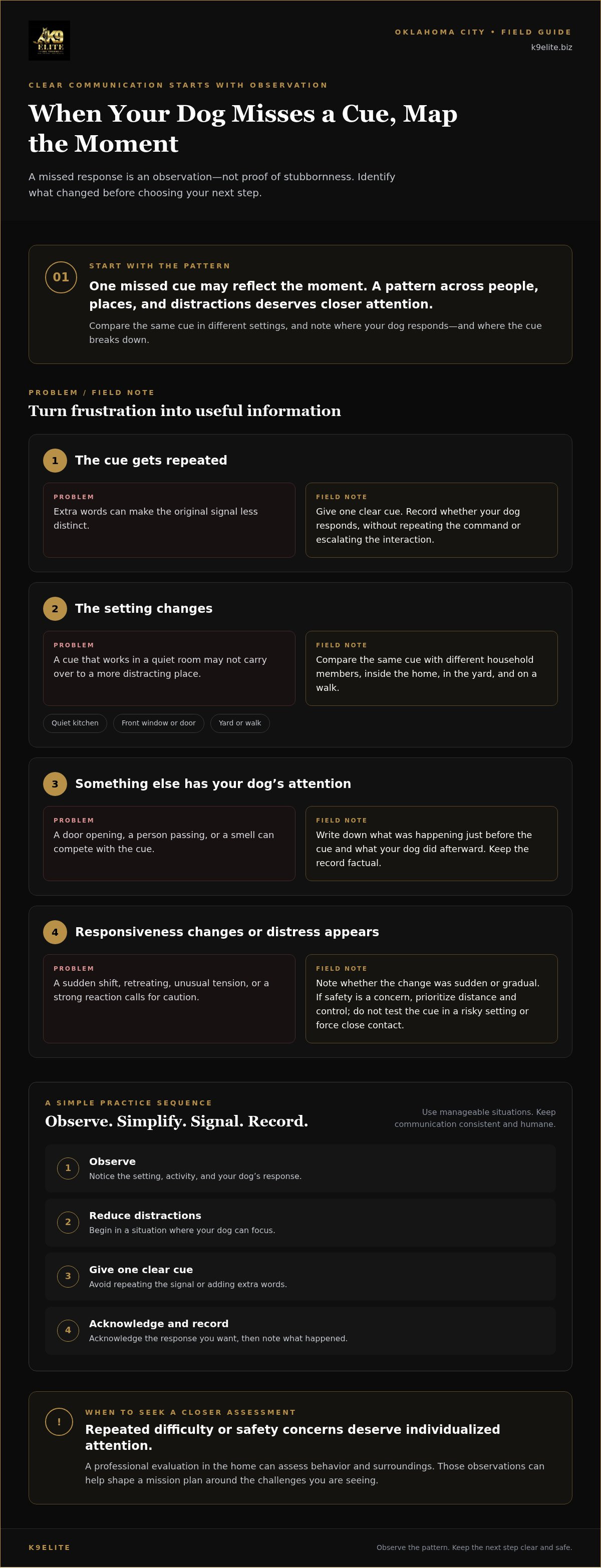
Repeating “come,” “leave it,” or “sit” without getting a response wears down patience and can make everyday routines tense. If you’re thinking, “my dog won't listen to me anymore OKC,” start with a clear distinction: reduced responsiveness is something you observe, not a diagnosis or proof that your dog is stubborn. A missed cue is one moment. A pattern across people, places, and distractions deserves closer attention.
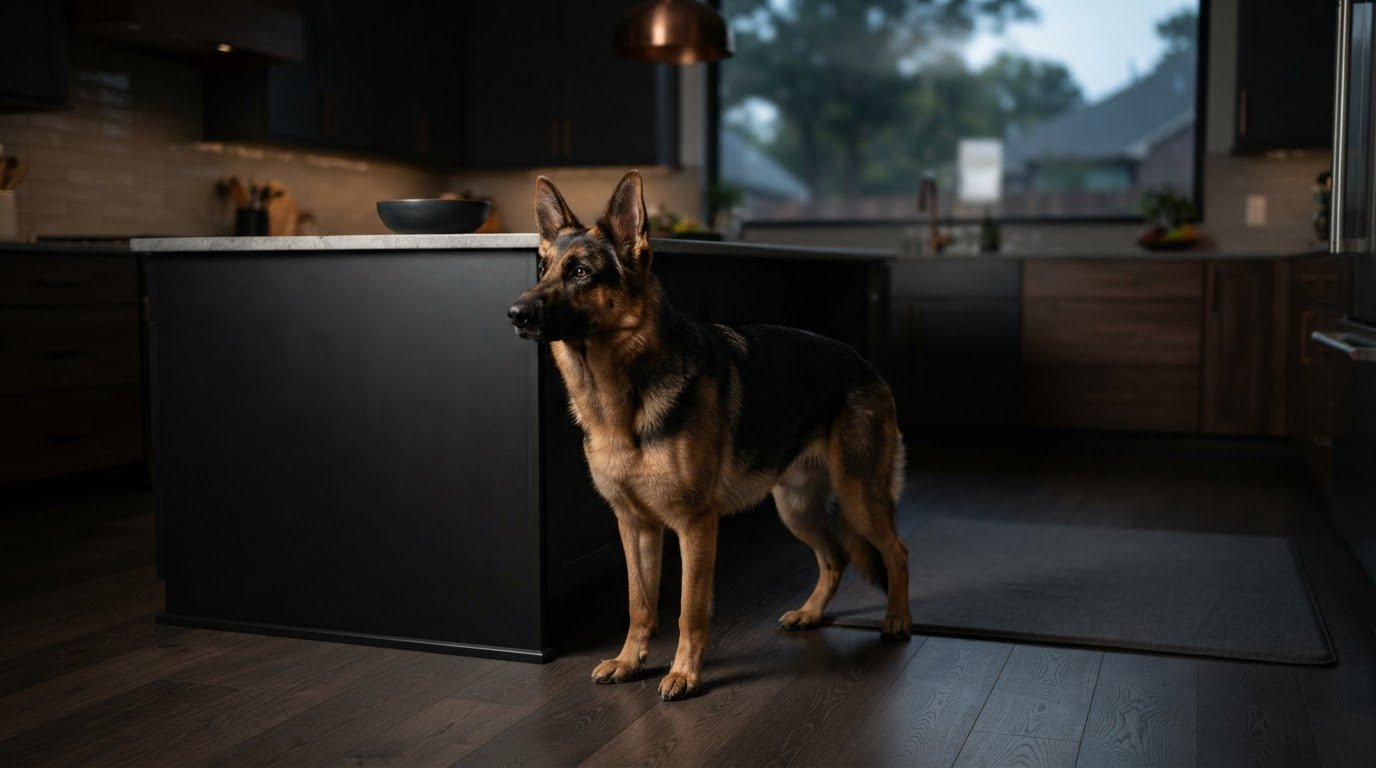
Context matters. Your dog may respond to “come” in a quiet kitchen but not when the back door opens or a walk brings new sights and sounds. Compare the same cue with different household members, in the yard, and on a walk. Record where your dog responds and where the cue breaks down. That comparison helps identify the context instead of assigning blame.
How to describe the listening problem clearly
Keep a short, factual record. It can help you spot patterns and explain the concern during a professional discussion. For each missed cue, note:
The cue: Record which signals your dog responds to reliably and which are being missed.
The setting: Identify whether it happens inside the home, in the yard, or during walks.
The surrounding activity: Describe what was happening just before the cue, such as a door opening, a person approaching, or your dog focusing on a smell.
The response afterward: Note what your dog did next and what you did, without interpreting the behavior as deliberate defiance.
For example, “didn’t come” is less useful than “I called once from the kitchen while my dog watched a person pass the front window; the dog stayed by the window.” That detail captures the cue, setting, and competing event. It gives you a practical starting point for understanding your dog’s behavior. General Dog training methods and principles can offer background, but the pattern in your own home is what matters for this observation.
When a change deserves closer attention
Compare today’s behavior with your dog’s usual baseline. Has your dog stopped responding to one cue in one setting, or has responsiveness changed across familiar routines and people? Note whether the shift appeared suddenly or developed gradually. A single missed cue may reflect the immediate situation. A broader change is useful information to discuss with a professional.
Also record signs of fear or distress, such as trying to retreat, becoming unusually tense, or reacting strongly to a particular situation. If the behavior creates a safety concern, don’t test the cue in a risky setting or move closer to force a response. Prioritize distance and control, then bring your notes to a qualified professional. Accurate observations are the first tactical step toward understanding what changed and choosing a safe next move.
Why Dogs Stop Responding: Cues, Context, and Behavioral Triggers
A cue doesn’t operate in isolation. Your dog responds amid competing sights, sounds, smells, prior learning, and an emotional state that can shift from one moment to the next. A response learned in one setting may not transfer automatically to another. A dog who responds to “come” in a quiet room may struggle when the front door opens or activity in the yard draws attention.
For an owner thinking, “my dog won't listen to me anymore OKC,” the useful question is not simply whether the dog knows a cue. Ask whether the cue has been practiced in that context, whether your dog can focus, and what tends to happen after the signal. The pattern can point toward ordinary distraction or inconsistent practice. Signs of fear or reactive behavior call for greater caution and a closer assessment, not a conclusion based on one missed response.
How reinforcement history shapes a response
Dogs learn from what follows their actions. If a dog hears “come” while watching a squirrel and stays outside, continuing to investigate may be more rewarding in that moment than returning. If a cue is repeated several times without a clear next step, the original signal can become less distinct amid the extra words. This isn’t spite. Consistent cues and predictable, humane follow-through make communication clearer without intimidation.
How the home environment reveals behavioral triggers
Observe routines and transitions, not just formal practice. Visitors arriving, activity near a doorway, family members moving through the kitchen, or noise from the yard may change how readily a dog responds. Behavioral triggers are specific situations or stimuli that provoke an unwanted response in a dog. Note what happens before and after the behavior, and whether the response occurs with particular people, places, or activities.
Home field advantage means seeing the behavior in the environment where it occurs. A dog may respond differently near the front door than in a quiet room, and that difference can help clarify which details matter. It does not, by itself, establish a diagnosis. A brief description cannot confirm aggression, anxiety, or a medical cause; those possibilities require appropriate professional discussion.
Use a simple observation sequence: identify the cue, note what was competing for your dog’s attention, and record the response without repeating the command or escalating the interaction. Also note whether your dog appeared relaxed, hesitant, or distressed. If fear or a safety concern is involved, don’t recreate the situation just to test a cue. Accurate observations can connect general Dog training methods and principles to your dog’s actual surroundings and support a safe next step. An in-home dog training discussion can help interpret those details in context.
At-Home Practice or Professional Dog Training in OKC?
Choose the next step by weighing three factors: how complex the behavior is, whether practice can stay safe, and whether everyone in the household can respond consistently. If your dog misses a familiar cue only in a manageable, low-distraction situation, structured owner-led practice may be a reasonable first move. If the problem keeps happening, disrupts household routines, or creates a safety concern, individualized guidance can help clarify what is driving the response and how to proceed.
Obedience training can help owners build clearer communication and more reliable routines. For guidance on those skills, explore Master Dog Obedience OKC. The right approach depends on the dog and the situation, not on how many times an owner repeats a cue.
When owner-led practice is a reasonable first move
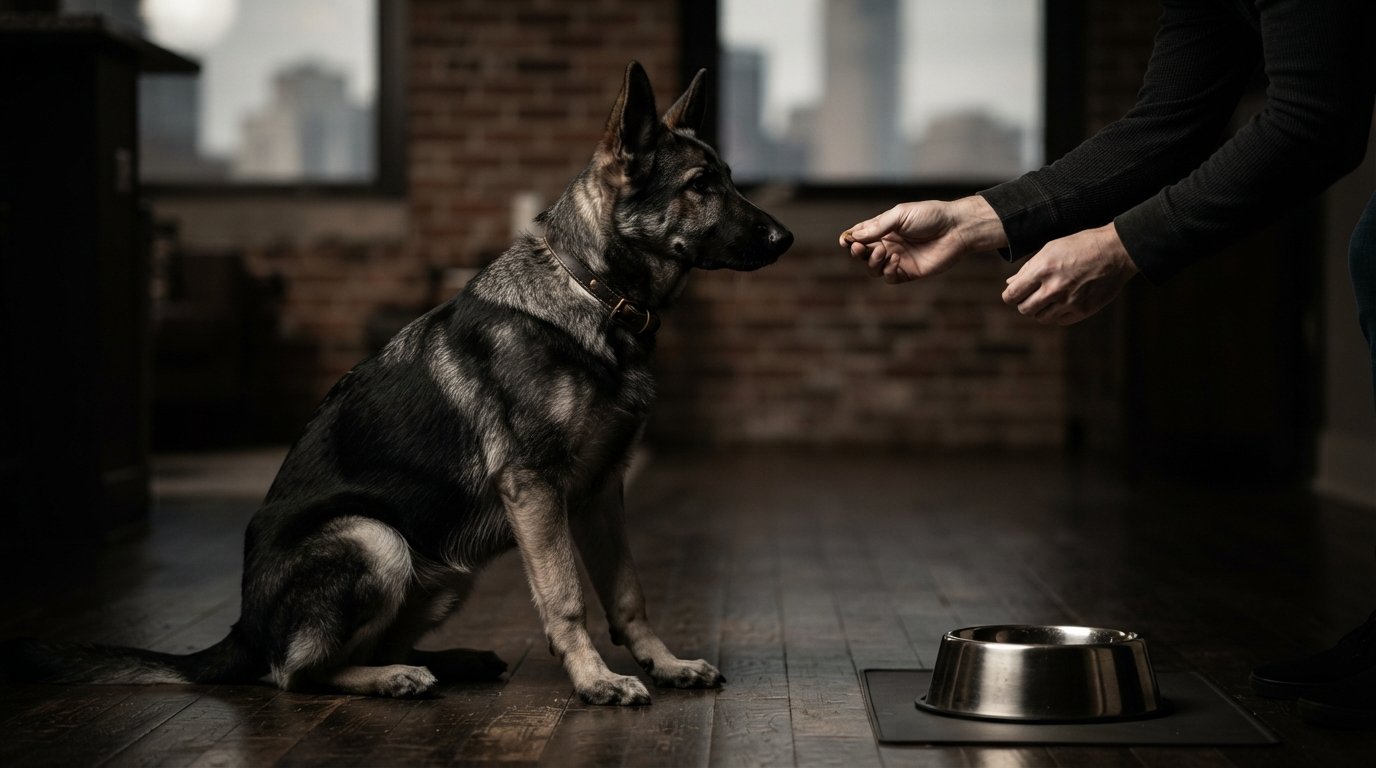
Keep practice simple and low risk. Select one familiar cue, move to a quiet place where your dog can focus, and give the cue once in a clear, steady voice. Observe what happens rather than repeating the command or adding pressure. If your dog responds, acknowledge the response in a way that suits the training plan. Keep the session brief and stop if your dog appears distressed or the situation becomes unsafe.
This approach can help when the difficulty is limited to a routine cue and you can manage the setting calmly. It also gives the household a consistent way to notice what works. Self-guided practice has limits, though. If the same breakdown continues despite a simpler setting, or the dog’s behavior is difficult to handle safely, don’t keep raising the challenge to test the cue.
When an in-home behavioral assessment can help
An in-home behavioral assessment lets a professional observe the dog, relevant behavioral triggers, and the environment where the concern occurs. Individualized guidance accounts for the specific routine, setting, and response pattern, rather than relying on a generic exercise. That matters when a doorway, visitor, household activity, or interaction between family members is part of the challenge.
Consider professional guidance if repeated cue practice isn’t improving clarity, the behavior affects daily life, or fear, reactivity, or safety concerns are present. An assessment is a diagnostic first step, not a promise of a quick fix. It helps establish what is happening and what structured training may be appropriate. To examine the behavior in its real setting, explore K9Elite’s OKC in-home evaluation.
A Structured Plan to Rebuild Listening at Home
Make practice a controlled mission, not a test of obedience. Use a repeatable sequence: observe the situation, lower the difficulty, give one clear cue, and record what happens. The aim is to assess the response without adding pressure. Don’t correct, intimidate, or confront your dog for missing a cue. If more than one person handles the dog, agree on the cue and routine before practice begins.
Run a low-distraction practice session
Choose one familiar cue and a calm location, such as a room where your dog can settle. Pick a time when household activity is low, and have what you need ready before starting. Keep the wording consistent, say the cue once, and allow your dog time to respond. Avoid adding gestures or extra commands unless they are already part of the cue your dog knows.
Observe: Notice your dog’s attention and body language before beginning. If your dog is focused on something else or appears unsettled, wait for a better moment.
Reduce distractions: Choose a familiar spot and limit competing activity where practical. Ask household members to pause noisy tasks during the brief practice.
Give one cue: Use the agreed wording in a steady voice, then pause. Don’t repeat it rapidly or raise your voice to force a response.
Record the result: Write down the setting, any behavioral trigger, your dog’s response, and what followed. Note whether the cue was clear and the environment stayed manageable.
Keep the session brief and stop if your dog appears distressed or the situation becomes unsafe. A neutral record helps you compare sessions without treating one response as a final verdict. If the same cue is easy in one room but difficult in another, record that difference rather than immediately testing it in a more demanding setting.
Adjust the plan when the dog struggles
If your dog doesn’t respond, change the setup instead of making the cue more forceful. Reduce nearby activity, increase distance from a distraction, or end the attempt and try again in a calmer moment. If your dog shows distress or unsafe behavior, stop and create distance. Don’t force contact or continue rehearsing a situation that could escalate.
A drag leash can guide movement without requiring you to reach into your dog’s personal space, but it should not be used to pull, confront, or push a dog through distress. A muzzle may be a temporary safety tool in an appropriate situation; it isn’t a substitute for training, assessment, or careful management. If you’re unsure how to handle equipment safely, don’t improvise during a tense moment. Persistent difficulty, rising risk, or disruption to household routines are reasons to seek professional guidance. An in-home evaluation can assess the behavior in context and inform a practical plan. For structured support at home, explore K9Elite’s in-home dog training.
How K9Elite Helps OKC Owners Restore Clear Communication
A concern like my dog won't listen to me anymore OKC can point to a breakdown between a cue, the dog’s surroundings, and the response expected. K9Elite provides in-home training across Oklahoma City, Edmond, Moore, Norman, and Midwest City. Seeing the dog in the home environment puts everyday behavior in context, rather than relying only on how the dog responds somewhere else.
The first step is an in-home evaluation. During this session, the trainer observes the dog’s behavior, communication, relevant behavioral triggers, and household environment. Those observations help identify where cues are unclear or where routines and surroundings may be affecting the dog’s response. From there, K9Elite develops a mission plan suited to the dog and household, with practical guidance for the owner.
What the evaluation helps clarify
An evaluation looks beyond whether a dog follows a command in isolation. The trainer considers what happens around the cue, how the dog responds to household routines, and which environmental details may contribute to the concern. Owner education connects those observations to daily decisions, helping the household apply a structured approach with clearer communication and consistent expectations.
If the concern involves aggression, the assessment can help clarify the behavior and inform an appropriate next step. Learn how K9Elite approaches these cases through Aggressive Dog Rehabilitation OKC. The aim is to understand the behavior and create a plan grounded in the dog’s needs, not to force a response or promise an instant change.
K9Elite’s mission‑driven structure moves through four stages: briefing, assessment, active work, and debrief. This format gives each session a clear purpose: establish the concern, observe the dog, work on relevant skills, and review what the owner can carry into daily routines. It keeps the work organized and makes owner participation part of the plan.
What continued support looks like
K9Elite is led by Marine Corps veteran Coty Cortez, who brings more than 15 years of hands-on dog-training experience. The focus is on balanced, science-based training that combines structure, clear communication, owner education, and humane handling. Progress depends on practice and consistency. An evaluation sets direction, but it doesn’t replace continued work at home.
After training sessions conclude, lifetime support means ongoing assistance and resources as owners continue applying what they’ve learned. That follow-through can help families keep their approach consistent as everyday situations arise. If you’re ready to have your dog’s behavior and home environment assessed, schedule an in-home evaluation with K9Elite.
Take the Next Step Toward Clearer Communication
If you’re still thinking, “my dog won't listen to me anymore OKC,” treat that concern as a signal to take a closer, calmer look, not as a verdict on your dog or your relationship. Choose one recurring moment that feels difficult and write down what happens before, during, and after it. That record can turn frustration into useful information.
Then decide whether the situation is safe and manageable to practice on your own. If the pattern persists, disrupts daily routines, or raises concerns about fear or safety, an in-home evaluation can help establish a focused next step. Training is a shared mission: clear structure gives you a practical way to lead, while careful observation helps you understand what your dog needs in that moment.
Schedule an in-home evaluation with K9Elite to discuss the behavior and begin planning a path forward. Consistent, informed action can help you approach the next challenge with greater clarity.
Frequently Asked Questions
Why has my dog suddenly stopped listening to me?
A sudden change can follow a disruption in routine, a new household demand, a difficult recent experience, or a shift in how a familiar cue has been practiced. These possibilities don’t establish a cause. Note when you first noticed the change and whether it affects familiar activities such as meals, settling, or getting ready for a walk. If the change is abrupt or comes with other concerning signs, contact your veterinarian.
Could my dog be ignoring me because of a medical problem?
It’s possible, but a missed cue alone can’t show whether a health issue is involved. A veterinarian can assess concerns such as discomfort or changes in hearing that may affect how a dog responds. Arrange a veterinary discussion if the change persists, appears suddenly, or occurs with physical or behavioral symptoms. Training can help address communication and learned responses, but it can’t replace a health assessment or determine the medical cause.
Why does my dog listen to one person but not another?
Different handlers may unintentionally teach different versions of the same cue. One person may pair a word with a hand signal, while another uses the word alone. Tone, timing, and what follows the response can differ too. Household members can agree on one cue, decide what response they expect, and take turns practicing the same routine. This gives the dog a more consistent message across people.
Should I repeat a command when my dog does not respond?
Repeating a cue several times can blur the signal, so avoid turning one request into a string of words. First make sure your dog is oriented toward you, then give the cue clearly. If there’s no response, pause and consider whether the dog can engage in that moment. Keep your voice calm; shouting or rapid repetition can add pressure without making the cue easier to understand.
Can a dog learn to listen again after months of ignoring commands?
Improvement may be possible, but there’s no fixed timeline. Results depend on the dog’s history, the cue, the conditions around practice, and how consistently the household follows the plan. Start with a cue your dog has previously performed well, and note whether the response becomes more reliable over repeated sessions. If the cue has become confusing or the behavior is complicated, individualized guidance can help set appropriate priorities.
What should I do if my dog runs away when I approach with a leash?
Don’t pursue or corner your dog; that can increase tension and make the approach harder next time. Secure the immediate area and avoid grabbing at the collar. In a controlled setting, calm leash handling can be practiced without forcing contact. A drag leash may help guide movement when appropriate, but it isn’t right for every dog or situation. If avoidance continues or safety is uncertain, get professional guidance.
When should I seek professional help for a dog that will not listen?
Seek individualized help if the problem continues, interferes with ordinary household activities, or creates risk for people or animals. Before a session, prepare a brief account of the most difficult situations and the cues involved; this helps keep the discussion focused. An in-home evaluation can consider the dog’s behavior and surroundings together, giving you a clearer basis for deciding what training support is appropriate in the Oklahoma City area.
Comments