
Puppy Social Skills in Oklahoma City: A Guide for Owners
More greetings don’t automatically create a confident puppy. Puppy social skills Oklahoma City owners can build depend less on how many people or dogs their puppy meets than on whether each experience feels manageable and safe.
It’s understandable to wonder what to introduce first, when to begin, and whether a nervous reaction will become a lasting habit. The first months are an important learning period, but socialization doesn’t mean forcing interaction or expecting every puppy to enjoy every encounter. Calm observation counts. So does giving a puppy space to process new sights, sounds, people, and settings without becoming overwhelmed. Follow your veterinarian’s guidance about health precautions as you plan outings.
This guide explains how to recognize relaxed curiosity and signs of stress, plan brief and positive exposures, and distinguish socialization from direct play or greetings. You’ll also learn how to approach puppy classes and everyday outings with structure. When progress feels uncertain, an in-home professional evaluation can identify behavioral triggers and communication gaps in the environment where your puppy lives. The mission is steady confidence, built one well-managed experience at a time.
Table of Contents
What Puppy Social Skills Mean for Oklahoma City Owners
The goal is a puppy who can notice something unfamiliar, take it in, and respond without losing the ability to settle and reconnect with you. That might mean watching a person pass, hearing a household sound, or seeing another dog from a comfortable distance. Puppy social skills Oklahoma City owners develop aren’t measured by how many greetings a puppy accepts. They show up in the puppy’s ability to adapt while the handler keeps the situation clear and manageable.
Puppy social skills are a puppy’s adaptable responses to people, animals, sounds, surfaces, and everyday routines. They involve more than encountering new things. Social skills develop as a puppy learns to process experiences, communicate, and adjust behavior to the situation. Simple exposure means being near something new. Useful social learning gives the puppy room to observe and respond without pressure.
That distinction matters. A puppy can practice social skills without touching, greeting, or playing with anyone. Calmly watching activity from a suitable distance can be more productive than moving closer when the puppy is uncertain. For broader context on canine communication and social behavior, see this overview of dog behavior and socialization.
What does a socially capable puppy look like?
Look for curiosity, relaxed observation, and the ability to disengage. A puppy might glance at a new person, sniff the ground, then turn back toward the handler or explore the surroundings. Those responses suggest the puppy can take in information and shift attention. They aren’t a fixed test. Temperament, context, fatigue, and prior experience all influence a puppy’s response.
Stress can look different from one puppy to another. A puppy might pause, move away, avoid looking, or become unusually still. Don’t treat every hesitation as defiance or push for a greeting to “get it over with.” Give the puppy space, reduce the intensity, and see whether the puppy can recover. The mission isn’t to make every encounter a success on your schedule. It’s to help the puppy remain able to learn.
Why everyday settings matter in Oklahoma City
Begin with familiar home routines, where you can notice how your puppy responds to ordinary movement, household sounds, visitors, and changes in activity. This gives you a baseline before adding unfamiliar experiences. Keep the first practice simple: let the puppy observe a routine, watch body language, and create more distance or end the exercise if the puppy struggles to settle.
As your puppy’s skills develop, local life may bring different people, dogs, vehicle sounds, outdoor surfaces, and public settings into view. Choose opportunities that allow space and calm observation rather than assuming closer contact is better. Watching passersby from the sidewalk or pausing briefly to observe activity can be useful practice. Set the pace according to your puppy’s response, not a quota of greetings.
How Puppies Build Social Skills Through Structured Experiences
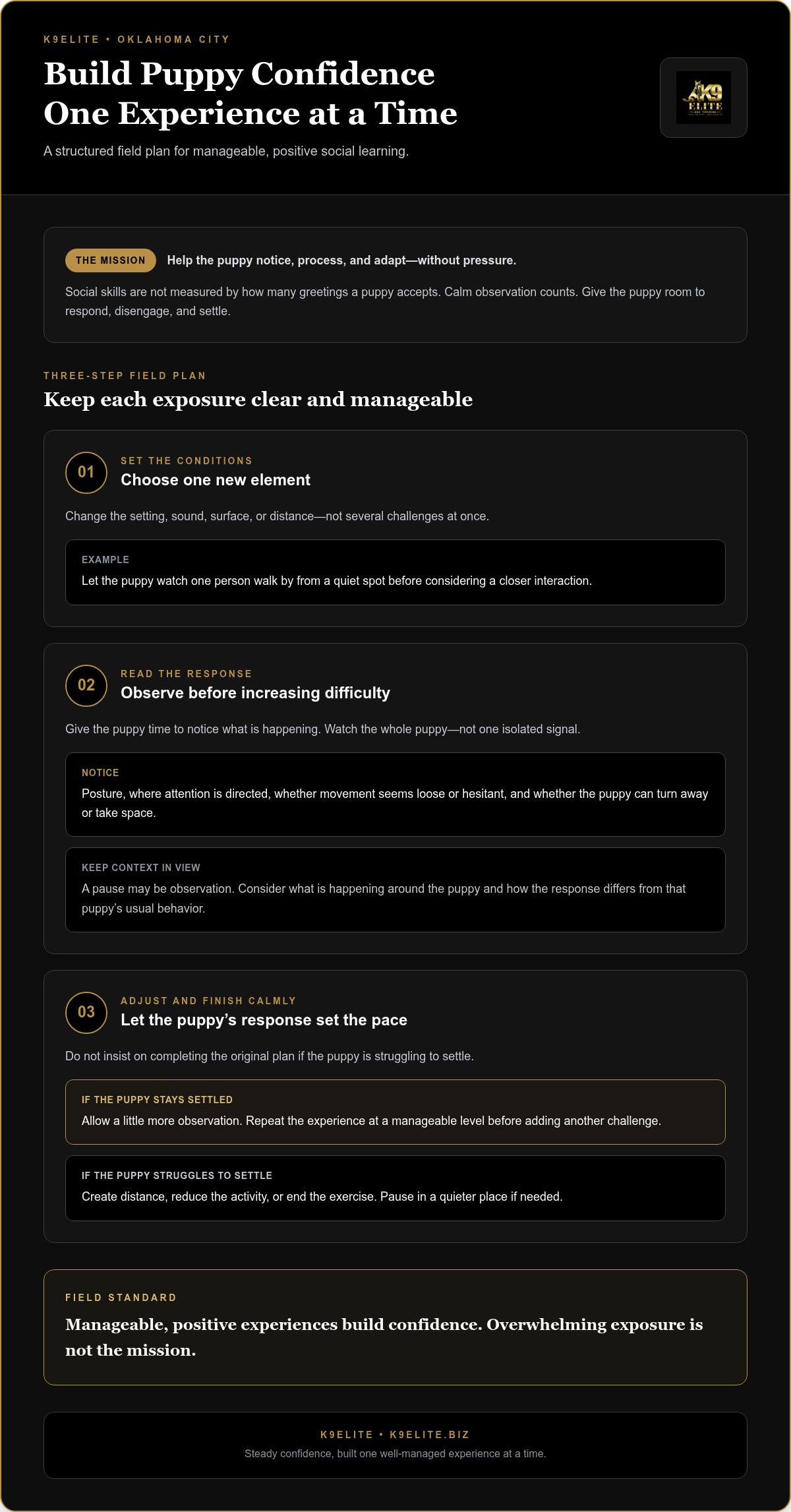
Confidence develops through experiences a puppy can process, not through a rapid sequence of new sights and sounds. Introduce one manageable change at a time, keep enough distance for the puppy to observe, and allow the puppy to move away or reorient. For example, let a puppy watch a person walk by from a quiet spot before attempting a closer interaction. The AVMA guidelines on puppy socialization offer additional context for planning positive early experiences.
Use a consistent field plan:
Choose one new element. Change the setting, sound, surface, or distance, rather than adding several challenges at once.
Observe the response. Give the puppy time to notice what is happening without pulling closer or demanding a greeting.
Adjust and finish calmly. If the puppy stays settled, allow a little more observation. If the puppy struggles to settle, create distance or end the exercise.
Keep your own response predictable. Use a calm voice, steady handling, and familiar cues so the puppy has clear information about what to do next. A consistent routine helps the puppy learn that new experiences can be approached without pressure.
Puppies build confidence through manageable, positive experiences, not by being overwhelmed with exposure. That principle is central to puppy social skills Oklahoma City owners can develop in everyday life.
Read the puppy’s response before increasing difficulty
Watch the whole puppy, not one isolated signal. Notice posture, where the puppy directs attention, whether movement is loose or hesitant, and whether the puppy can turn away or take space. A puppy who pauses may simply be observing. One behavior alone doesn’t establish fear or aggression. Look for changes from that puppy’s usual response and consider what is happening around the puppy.
If the puppy becomes still, repeatedly tries to move away, or can’t settle attention, don’t advance the exercise. Increase distance, reduce the activity, or pause in a quieter place. The handler’s job is to adjust the mission to the puppy’s current capacity, not to insist on completing the original plan.
Build confidence through repetition and recovery
Repeat an experience at a manageable level before adding another challenge. A puppy might watch the same kind of activity from a comfortable distance more than once, with quiet breaks between observations. Recovery matters: give the puppy room to sniff, rest, or focus on a familiar routine before deciding whether to continue. Progress means the puppy can engage and then return to a settled state, not simply endure a longer exposure.
Flooding means overwhelming a puppy with too many stimuli at once. It isn’t a shortcut to confidence. Crowding a puppy with unfamiliar people, dogs, noise, and movement can make it harder to identify what the puppy needs. If you want help tailoring a gradual plan to your household, K9Elite’s in-home dog training can address practice in the puppy’s everyday environment.
Puppy Socialization in Oklahoma City: Myths That Can Create Pressure
A common misconception is that a puppy must meet every dog and person to develop good social skills. That turns socialization into a greeting quota. The more useful mission is helping a puppy notice unfamiliar people, animals, and activity without being required to approach. In Oklahoma City, a puppy can observe everyday movement from a calm, comfortable distance rather than entering the busiest part of a public setting.
Socialization and interaction aren’t the same. Neutral observation means the puppy can see or hear something without direct contact. A greeting brings people or dogs closer; play adds movement and physical interaction. Each asks something different of the puppy, so accepting a greeting isn’t the measure of successful learning. UC Davis puppy socialization advice discusses the value of positive early experiences, which can include controlled observation rather than forced contact.
A calm, voluntary observation can be more useful than a forced greeting.
Does socialization mean greeting every dog and person?
No. Safe observation and disengagement are valid social experiences. A puppy who watches a passerby from a quiet place, then turns attention back to the handler, has practiced noticing and moving on. Owners can prevent greetings from becoming the default by standing aside, creating space, and calmly declining an approach when the puppy needs more room.
For example, on a quiet neighborhood walk, let the puppy watch a person or dog pass without closing the distance. Around a busier sidewalk or public setting, choose a place where you can step away if activity increases. The handler sets the pace. Contact is an option, not an obligation.
How to respond when a puppy seems overwhelmed
If a puppy struggles to settle, don’t scold, drag the puppy toward the activity, or demand a greeting. Calmly increase distance or end the exposure. Give the puppy time to recover in a quieter place before deciding whether to continue. A controlled exit lets you respond to the puppy’s needs while keeping the situation safe and predictable.
Afterward, note what happened: the setting, the distance, the activity level, and any possible behavioral triggers, such as a sudden sound or a fast approach. Look for patterns across situations instead of drawing a firm conclusion from one reaction. A puppy’s response can reflect context, temperament, or prior experience. One moment alone doesn’t diagnose fear or aggression.
If concerning responses recur or begin to interfere with walks, visitors, or other daily routines, professional guidance can clarify what the puppy is communicating and how to structure practice. Puppy social skills Oklahoma City owners build should reflect the individual puppy’s responses, not pressure to keep up with other dogs or a crowded setting.
A Practical Puppy Social-Skills Plan for Oklahoma City
Use a flexible sequence: start with what your puppy knows, add one manageable experience, observe the response, then adjust. This gives you a clear mission without turning practice into a rigid schedule. A familiar room, a quiet walk, and watching activity from a comfortable distance can all provide useful learning opportunities. The right pace depends on your puppy’s behavior that day.
Begin with a familiar setting. Choose a routine your puppy can observe calmly, such as household activity or a person moving through a room.
Add one change. Introduce a new sound, surface, person, or view of passing activity while keeping space available.
Watch and record. Note what happened, how your puppy responded, and how quickly the puppy returned to a settled state.
Adjust the next practice. Repeat at the same level, make the experience easier, or add a small challenge only when your puppy can remain engaged and recover.
Start with familiar people, sounds, and routines
At home, let your puppy observe ordinary experiences without requiring an approach. A visitor can enter and settle while the puppy watches from a comfortable spot. A household sound can occur while you continue a familiar routine. Keep your voice and handling consistent, and allow your puppy to move away. Add variety only when the puppy can stay engaged and recover without pressure or repeated prompting.
Make a brief record after practice. Write down the setting, what changed, the puppy’s posture and movement, and whether the puppy could return to a familiar activity afterward. This record helps you spot patterns instead of relying on memory. If a particular sound or approach repeatedly makes settling difficult, keep more distance or choose an easier version of the experience next time.
Practice calm observation beyond the home
For an outing, select a lower-intensity setting where you can manage distance and leave easily. Start far enough away that your puppy can notice people, dogs, or movement without being pulled toward them. Keep the first observation brief. If your puppy stays settled, end on that successful note rather than waiting for signs of strain. If the puppy becomes uneasy, calmly move farther away or head home.
Owners developing puppy social skills Oklahoma City can adapt this plan across the metro area, including Edmond, Moore, Norman, and Midwest City. Local practice doesn’t require a busy destination. A quiet sidewalk or a stationary observation point may offer more room to manage distance. When reviewing a puppy socialization class, look for opportunities to practice controlled exposure, observation, and recovery.
If you’re unsure how to pace practice or recurring reactions are affecting daily routines, explore in-home puppy training support to address your puppy’s behavior in the settings where it occurs.
How K9Elite Builds Puppy Social Skills Through Structured Support
Social-skills guidance is most useful when it accounts for where the puppy lives and how the household operates. K9Elite provides private in-home dog training in Oklahoma City and the surrounding metro area. The trainer can observe the puppy in familiar surroundings, where daily routines and environmental details shape behavior. That home field advantage connects what an owner sees during practice with what happens in ordinary life.
Why home-field advantage can clarify puppy behavior
A professional evaluation looks at the puppy’s behavior alongside the surroundings and the owner’s communication. The trainer can observe how the puppy responds to household activity, transitions, visitors, and familiar routines, while also seeing how the owner gives direction and responds to the puppy. These details can reveal behavioral triggers or communication gaps that are harder to identify in an unfamiliar setting.
In-home work provides useful context for deciding what the puppy needs to practice at home and how to carry clear, consistent handling into other environments. The goal is a plan grounded in the puppy’s actual routines, not a generic sequence applied without regard for temperament or context.
Build a mission plan with ongoing owner support
After the professional evaluation, the mission plan gives the owner a tailored roadmap based on the puppy’s responses, surroundings, and learning needs. K9Elite’s science-based, balanced instruction emphasizes structure and practical owner education. The owner learns what to practice, how to keep communication consistent, and when to reduce difficulty so the puppy can remain engaged.
Between sessions, the owner’s role is to apply that plan in daily routines and notice how the puppy responds. Clear responsibilities make practice more deliberate: follow the guidance, observe behavior, and bring questions or changes into the training process. This steady participation supports learning without relying on pressure or expecting immediate change.
K9Elite’s lifetime support provides ongoing assistance and resources after training sessions conclude. It supports owners as they continue applying the instruction, while recognizing that each puppy’s development and responses are individual. Puppy social skills Oklahoma City families build are strengthened by consistent handling, thoughtful practice, and a plan shaped around the puppy’s real life.
If you’re uncertain about your puppy’s responses or want guidance tailored to your home routines, K9Elite provides an in-home professional evaluation. It helps identify what is happening and establish a mission plan for moving forward.
Set a Steady Course for Your Puppy
Your puppy doesn’t need to master every new situation at once. Choose one everyday experience, set it up so your puppy has room to observe, and pay attention to the response. Keep your guidance consistent. If the puppy has difficulty settling, make the experience easier and try again when conditions are more manageable.
That steady process turns uncertainty into useful information. You’ll learn which situations support calm curiosity, where your puppy needs more distance, and when added guidance could help. Progress comes from thoughtful adjustments, not from forcing a faster pace. That is the practical mission behind building puppy social skills Oklahoma City owners can carry into daily life.
For a tailored plan and clear coaching around your puppy’s needs, take the next step with Build your puppy’s skills with structured, veteran-led guidance. Schedule an in-home evaluation with K9Elite to identify your puppy’s needs and establish a clear training mission. With consistent practice and the right support, you can help your puppy approach new experiences with greater confidence, one manageable step at a time.
Frequently Asked Questions
What are good social skills for a puppy?
Good social skills include responding to the handler, settling briefly, and cooperating with gentle routine care. Try a short name-response practice at home: say your puppy’s name once, reward a turn toward you, then pause before repeating. You can also reward calm behavior while checking paws or fitting a harness. These small skills help prepare a puppy for everyday handling and make shared routines more predictable.
Can a puppy learn social skills without meeting other dogs?
Yes. Puppy social skills Oklahoma City owners build can include cooperation with household routines and comfort with ordinary sounds, surfaces, and handling. For example, reward your puppy for calmly stepping onto a different floor surface or responding to a familiar cue while a household appliance runs. Keep each practice brief and straightforward. These exercises develop useful responses without requiring dog-to-dog contact.
How can I tell if my puppy is overwhelmed during socialization?
Notice whether your puppy can return to familiar behaviors after an experience, such as responding to a known cue or settling at home. If the puppy remains unsettled after the activity ends, treat that as a signal to make future practice simpler. Keep a brief log of the situation and how long it takes your puppy to resume normal routines. A pattern across several outings is more informative than one moment.
Should I let my puppy greet every dog on walks?
No. Walks can include a simple handler-focus routine instead: say your puppy’s name, reward attention, and continue along your route. This gives the puppy a clear job when another dog appears, without making every passing encounter a social event. Use a secure leash and follow local leash requirements. If a greeting is appropriate, keep it controlled and end it calmly before either dog becomes difficult to guide.
Can older puppies still develop social skills?
Yes. Older puppies can continue learning through consistent practice that matches their current abilities. Strengthen foundation behaviors first, such as responding to a name, waiting briefly at a door, or settling while you handle routine tasks. Then build on those skills in new contexts without rushing. If your puppy has had limited experience or shows persistent difficulty in daily situations, K9Elite’s in-home training can help set a practical direction.
What should I do if my puppy barks at people in Oklahoma City?
Look for patterns in the setting, timing, and activity around the barking, and record possible behavioral triggers across repeated situations. If barking happens at a window, manage access to that viewing spot while teaching a calm alternative, such as going to a resting area when someone passes. Avoid turning each incident into a confrontation. If the behavior continues to disrupt home routines, K9Elite’s in-home evaluation can assess the puppy’s behavior and surroundings.
Are puppy socialization classes the only way to build social skills?
No. Classes can provide a planned learning environment, but owners can also reinforce useful behaviors during ordinary routines. Ask your puppy to respond to a familiar cue before meals, practice a brief settle while you prepare a leash, or reward calm cooperation during harnessing. These moments make training part of daily life. K9Elite offers group classes where you can practice handler focus and following cues amid activity, without making greetings with every puppy the goal.
Comments